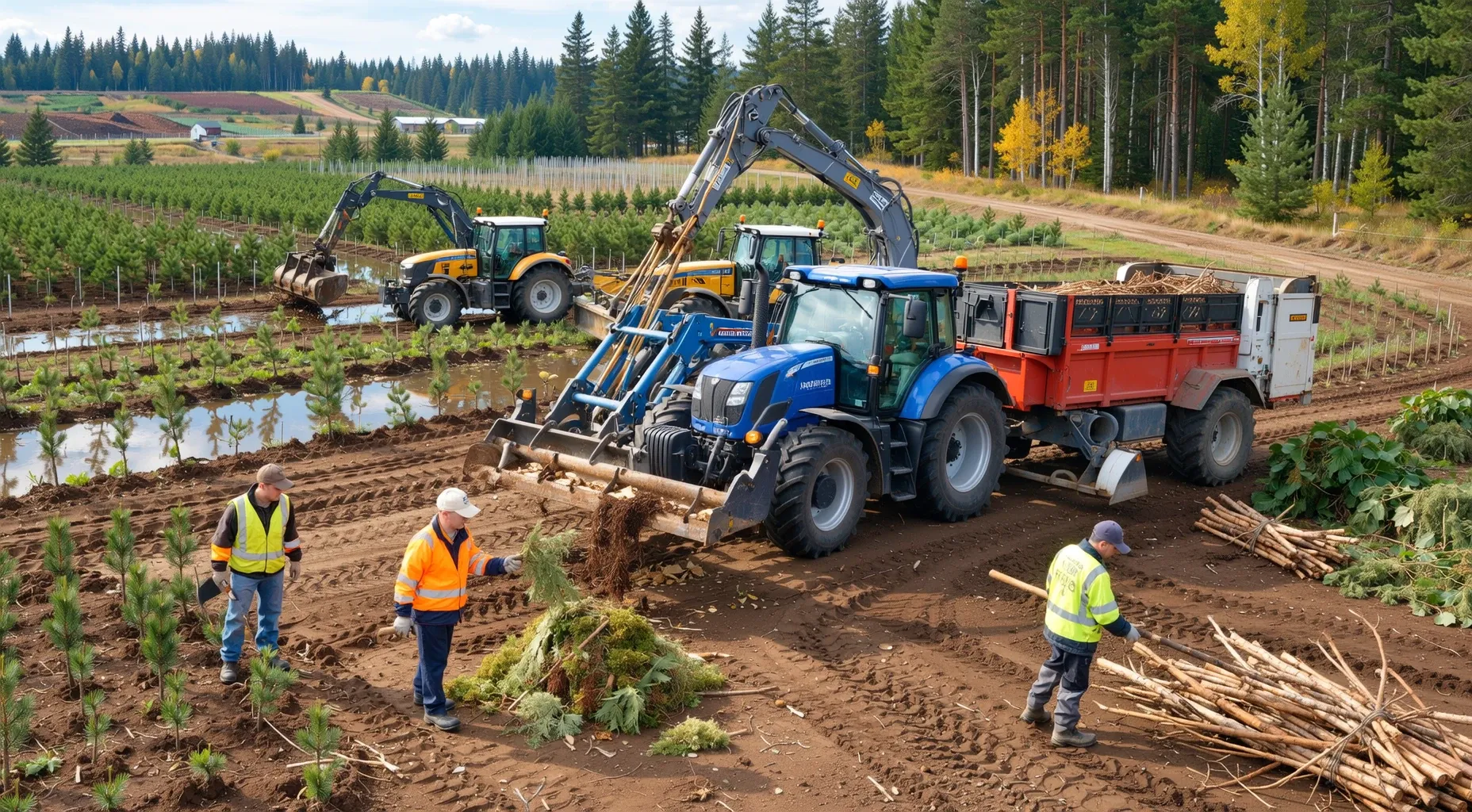
Forest Nurseries and Gathering of Forest Products
Description
This industry comprises establishments primarily engaged in (1) growing trees for reforestation and/or (2) gathering forest products, such as gums, barks, balsam needles, rhizomes, fibers, Spanish moss, ginseng, and truffles.
Hierarchy
| Code | Title | Description |
|---|---|---|
| 11 | Agriculture, Forestry, Fishing and Hunting 2-digit sector | The Sector as a Whole The Agriculture, Forestry, Fishing and Hunting sector comprises establishments primarily engaged in growing crops, raising animals, harvesting timber, and harvesting fish and other animals from a farm, ranch, or their natural habitats. The establishments in this sector are often described as farms, ranches, dairies, greenhouses, nurseries, orchards, or hatcheries. A farm may consist of a single tract of land or a number of separate tracts which may be held under different tenures. For example, one tract may be owned by the farm operator and another rented. It may be operated by the operator alone or with the assistance of members of the household or hired employees, or it may be operated by a partnership, corporation, or other type of organization. When a landowner has one or more tenants, renters, croppers, or managers, the land operated by each is considered a farm. The sector distinguishes two basic activities: agricultural production and agricultural support activities. Agricultural production includes establishments performing the complete farm or ranch operation, such as farm owner-operators and tenant farm operators. Agricultural support activities include establishments that perform one or more activities associated with farm operation, such as soil preparation, planting, harvesting, and management, on a contract or fee basis. Excluded from the Agriculture, Forestry, Fishing and Hunting sector are establishments primarily engaged in agricultural research (e.g., experimental farms) and government establishments primarily engaged in administering programs for regulating and conserving land, mineral, wildlife, and forest use. These establishments are classified in Industry 54171, Research and Development in the Physical, Engineering, and Life Sciences; and Industry 92412, Administration of Conservation Programs, respectively. |
| 113 | Forestry and Logging 3-digit subsector | Industries in the Forestry and Logging subsector grow and harvest timber on a long production cycle (i.e., of 10 years or more). Long production cycles use different production processes than short production cycles, which require more horticultural interventions prior to harvest, resulting in processes more similar to those found in the Crop Production subsector. Consequently, Christmas tree production and other production involving production cycles of less than 10 years, are classified in the Crop Production subsector. Industries in this subsector specialize in different stages of the production cycle. Reforestation requires production of seedlings in specialized nurseries. Timber production requires natural forest or suitable areas of land that are available for a long duration. The maturation time for timber depends upon the species of tree, the climatic conditions of the region, and the intended purpose of the timber. The harvesting of timber (except when done on an extremely small scale) requires specialized machinery unique to the industry. Establishments gathering forest products, such as gums, barks, balsam needles, rhizomes, fibers, Spanish moss, and ginseng and truffles, are also included in this subsector. |
| 1132 | Forest Nurseries and Gathering of Forest Products 4-digit industry group | Industries in the Forestry and Logging subsector grow and harvest timber on a long production cycle (i.e., of 10 years or more). Long production cycles use different production processes than short production cycles, which require more horticultural interventions prior to harvest, resulting in processes more similar to those found in the Crop Production subsector. Consequently, Christmas tree production and other production involving production cycles of less than 10 years, are classified in the Crop Production subsector. Industries in this subsector specialize in different stages of the production cycle. Reforestation requires production of seedlings in specialized nurseries. Timber production requires natural forest or suitable areas of land that are available for a long duration. The maturation time for timber depends upon the species of tree, the climatic conditions of the region, and the intended purpose of the timber. The harvesting of timber (except when done on an extremely small scale) requires specialized machinery unique to the industry. Establishments gathering forest products, such as gums, barks, balsam needles, rhizomes, fibers, Spanish moss, and ginseng and truffles, are also included in this subsector. |
| 11321 | Forest Nurseries and Gathering of Forest Products 5-digit NAICS industry | See industry description for 113210. |
| 113210 | Forest Nurseries and Gathering of Forest Products 6-digit U.S. detail | This industry comprises establishments primarily engaged in (1) growing trees for reforestation and/or (2) gathering forest products, such as gums, barks, balsam needles, rhizomes, fibers, Spanish moss, ginseng, and truffles. |
Need a supply chain stack that maps to this industry?
Use this NAICS classification as the starting point, then connect it to Item workflows across inventory, warehousing, order management, fulfillment, and transportation.
Classification References
- 01Gathering tea and maple sap--are classified in U.S. Industry 111998, All Other Miscellaneous Crop Farming;
- 02Processing maple syrup into other products--are classified in U.S. Industry 311999, All Other Miscellaneous Food Manufacturing; and
- 03Operating timber tracts for the purpose of selling standing timber--are classified in Industry 113110, Timber Tract Operations.
Index Items
Aromatic wood gathering
Balsam needles gathering
Bark gathering
Cherry gum, gathering
Chestnut gum, gathering
Forest nurseries for reforestation, growing trees
Gathering of forest products (e.g., barks, gums, needles, seeds)
Gathering, extracting, and selling tree seeds
Ginseng gathering
Gum (i.e., forest product) gathering
Harvesting berries or nuts from native and non-cultivated plants
Hemlock gum gathering
Huckleberry greens, gathering of
Moss gathering
Nurseries for reforestation growing trees
Pine gum extracting
Spanish moss gathering
Sphagnum moss gathering
Spruce gum gathering
Teaberries gathering
Tree seed extracting
Tree seed gathering
Tree seed growing for reforestation
Truffles gathering
How Item Can Help
Item's Warehouse Management System optimizes inventory tracking for diverse seedlings and cut stock while streamlining picking operations across large nursery facilities.
The Order Management System consolidates sales channels to provide real-time visibility into order status and automate fulfillment for both B2B wholesale and direct-to-consumer requests.
Transportation Management Software plans efficient delivery routes for heavy timber loads and fragile plant products to minimize transit damage and fuel costs.
Item.com Tools
External Resources
Census.gov NAICS Detail
Official US Census Bureau definition and scope for NAICS 113210.
North American Forest and Nursery Association
A leading trade association representing the forest nursery and forest products industry in North America.
USDA Forest Service - Forest Nursery and Plant Production
A government resource providing information on forest plant production, propagation techniques, and seedling sales.
Association of the Nursery Trade
An organization focused on the horticulture and nursery trade sector in North America, often including forest nursery operators.
