Logging
Description
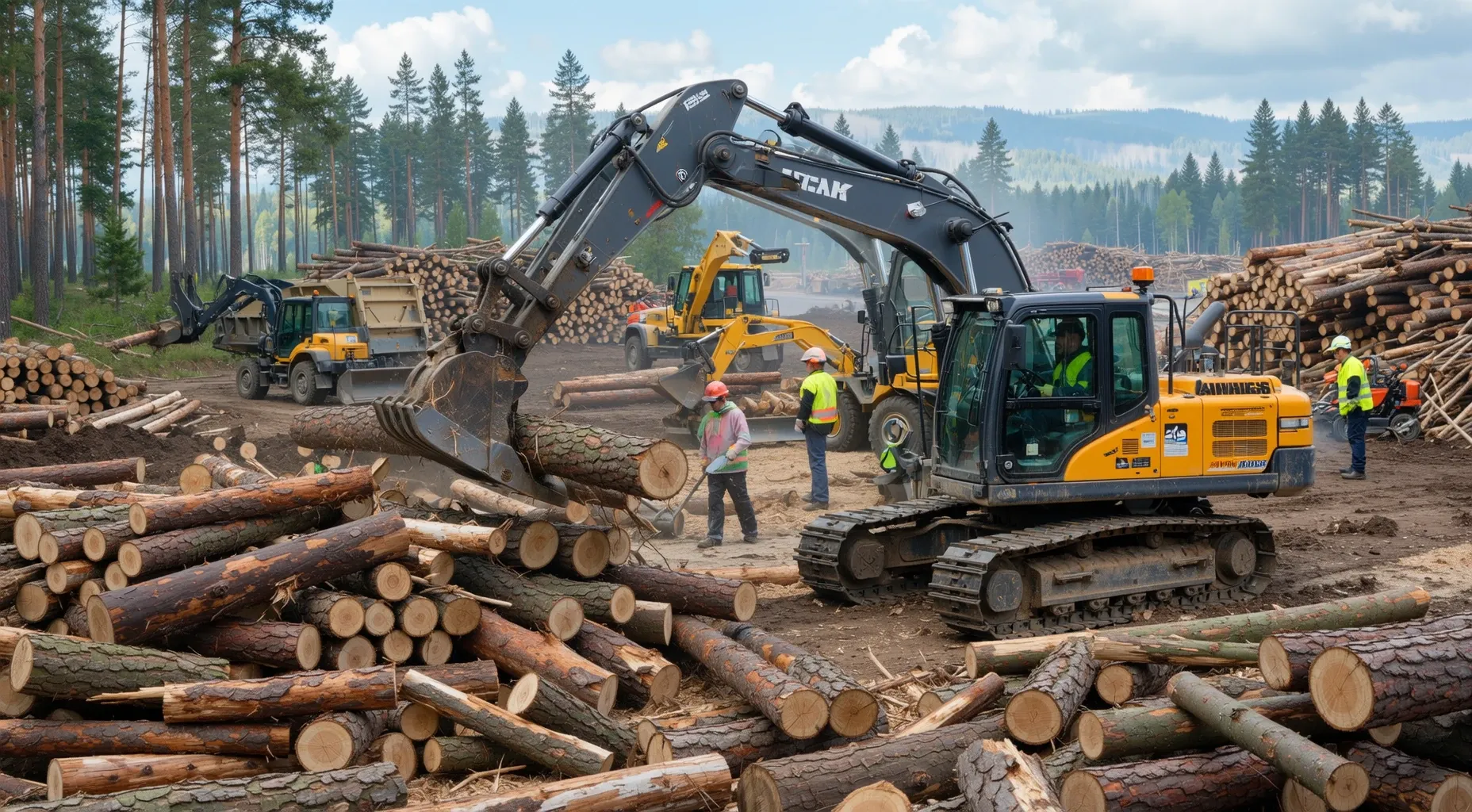
The logging sector encompasses businesses dedicated to harvesting timber, removing trees, and preparing wood for further processing or direct market sale. These establishments focus primarily on cutting timber, moving harvested wood to processing sites, and producing raw wood chips directly in the field. Typical business activities include site preparation, clearing vegetation, felling trees, bucking logs into sections, and either transporting the biomass to mills or loading it into chips. Operators range from small, independent contractors utilizing modest equipment to large corporate entities managing vast tracts of forestland across multiple counties or states. Some firms specialize exclusively in sawlog production while others prioritize chip production for industrial fuel. The scale of operations varies significantly, with individual operations often covering less than fifty hundred acres, whereas major companies may manage thousands of acres annually. Geographic scope can extend from localized regions to national networks, particularly where forests are concentrated in the Pacific Northwest, the Southeast, and the Midwest. Labor requirements depend heavily on the season and volume of timber available, necessitating crews skilled in operating feller bunchers, skidders, and forwarders. This industry serves as a critical upstream component of the broader forest products manufacturing chain, supplying essential raw materials to pulp and paper mills, lumber producers, and bioenergy facilities. Its economic impact relies on sustainable forestry practices, regulatory compliance regarding environmental protection, and efficient logistics to maintain profitability.
Hierarchy
| Code | Title | Description |
|---|---|---|
| 11 | Agriculture, Forestry, Fishing and Hunting 2-digit sector | The Sector as a Whole The Agriculture, Forestry, Fishing and Hunting sector comprises establishments primarily engaged in growing crops, raising animals, harvesting timber, and harvesting fish and other animals from a farm, ranch, or their natural habitats. The establishments in this sector are often described as farms, ranches, dairies, greenhouses, nurseries, orchards, or hatcheries. A farm may consist of a single tract of land or a number of separate tracts which may be held under different tenures. For example, one tract may be owned by the farm operator and another rented. It may be operated by the operator alone or with the assistance of members of the household or hired employees, or it may be operated by a partnership, corporation, or other type of organization. When a landowner has one or more tenants, renters, croppers, or managers, the land operated by each is considered a farm. The sector distinguishes two basic activities: agricultural production and agricultural support activities. Agricultural production includes establishments performing the complete farm or ranch operation, such as farm owner-operators and tenant farm operators. Agricultural support activities include establishments that perform one or more activities associated with farm operation, such as soil preparation, planting, harvesting, and management, on a contract or fee basis. Excluded from the Agriculture, Forestry, Fishing and Hunting sector are establishments primarily engaged in agricultural research (e.g., experimental farms) and government establishments primarily engaged in administering programs for regulating and conserving land, mineral, wildlife, and forest use. These establishments are classified in Industry 54171, Research and Development in the Physical, Engineering, and Life Sciences; and Industry 92412, Administration of Conservation Programs, respectively. |
| 113 | Forestry and Logging 3-digit subsector | Industries in the Forestry and Logging subsector grow and harvest timber on a long production cycle (i.e., of 10 years or more). Long production cycles use different production processes than short production cycles, which require more horticultural interventions prior to harvest, resulting in processes more similar to those found in the Crop Production subsector. Consequently, Christmas tree production and other production involving production cycles of less than 10 years, are classified in the Crop Production subsector. Industries in this subsector specialize in different stages of the production cycle. Reforestation requires production of seedlings in specialized nurseries. Timber production requires natural forest or suitable areas of land that are available for a long duration. The maturation time for timber depends upon the species of tree, the climatic conditions of the region, and the intended purpose of the timber. The harvesting of timber (except when done on an extremely small scale) requires specialized machinery unique to the industry. Establishments gathering forest products, such as gums, barks, balsam needles, rhizomes, fibers, Spanish moss, and ginseng and truffles, are also included in this subsector. |
| 1133 | Logging 4-digit industry group | Industries in the Forestry and Logging subsector grow and harvest timber on a long production cycle (i.e., of 10 years or more). Long production cycles use different production processes than short production cycles, which require more horticultural interventions prior to harvest, resulting in processes more similar to those found in the Crop Production subsector. Consequently, Christmas tree production and other production involving production cycles of less than 10 years, are classified in the Crop Production subsector. Industries in this subsector specialize in different stages of the production cycle. Reforestation requires production of seedlings in specialized nurseries. Timber production requires natural forest or suitable areas of land that are available for a long duration. The maturation time for timber depends upon the species of tree, the climatic conditions of the region, and the intended purpose of the timber. The harvesting of timber (except when done on an extremely small scale) requires specialized machinery unique to the industry. Establishments gathering forest products, such as gums, barks, balsam needles, rhizomes, fibers, Spanish moss, and ginseng and truffles, are also included in this subsector. |
| 11331 | Logging 5-digit NAICS industry | See industry description for 113310. |
| 113310 | Logging 6-digit U.S. detail | The logging sector encompasses businesses dedicated to harvesting timber, removing trees, and preparing wood for further processing or direct market sale. These establishments focus primarily on cutting timber, moving harvested wood to processing sites, and producing raw wood chips directly in the field. Typical business activities include site preparation, clearing vegetation, felling trees, bucking logs into sections, and either transporting the biomass to mills or loading it into chips. Operators range from small, independent contractors utilizing modest equipment to large corporate entities managing vast tracts of forestland across multiple counties or states. Some firms specialize exclusively in sawlog production while others prioritize chip production for industrial fuel. The scale of operations varies significantly, with individual operations often covering less than fifty hundred acres, whereas major companies may manage thousands of acres annually. Geographic scope can extend from localized regions to national networks, particularly where forests are concentrated in the Pacific Northwest, the Southeast, and the Midwest. Labor requirements depend heavily on the season and volume of timber available, necessitating crews skilled in operating feller bunchers, skidders, and forwarders. This industry serves as a critical upstream component of the broader forest products manufacturing chain, supplying essential raw materials to pulp and paper mills, lumber producers, and bioenergy facilities. Its economic impact relies on sustainable forestry practices, regulatory compliance regarding environmental protection, and efficient logistics to maintain profitability. |
Need a supply chain stack that maps to this industry?
Use this NAICS classification as the starting point, then connect it to Item workflows across inventory, warehousing, order management, fulfillment, and transportation.
Classification References
- 01Trucking timber without cutting timber--are classified in Industry 484220, Specialized Freight (except Used Goods) Trucking, Local; and
- 02Producing wood chips in sawmills--are classified in U.S. Industry 321113, Sawmills.
Index Items
Cutting and transporting timber
Cutting timber
Log harvesting
Logging
Pulpwood logging camps
Rails, rough wood, manufacturing
Stump removing in the field
Timber piling
Timber pole cutting
Tree chipping in the field
Wood chipping in the field
How Item Can Help
WMS helps logging companies manage complex inventory across remote forest sites by digitizing timber tracking and optimizing pick-and-pack operations for bulk shipments.
OMS ensures seamless order fulfillment by aggregating demand from various sales channels and automatically routing orders to the nearest logging asset or warehouse.
This tool analyzes historical harvest patterns and market trends to predict inventory needs, allowing businesses to make data-driven decisions on inventory levels and procurement timing.
Item.com Tools
External Resources
Census.gov NAICS Detail
Official US Census Bureau definition and scope for NAICS 113310.
American Wood Council
A non-profit dedicated to wood products including detailed forestry industry resources and data.
USDA Forest Service - Logging and Timber Harvesting
Federal agency providing official information and regulations on timber harvest and forest management practices.
Timber.com - Industry Directory
A B2B directory featuring thousands of verified logging and timber supply companies for sourcing and contracting.
