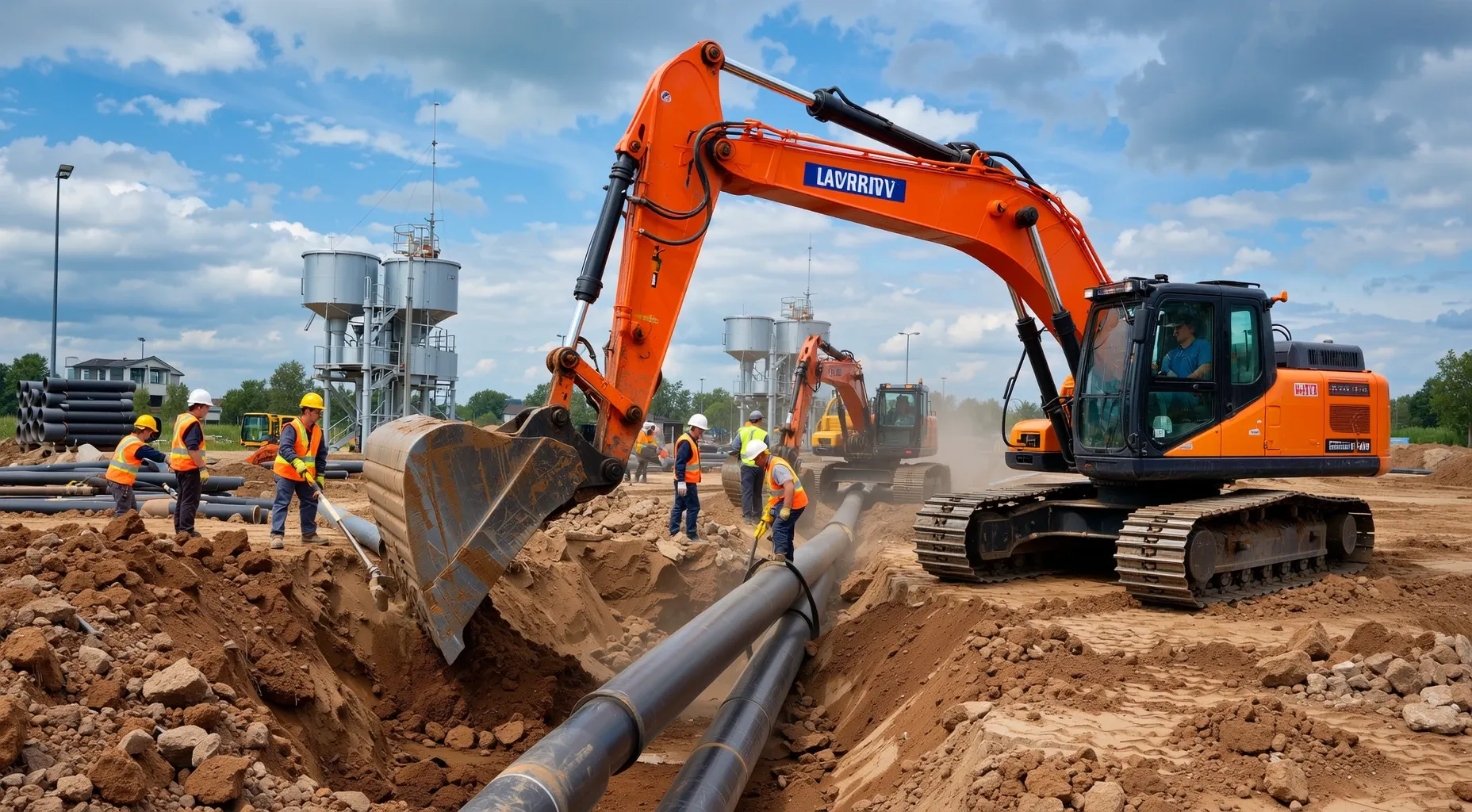
Construcción de tuberías y estructuras de agua y alcantarillado
Description
Este sector comprende establecimientos principalmente dedicados a la construcción de tuberías y redes de agua y alcantarillado, tuberías principales, estaciones de bombeo, plantas de tratamiento y tanques de almacenamiento. El trabajo realizado puede incluir nueva construcción, reconstrucción, rehabilitación y reparaciones. Los contratistas especializados se incluyen en este sector si están involucrados en actividades principalmente relacionadas con la construcción de tuberías y estructuras de agua y alcantarillado. Todas las estructuras (incluidas las edificios) que son parte integral de las redes de agua y alcantarillado (por ejemplo, tanques de almacenamiento, estaciones de bombeo, plantas de tratamiento de agua y plantas de tratamiento de aguas residuales) se incluyen en este sector. Ejemplos ilustrativos: Construcción de tuberías de distribución, alcantarillado y agua Tubería principal, tubería y conexión, construcción Instalación de hidrantes Construcción de alcantarillado de aguas pluviales Construcción de sistemas de riego Construcción de tubería de agua y línea Construcción de planta de tratamiento de aguas residuales Construcción de planta de tratamiento de agua Estación de bombeo, sistema de agua y alcantarillado, construcción Construcción de tanque de almacenamiento de agua y torre Construcción de embalse Perforación, excavación, perforación o hundimiento de pozos de agua (excepto pozos de agua de entrada en campos petroleros)
Hierarchy
| Code | Title | Description |
|---|---|---|
| 23 | Construcción 2-digit sector | El Sector en su Conjunto El sector de la Construcción comprende establecimientos principalmente dedicados a la construcción de edificios o proyectos de ingeniería (por ejemplo, autopistas y sistemas de servicios públicos). También se incluyen en este sector los establecimientos principalmente dedicados a la preparación de terrenos para nuevas construcciones y los establecimientos principalmente dedicados a la subdivisión de terrenos para la venta como terrenos de construcción. El trabajo de construcción puede incluir nueva construcción, adiciones, modificaciones o mantenimiento y reparaciones. Las actividades de estos establecimientos generalmente se gestionan en un lugar de negocio fijo, pero generalmente realizan actividades de construcción en múltiples sitios de proyecto. Las responsabilidades de producción para los establecimientos de este sector generalmente se especifican en (1) contratos con los propietarios de proyectos de construcción (contratos principales) o (2) contratos con otros establecimientos de construcción (subcontratos). Los establecimientos principalmente dedicados a contratos que incluyen la responsabilidad de todos los aspectos de proyectos de construcción individuales se conocen comúnmente como contratistas generales, pero también pueden conocerse como contratistas de diseño-construcción, administradores de construcción, contratistas llave en mano o (en los casos en que dos o más establecimientos obtienen conjuntamente un contrato general) contratistas de joint venture. Los administradores de construcción que brindan solo la supervisión y la programación (es decir, agencia) así como los administradores de construcción que son responsables de todo el proyecto (es decir, en riesgo) se incluyen como establecimientos de tipo contratista general. Los establecimientos de "tipo contratista general" a menudo organizan la construcción de partes separadas de sus proyectos a través de subcontratos con otros establecimientos de construcción. Los establecimientos principalmente dedicados a actividades para producir un componente específico (por ejemplo, albañilería, pintura y trabajos eléctricos) de un proyecto de construcción se conocen comúnmente como contratistas de servicios especializados. Las actividades de los contratistas de servicios especializados generalmente se subcontratan de otros establecimientos de construcción, pero especialmente en la remodelación y la construcción de reparaciones, el trabajo puede realizarse directamente para el propietario de la propiedad. Los establecimientos principalmente dedicados a actividades para construir edificios para la venta en terrenos que poseen se conocen como constructores para la venta, pero también pueden conocerse como constructores especulativos o constructores comerciales. Los constructores para la venta producen edificios de manera similar a los contratistas generales, pero sus procesos de producción también incluyen la adquisición de terrenos y la obtención de financiación. Los constructores para la venta a menudo se asocian principalmente con la construcción de edificios residenciales. Al igual que los contratistas generales, pueden subcontratar toda o parte del trabajo de construcción real en sus edificios. Existen diferencias sustanciales en los tipos de equipos, habilidades de la fuerza laboral y otras entradas requeridas por los establecimientos de este sector. Para resaltar estas diferencias y las variaciones en las funciones de producción subyacentes, este sector se divide en tres subsectores. El subsector 236, Construcción de Edificios, comprende los establecimientos de tipo contratista general y los constructores para la venta involucrados en la construcción de edificios. El subsector 237, Construcción de Ingeniería y Obras Civiles, comprende los establecimientos involucrados en la construcción de proyectos de ingeniería. El subsector 238, Contratistas de Servicios Especializados, comprende los establecimientos que se dedican a actividades de servicios especializados que generalmente se necesitan en la construcción de todos los tipos de edificios. La construcción realizada por una empresa principalmente dedicada a algún negocio distinto de la construcción para su propia cuenta, utilizando los empleados de la empresa, se conoce como construcción de cuenta propia. Esta actividad no se incluye en el sector de la construcción a menos que el trabajo de construcción realizado sea la actividad principal de un establecimiento separado de la empresa. La instalación y el mantenimiento y reparación continuos de redes de telecomunicaciones y servicios públicos se excluyen de la construcción cuando los establecimientos que realizan el trabajo no son contratistas independientes. Aunque una proporción cada vez mayor de este trabajo se subcontrata a contratistas independientes en el sector de la construcción, las unidades operativas de las compañías de telecomunicaciones y servicios públicos que realizan este trabajo se incluyen en las actividades de telecomunicaciones o servicios públicos. |
| 237 | Construcción de Ingeniería y Obras Civiles 3-digit subsector | El subsector de la Construcción de Ingeniería y Obras Civiles comprende los establecimientos cuyo principal actividad es la construcción de proyectos de ingeniería completos (por ejemplo, autopistas y presas), y los contratistas de servicios especializados, cuyo principal actividad es la producción de un componente específico para dichos proyectos. Los contratistas de servicios especializados en el subsector de la Construcción de Ingeniería y Obras Civiles generalmente realizan actividades que son específicas para los proyectos de ingeniería y de obras civiles y que normalmente no se realizan en edificios. El trabajo puede incluir nueva construcción, adiciones, modificaciones o reparaciones. Las actividades de servicios especializados se clasifican en este subsector si las habilidades y el equipo presentes son específicos para los proyectos de ingeniería o de obras civiles. Por ejemplo, se necesita un equipo especializado para pintar líneas en autopistas. Este equipo normalmente no se utiliza en aplicaciones de construcción, por lo que la actividad se clasifica en este subsector. La instalación de semáforos, aunque específica para las autopistas, utiliza las mismas habilidades y equipos que se necesitan para los trabajos eléctricos en los proyectos de edificios y, por lo tanto, se clasifican en el subsector 238, Contratistas de Servicios Especializados. Los proyectos de construcción que involucran recursos hídricos (por ejemplo, dragado y drenaje) y los proyectos que involucran mejoras de espacios abiertos (por ejemplo, parques y senderos) se incluyen en este subsector. Los establecimientos cuyo principal actividad es la subdivisión de terrenos en lotes individuales generalmente realizan varias actividades adicionales de mejora del sitio (por ejemplo, construcción de carreteras e instalación de líneas de servicios públicos) y se incluyen en este subsector. Los establecimientos en este subsector se clasifican según los tipos de estructuras que construyen. Esta clasificación refleja las variaciones en los requisitos de los procesos de producción subyacentes. |
| 2371 | Construcción de Sistemas de Servicios Públicos 4-digit industry group | Este grupo de industrias comprende los establecimientos principalmente dedicados a la construcción de líneas de distribución y estructuras relacionadas para servicios públicos (es decir, agua, alcantarillado, petróleo, gas, electricidad y comunicaciones). Todas las estructuras (incluidos los edificios) que son partes integrales de los sistemas de servicios públicos (por ejemplo, tanques de almacenamiento, estaciones de bombeo, plantas de energía y refinerías) se incluyen en este grupo de industrias. |
| 23711 | Construcción de Líneas de Agua y Alcantarillado y Estructuras Relacionadas 5-digit NAICS industry | Ver descripción para 237110. |
| 237110 | Construcción de tuberías y estructuras de agua y alcantarillado 6-digit U.S. detail | Este sector comprende establecimientos principalmente dedicados a la construcción de tuberías y redes de agua y alcantarillado, tuberías principales, estaciones de bombeo, plantas de tratamiento y tanques de almacenamiento. El trabajo realizado puede incluir nueva construcción, reconstrucción, rehabilitación y reparaciones. Los contratistas especializados se incluyen en este sector si están involucrados en actividades principalmente relacionadas con la construcción de tuberías y estructuras de agua y alcantarillado. Todas las estructuras (incluidas las edificios) que son parte integral de las redes de agua y alcantarillado (por ejemplo, tanques de almacenamiento, estaciones de bombeo, plantas de tratamiento de agua y plantas de tratamiento de aguas residuales) se incluyen en este sector. Ejemplos ilustrativos: Construcción de tuberías de distribución, alcantarillado y agua Tubería principal, tubería y conexión, construcción Instalación de hidrantes Construcción de alcantarillado de aguas pluviales Construcción de sistemas de riego Construcción de tubería de agua y línea Construcción de planta de tratamiento de aguas residuales Construcción de planta de tratamiento de agua Estación de bombeo, sistema de agua y alcantarillado, construcción Construcción de tanque de almacenamiento de agua y torre Construcción de embalse Perforación, excavación, perforación o hundimiento de pozos de agua (excepto pozos de agua de entrada en campos petroleros) |
Need a supply chain stack that maps to this industry?
Use this NAICS classification as the starting point, then connect it to Item workflows across inventory, warehousing, order management, fulfillment, and transportation.
Classification References
- 01La construcción de instalaciones marinas (por ejemplo, puertos), estructuras de control de inundaciones, presas o instalaciones de generación hidroeléctrica se clasifican en la Industria 237990, Otras Construcciones de Ingeniería Pesada y Civil;
- 02La instalación de tanques sépticos se clasifica en la Industria 238910, Contratistas de Preparación de Sitios;
- 03La perforación de pozos de toma de agua en campos petroleros y de gas se clasifica en la Industria 213111 de los EE. UU., Perforación de Pozos de Petróleo y Gas; y
- 04La instalación y el mantenimiento de tuberías de agua y alcantarillado realizados por empresas de servicios públicos de agua y alcantarillado se clasifican en el Grupo de Industrias 2213, Agua, Alcantarillado y Otros Sistemas.
Index Items
Construcción de acueductos
Construcción de pozos artesianos
Tapado de pozos de agua
Gestión de la construcción de plantas de tratamiento de agua y saneamiento
Gestión de la construcción de tuberías de agua y saneamiento
Construcción de tuberías de distribución, alcantarillado y agua
Perforación de pozos de agua (excepto pozos de toma de agua en campos petroleros y de gas)
Instalación de hidrantes
Perforación geotérmica
Instalación e inspección de hidrantes
Construcción de proyectos de riego (excepto jardines)
Construcción de laguna, planta de tratamiento de aguas residuales
Construcción de estación de bombeo, sistema de agua y saneamiento
Construcción de embalse
Construcción de alcantarillado sanitario
Construcción de línea de recolección y disposición de aguas residuales
Construcción de planta de tratamiento de aguas residuales
Construcción de alcantarillado
Construcción de tubería principal, conducto y conexión de alcantarillado
Construcción de alcantarillado de aguas pluviales
Construcción de tubería de servicios públicos (es decir, alcantarillado, agua)
Construcción de planta de desalinización de agua
Construcción de planta de filtración de agua
Construcción de tubería y línea de agua
Construcción de estación de bombeo o elevación de agua
Instalación de estación de muestreo de agua
Construcción de tanque y torre de almacenamiento de agua
Construcción de planta de tratamiento de agua
Perforación de pozos de agua, excavación, perforación o hundimiento (excepto pozos de toma de agua en campos petroleros y de gas)
Instalación de bomba de pozo y sistema de tuberías de agua
How Item Can Help
Item.com's Warehouse Management System optimizes inventory placement for heavy materials like concrete pipes, ensuring rapid access during urgent utility construction projects. It provides real-time stock levels across multiple sites, reducing delays caused by material shortages on active work zones.
The Order Management System streamlines the procurement of specific line components by aggregating needs from various field sites into a single view. This unified approach minimizes duplicate orders and centralizes purchasing, leading to cost savings and faster delivery of essential parts to job sites.
Predictive analytics identify potential supply chain disruptions, such as delays in manufacturing water pipes or trucking routes affected by weather. By forecasting these risks early, construction managers can reroute orders and adjust project schedules to prevent costly downtime.
Item.com Tools
External Resources
Census.gov NAICS Detail
Official US Census Bureau definition and scope for NAICS 237110.
National Association of Home Builders
Provides resources and advocacy for residential construction including plumbing and foundation work.
U.S. Department of Housing and Urban Development
Offers government guidance on housing safety standards and infrastructure maintenance.
Procore
A project management platform widely used by contractors for managing civil and structural projects.
