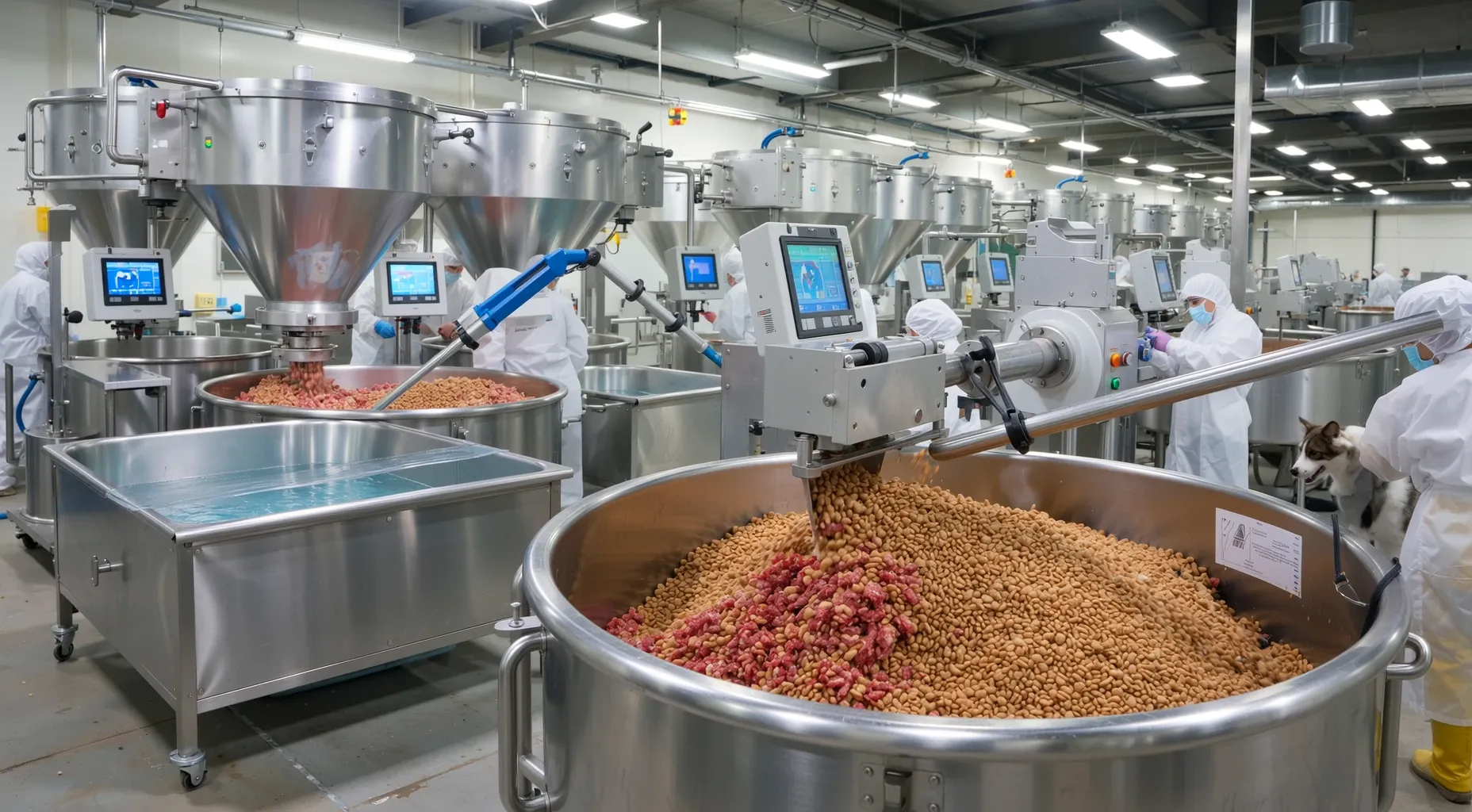
Dog and Cat Food Manufacturing
Description
This manufacturing sector specializes in creating nutrient-dense feed specifically for canines and felines, utilizing a broad spectrum of ingredients including grains, oilseed byproducts, and various meat products. Facilities within this group process raw materials through extrusion, baking, or mixing operations to formulate kibble, canned food, and semi-moist treats. Typical business activities involve large-scale blending, packaging, and quality control to ensure safety standards meet regulatory requirements for animal consumption. Operators range from small, local bakeries producing custom diets for regional veterinary clinics to massive industrial conglomerates with global distribution networks. These companies often employ advanced machinery to achieve consistent texture, flavor, and nutritional profiles tailored to different life stages of pets such as puppies, kittens, seniors, or specific health conditions. The scale of operations varies significantly, with some establishments serving hundreds of thousands of units daily while others focus on niche premium or organic lines. Many of these manufacturers also engage in research and development to innovate new protein sources or sustainable packaging solutions. The scope extends beyond simple production, encompassing logistics, marketing, and direct-to-consumer shipping, making this a critical part of the broader pet care economy across the United States.
Hierarchy
| Code | Title | Description |
|---|---|---|
| 31 | Manufacturing 2-digit sector | The Sector as a Whole The Manufacturing sector comprises establishments engaged in the mechanical, physical, or chemical transformation of materials, substances, or components into new products. The assembling of component parts of manufactured products is considered manufacturing, except in cases where the activity is appropriately classified in Sector 23, Construction. Establishments in the Manufacturing sector are often described as plants, factories, or mills and characteristically use power-driven machines and material handling equipment. However, establishments that transform materials or substances into new products by hand or in the worker's home and those engaged in selling to the general public products made on the same premises from which they are sold, such as bakeries, candy stores, and custom tailors, may also be included in this sector. Manufacturing establishments may process materials or may contract with other establishments to process their materials for them. Both types of establishments are included in manufacturing. Selected industries in the Manufacturing sector are comprised solely of establishments that process materials for other establishments on a contract or fee basis. Beyond these dedicated contract manufacturing industries, establishments that process materials for other establishments are generally classified in the Manufacturing industry of the processed materials. The materials, substances, or components transformed by manufacturing establishments are raw materials that are products of agriculture, forestry, fishing, mining, or quarrying as well as products of other manufacturing establishments. The materials used may be purchased directly from producers, obtained through customary trade channels, or secured without recourse to the market by transferring the product from one establishment to another, under the same ownership. The new product of a manufacturing establishment may be finished in the sense that it is ready for utilization or consumption, or it may be semi-finished to become an input for an establishment engaged in further manufacturing. For example, the product of the alumina refinery is the input used in the primary production of aluminum; primary aluminum is the input to an aluminum wire drawing plant; and aluminum wire is the input for a fabricated wire product manufacturing establishment. The subsectors in the Manufacturing sector generally reflect distinct production processes related to material inputs, production equipment, and employee skills. In the machinery area, where assembling is a key activity, parts and accessories for manufactured products are classified in the industry of the finished manufactured item when they are made for separate sale. For example, an attachment for a piece of metalworking machinery would be classified with metalworking machinery. However, component inputs from other manufacturing establishments are classified based on the production function of the component manufacturer. For example, electronic components are classified in Subsector 334, Computer and Electronic Product Manufacturing, and stampings are classified in Subsector 332, Fabricated Metal Product Manufacturing. Manufacturing establishments often perform one or more activities that are classified outside the Manufacturing sector of NAICS. For instance, almost all manufacturing has some captive research and development or administrative operations, such as accounting, payroll, or management. These captive services are treated the same as captive manufacturing activities. When the services are provided by separate establishments, they are classified in the NAICS sector where such services are primary, not in manufacturing. The boundaries of manufacturing and the other sectors of the classification system can be somewhat blurry. The establishments in the Manufacturing sector are engaged in the transformation of materials into new products. Their output is a new product. However, the definition of what constitutes a new product can be somewhat subjective. As clarification, the following activities are considered manufacturing in NAICS: <table width=100%><tr><td width=10%> </td><td><dl><dt style='padding-left: 10px; text-indent: -10px;'>Milk bottling and pasteurizing;</dt><dt style='padding-left: 10px; text-indent: -10px;'>Water bottling and processing;</dt><dt style='padding-left: 10px; text-indent: -10px;'>Fresh fish packaging (oyster<br/> shucking, fish filleting);</dt><dt style='padding-left: 10px; text-indent: -10px;'>Apparel jobbing (assigning<br/> materials to contract<br/> factories or shops for<br/> fabrication or other contract<br/> operations) as well as<br/> contracting on materials<br/> owned by others;</dt><dt style='padding-left: 10px; text-indent: -10px;'>Printing and related activities;</dt><dt style='padding-left: 10px; text-indent: -10px;'>Ready-mix concrete production;</dt><dt style='padding-left: 10px; text-indent: -10px;'>Leather converting;</dt><dt style='padding-left: 10px; text-indent: -10px;'>Grinding lenses to<br/> prescription;</dt><dt style='padding-left: 10px; text-indent: -10px;'>Wood preserving;</dt><dt style='padding-left: 10px; text-indent: -10px;'>Lapidary work for the trade;</dt></dl></td><td width=10%> </td><td><dl><dt style='padding-left: 10px; text-indent: -10px;'>Electroplating, plating, metal<br/> heat treating, and<br/> polishing for the trade;</dt><dt style='padding-left: 10px; text-indent: -10px;'>Fabricating signs and<br/> advertising displays;</dt><dt style='padding-left: 10px; text-indent: -10px;'>Rebuilding or remanufacturing<br/> machinery (i.e., automotive<br/> parts);</dt><dt style='padding-left: 10px; text-indent: -10px;'>Making manufactured homes<br/> (i.e., mobile homes) or<br/> prefabricated buildings,<br/> whether or not assembling/<br/> erecting at the customers'<br/> site;</dt><dt style='padding-left: 10px; text-indent: -10px;'>Ship repair and renovation;</dt><dt style='padding-left: 10px; text-indent: -10px;'>Machine shops; and</dt><dt style='padding-left: 10px; text-indent: -10px;'>Tire retreading.</dt></dl></td><td width=10%> </td></tr></table> Conversely, there are activities that are sometimes considered manufacturing, but which for NAICS are classified in another sector (i.e., not classified as manufacturing). They include: 1. Logging, classified in Sector 11, Agriculture, Forestry, Fishing and Hunting, is considered a harvesting operation; 2. Beneficiating ores and other minerals, classified in Sector 21, Mining, Quarrying, and Oil and Gas Extraction, is considered part of the activity of mining; 3. Constructing structures, assembling prefabricated buildings, and fabricating at the construction site by contractors are classified in Sector 23, Construction; 4. Breaking bulk and reselling in smaller lots, including packaging, repackaging, or bottling products, such as liquors or chemicals; assembling and selling computers on a custom basis; sorting and reselling scrap; mixing and selling paints to customer order; and cutting metals to customer order for resale are classified in Sector 42, Wholesale Trade, or Sector 44-45, Retail Trade; and 5. Publishing and the combined activity of publishing and printing, classified in Sector 51, Information, transform information into a product for which the value to the consumer lies in the information content, not in the format in which it is distributed (i.e., the book or software compact disc). |
| 311 | Food Manufacturing 3-digit subsector | Industries in the Food Manufacturing subsector transform livestock and agricultural products into products for intermediate or final consumption. The industry groups are distinguished by the raw materials (generally of animal or vegetable origin) processed into food products. The food products manufactured in these establishments are typically sold to wholesalers or retailers for distribution to consumers, but establishments primarily engaged in retailing bakery and candy products made on the premises not for immediate consumption are included. Establishments primarily engaged in manufacturing beverages are classified in Subsector 312, Beverage and Tobacco Product Manufacturing. |
| 3111 | Animal Food Manufacturing 4-digit industry group | Industries in the Food Manufacturing subsector transform livestock and agricultural products into products for intermediate or final consumption. The industry groups are distinguished by the raw materials (generally of animal or vegetable origin) processed into food products. The food products manufactured in these establishments are typically sold to wholesalers or retailers for distribution to consumers, but establishments primarily engaged in retailing bakery and candy products made on the premises not for immediate consumption are included. Establishments primarily engaged in manufacturing beverages are classified in Subsector 312, Beverage and Tobacco Product Manufacturing. |
| 31111 | Animal Food Manufacturing 5-digit NAICS industry | This industry comprises establishments primarily engaged in manufacturing food and feed for animals from ingredients, such as grains, oilseed mill products, and meat products. |
| 311111 | Dog and Cat Food Manufacturing 6-digit U.S. detail | This manufacturing sector specializes in creating nutrient-dense feed specifically for canines and felines, utilizing a broad spectrum of ingredients including grains, oilseed byproducts, and various meat products. Facilities within this group process raw materials through extrusion, baking, or mixing operations to formulate kibble, canned food, and semi-moist treats. Typical business activities involve large-scale blending, packaging, and quality control to ensure safety standards meet regulatory requirements for animal consumption. Operators range from small, local bakeries producing custom diets for regional veterinary clinics to massive industrial conglomerates with global distribution networks. These companies often employ advanced machinery to achieve consistent texture, flavor, and nutritional profiles tailored to different life stages of pets such as puppies, kittens, seniors, or specific health conditions. The scale of operations varies significantly, with some establishments serving hundreds of thousands of units daily while others focus on niche premium or organic lines. Many of these manufacturers also engage in research and development to innovate new protein sources or sustainable packaging solutions. The scope extends beyond simple production, encompassing logistics, marketing, and direct-to-consumer shipping, making this a critical part of the broader pet care economy across the United States. |
Need a supply chain stack that maps to this industry?
Use this NAICS classification as the starting point, then connect it to Item workflows across inventory, warehousing, order management, fulfillment, and transportation.
Classification References
- 01Manufacturing food for animals (except dog and cat)--are classified in U.S. Industry 311119, Other Animal Food Manufacturing;
- 02Slaughtering animals for feed--are classified in Industry 31161, Animal Slaughtering and Processing; and
- 03Manufacturing vitamins and minerals for dogs and cats--are classified in Industry 32541, Pharmaceutical and Medicine Manufacturing.
Index Items
Animal feed mills, dog and cat, manufacturing
Animal feeds, prepared, dog and cat, manufacturing
Cat food manufacturing
Dog and cat food (e.g., canned, dry, frozen, semimoist), manufacturing
Dog food manufacturing
Feed supplements, dog and cat, manufacturing
Feeds, prepared for dog and cat, manufacturing
Horsemeat, processing, for dog and cat food
Meat canning, dog and cat, pet food, made from purchased carcasses
Meat products, dog and cat, pet food, canning, made from purchased carcasses
Pet food, dog and cat, manufacturing
How Item Can Help
The Warehouse Management System tracks batch-specific pet food ingredients to ensure strict adherence to FDA labeling and recall requirements while optimizing storage for perishable raw materials.
The Order Management System routes high-volume online pet food orders to regional warehouses based on real-time customer data, reducing shipping times for fresh food and treats.
Data Intelligence analyzes historical sales trends to predict seasonal spikes in demand for specific pet food categories, enabling dynamic inventory allocation and reduced spoilage.
Item.com Tools
External Resources
Census.gov NAICS Detail
Official US Census Bureau definition and scope for NAICS 311111.
National Association of Pet Food Manufacturers
A leading trade association representing the pet food industry with resources and advocacy for manufacturers.
U.S. Census Bureau Pet Food Manufacturing
Official government data and definitions for the NAICS 311111 industry code regarding dog and cat food production.
Pet Food Industry Association
An industry directory and resource hub offering market research and information for dog and cat food producers.