Plastics Plumbing Fixture Manufacturing
Description
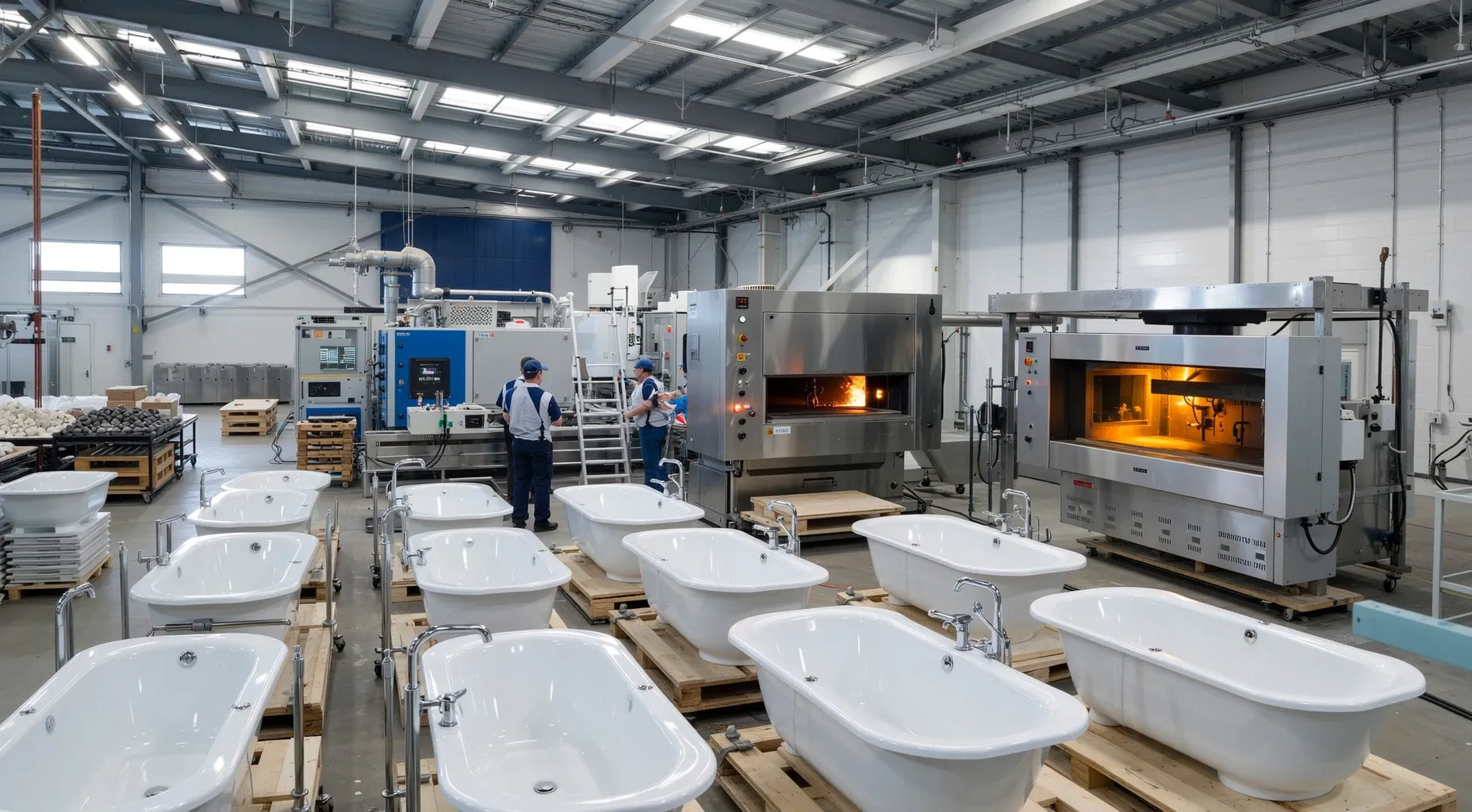
This U.S. industry comprises establishments primarily engaged in manufacturing plastics or fiberglass plumbing fixtures. Examples of products made by these establishments are plastics or fiberglass bathtubs, hot tubs, portable toilets, and shower stalls.
Hierarchy
| Code | Title | Description |
|---|---|---|
| 32 | Manufacturing 2-digit sector | The Sector as a Whole The Manufacturing sector comprises establishments engaged in the mechanical, physical, or chemical transformation of materials, substances, or components into new products. The assembling of component parts of manufactured products is considered manufacturing, except in cases where the activity is appropriately classified in Sector 23, Construction. Establishments in the Manufacturing sector are often described as plants, factories, or mills and characteristically use power-driven machines and material handling equipment. However, establishments that transform materials or substances into new products by hand or in the worker's home and those engaged in selling to the general public products made on the same premises from which they are sold, such as bakeries, candy stores, and custom tailors, may also be included in this sector. Manufacturing establishments may process materials or may contract with other establishments to process their materials for them. Both types of establishments are included in manufacturing. Selected industries in the Manufacturing sector are comprised solely of establishments that process materials for other establishments on a contract or fee basis. Beyond these dedicated contract manufacturing industries, establishments that process materials for other establishments are generally classified in the Manufacturing industry of the processed materials. The materials, substances, or components transformed by manufacturing establishments are raw materials that are products of agriculture, forestry, fishing, mining, or quarrying as well as products of other manufacturing establishments. The materials used may be purchased directly from producers, obtained through customary trade channels, or secured without recourse to the market by transferring the product from one establishment to another, under the same ownership. The new product of a manufacturing establishment may be finished in the sense that it is ready for utilization or consumption, or it may be semi-finished to become an input for an establishment engaged in further manufacturing. For example, the product of the alumina refinery is the input used in the primary production of aluminum; primary aluminum is the input to an aluminum wire drawing plant; and aluminum wire is the input for a fabricated wire product manufacturing establishment. The subsectors in the Manufacturing sector generally reflect distinct production processes related to material inputs, production equipment, and employee skills. In the machinery area, where assembling is a key activity, parts and accessories for manufactured products are classified in the industry of the finished manufactured item when they are made for separate sale. For example, an attachment for a piece of metalworking machinery would be classified with metalworking machinery. However, component inputs from other manufacturing establishments are classified based on the production function of the component manufacturer. For example, electronic components are classified in Subsector 334, Computer and Electronic Product Manufacturing, and stampings are classified in Subsector 332, Fabricated Metal Product Manufacturing. Manufacturing establishments often perform one or more activities that are classified outside the Manufacturing sector of NAICS. For instance, almost all manufacturing has some captive research and development or administrative operations, such as accounting, payroll, or management. These captive services are treated the same as captive manufacturing activities. When the services are provided by separate establishments, they are classified in the NAICS sector where such services are primary, not in manufacturing. The boundaries of manufacturing and the other sectors of the classification system can be somewhat blurry. The establishments in the Manufacturing sector are engaged in the transformation of materials into new products. Their output is a new product. However, the definition of what constitutes a new product can be somewhat subjective. As clarification, the following activities are considered manufacturing in NAICS: <table width=100%><tr><td width=10%> </td><td><dl><dt style='padding-left: 10px; text-indent: -10px;'>Milk bottling and pasteurizing;</dt><dt style='padding-left: 10px; text-indent: -10px;'>Water bottling and processing;</dt><dt style='padding-left: 10px; text-indent: -10px;'>Fresh fish packaging (oyster<br/> shucking, fish filleting);</dt><dt style='padding-left: 10px; text-indent: -10px;'>Apparel jobbing (assigning<br/> materials to contract<br/> factories or shops for<br/> fabrication or other contract<br/> operations) as well as<br/> contracting on materials<br/> owned by others;</dt><dt style='padding-left: 10px; text-indent: -10px;'>Printing and related activities;</dt><dt style='padding-left: 10px; text-indent: -10px;'>Ready-mix concrete production;</dt><dt style='padding-left: 10px; text-indent: -10px;'>Leather converting;</dt><dt style='padding-left: 10px; text-indent: -10px;'>Grinding lenses to<br/> prescription;</dt><dt style='padding-left: 10px; text-indent: -10px;'>Wood preserving;</dt><dt style='padding-left: 10px; text-indent: -10px;'>Lapidary work for the trade;</dt></dl></td><td width=10%> </td><td><dl><dt style='padding-left: 10px; text-indent: -10px;'>Electroplating, plating, metal<br/> heat treating, and<br/> polishing for the trade;</dt><dt style='padding-left: 10px; text-indent: -10px;'>Fabricating signs and<br/> advertising displays;</dt><dt style='padding-left: 10px; text-indent: -10px;'>Rebuilding or remanufacturing<br/> machinery (i.e., automotive<br/> parts);</dt><dt style='padding-left: 10px; text-indent: -10px;'>Making manufactured homes<br/> (i.e., mobile homes) or<br/> prefabricated buildings,<br/> whether or not assembling/<br/> erecting at the customers'<br/> site;</dt><dt style='padding-left: 10px; text-indent: -10px;'>Ship repair and renovation;</dt><dt style='padding-left: 10px; text-indent: -10px;'>Machine shops; and</dt><dt style='padding-left: 10px; text-indent: -10px;'>Tire retreading.</dt></dl></td><td width=10%> </td></tr></table> Conversely, there are activities that are sometimes considered manufacturing, but which for NAICS are classified in another sector (i.e., not classified as manufacturing). They include: 1. Logging, classified in Sector 11, Agriculture, Forestry, Fishing and Hunting, is considered a harvesting operation; 2. Beneficiating ores and other minerals, classified in Sector 21, Mining, Quarrying, and Oil and Gas Extraction, is considered part of the activity of mining; 3. Constructing structures, assembling prefabricated buildings, and fabricating at the construction site by contractors are classified in Sector 23, Construction; 4. Breaking bulk and reselling in smaller lots, including packaging, repackaging, or bottling products, such as liquors or chemicals; assembling and selling computers on a custom basis; sorting and reselling scrap; mixing and selling paints to customer order; and cutting metals to customer order for resale are classified in Sector 42, Wholesale Trade, or Sector 44-45, Retail Trade; and 5. Publishing and the combined activity of publishing and printing, classified in Sector 51, Information, transform information into a product for which the value to the consumer lies in the information content, not in the format in which it is distributed (i.e., the book or software compact disc). |
| 326 | Plastics and Rubber Products Manufacturing 3-digit subsector | Industries in the Plastics and Rubber Products Manufacturing subsector make goods by processing plastics materials and raw rubber. The core technology employed by establishments in this subsector is that of plastics or rubber product production. Plastics and rubber are combined in the same subsector because plastics are increasingly being used as a substitute for rubber; however, the subsector is generally restricted to the production of products made of just one material, either solely plastics or rubber. Many manufacturing activities use plastics or rubber, for example the manufacture of footwear or furniture. Typically, the production process of these products involves more than one material. In these cases, technologies that allow disparate materials to be formed and combined are of central importance in describing the manufacturing activity. In NAICS, such activities (footwear and furniture manufacturing) are not classified in the Plastics and Rubber Products Manufacturing subsector because the core technologies for these activities are diverse and involve multiple materials. Within the Plastics and Rubber Products Manufacturing subsector, a distinction is made between plastics and rubber products at the industry group level, although it is not a rigid distinction, as can be seen from the definition of Industry 32622, Rubber and Plastics Hoses and Belting Manufacturing. In the case of hoses and belting, plastics are used as a substitute for rubber, and the distinction in materials is not useful as a basis for establishment classification. In keeping with the core technology focus of plastics, lamination of plastics film to plastics film as well as the production of bags from plastics only is classified in this subsector. Lamination and bag production involving plastics and materials other than plastics are classified in Subsector 322, Paper Manufacturing. |
| 3261 | Plastics Product Manufacturing 4-digit industry group | This industry group comprises establishments primarily engaged in processing new or spent (i.e., recycled) plastics resins into intermediate or final products, using such processes as compression molding; extrusion molding; injection molding; blow molding; and casting. Within most of these industries, the production process is such that a wide variety of products can be made. |
| 32619 | Other Plastics Product Manufacturing 5-digit NAICS industry | This industry comprises establishments primarily engaged in manufacturing plastics plumbing fixtures and other plastics products (except film, sheet, bags, profile shapes, pipes, pipe fittings, laminates, foam products, bottles, and hoses). Illustrative Examples: Inflatable plastics swimming pool rafts and similar flotation devices manufacturing Plastics air mattresses manufacturing Plastics bottle caps and lids manufacturing Plastics bowls and bowl covers manufacturing Plastics clothes hangers manufacturing Plastics cups (except foam) manufacturing Plastics dinnerware (except foam) manufacturing Plastics gloves manufacturing Plastics hardware manufacturing Plastics ice chests or coolers (except plastics foam) manufacturing Plastics or fiberglass plumbing fixtures (e.g., toilets, shower stalls, urinals) manufacturing Plastics prefabricated buildings manufacturing Plastics siding manufacturing Plastics trash containers manufacturing Resilient floor coverings (e.g., sheet, tiles) manufacturing |
| 326191 | Plastics Plumbing Fixture Manufacturing 6-digit U.S. detail | This U.S. industry comprises establishments primarily engaged in manufacturing plastics or fiberglass plumbing fixtures. Examples of products made by these establishments are plastics or fiberglass bathtubs, hot tubs, portable toilets, and shower stalls. |
Need a supply chain stack that maps to this industry?
Use this NAICS classification as the starting point, then connect it to Item workflows across inventory, warehousing, order management, fulfillment, and transportation.
Classification References
- 01Assembling plastics components into plumbing fixture fittings, such as faucets--are classified in U.S. Industry 332913, Plumbing Fixture Fitting and Trim Manufacturing; and
- 02Manufacturing plastics pipe and pipe fittings--are classified in U.S. Industry 326122, Plastics Pipe and Pipe Fitting Manufacturing.
Index Items
Bathtubs, plastics, manufacturing
Chemical toilets, plastics, manufacturing
Cultured marble plumbing fixtures manufacturing
Drinking fountains (except mechanically refrigerated), plastics, manufacturing
Hot tubs, plastics or fiberglass, manufacturing
Laundry tubs, plastics, manufacturing
Plumbing fixtures (e.g., shower stalls, toilets, urinals), plastics or fiberglass, manufacturing
Portable toilets, plastics, manufacturing
Shower stalls, plastics or fiberglass, manufacturing
Sinks, plastics, manufacturing
Toilet fixtures, plastics, manufacturing
Urinals, plastics, manufacturing
How Item Can Help
Item.com's warehouse management system optimizes storage of complex plastic fixtures and manages high-volume order fulfillment to reduce errors and shipping delays.
The order management system integrates with distributors to provide real-time inventory visibility, enabling seamless order processing and automatic stock replenishment.
Transportation management software tracks shipments across long distances while monitoring temperature-sensitive plastic goods to ensure they arrive undamaged and on time.
Item.com Tools
External Resources
Census.gov NAICS Detail
Official US Census Bureau definition and scope for NAICS 326191.
Plastic Pipe & Fittings Institute
Industry association dedicated to advancing the plumbing fittings and components segment of the plastics industry.
NAICS 326191 Page on the Bureau of Labor Statistics
Official government resource providing labor statistics and occupational details for the plastics product manufacturing sector.
Plastics Industry Association Industry Insights
Comprehensive industry website offering market analysis, technology resources, and directory listings for the plastics manufacturing sector.
