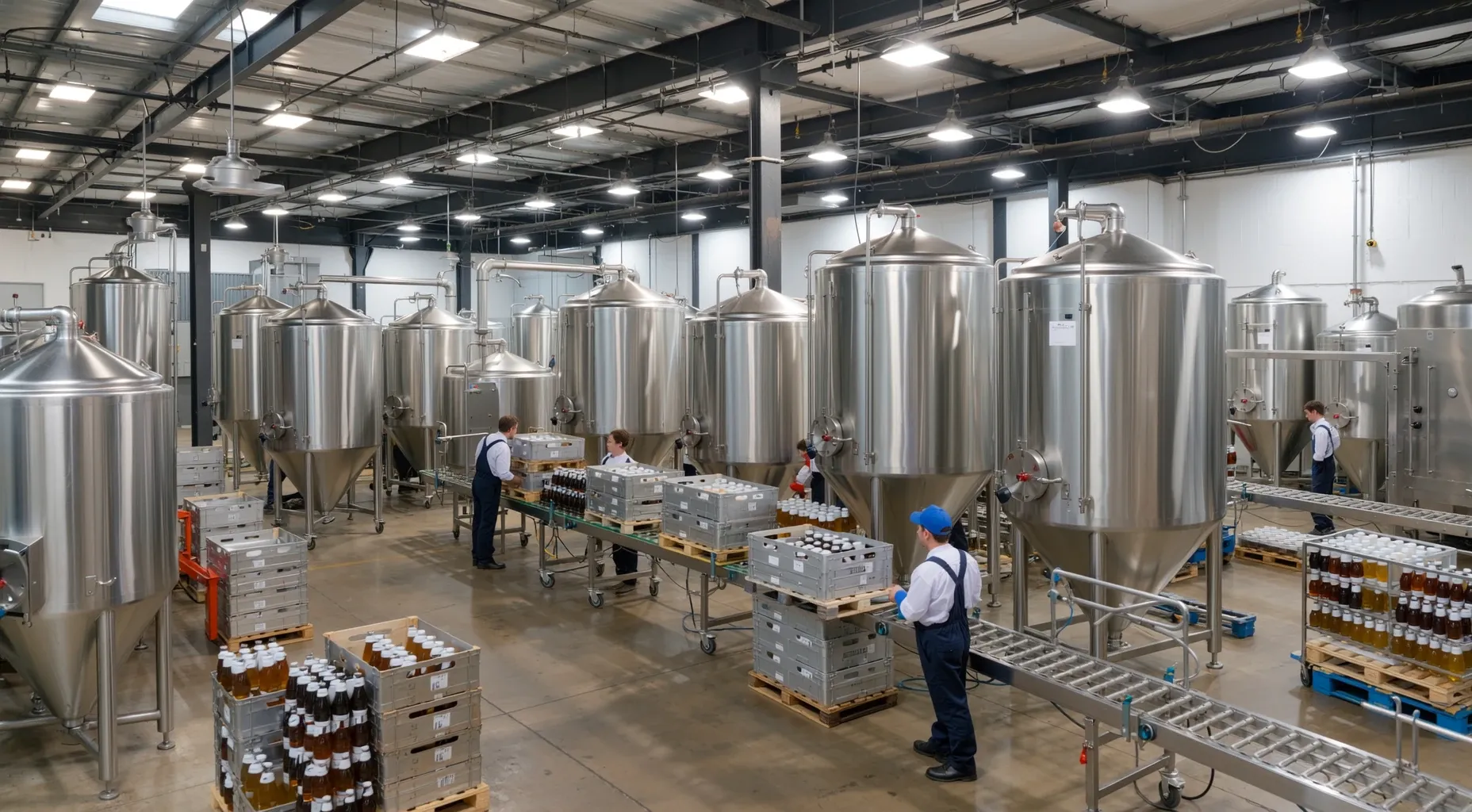
Beer and Ale Merchant Wholesalers
Description
Merchant wholesalers of beer and ale function as critical intermediaries in the beverage supply chain, connecting production facilities with retailers and on-premise establishments across the nation. These organizations primarily purchase fermented malt beverages in bulk, storing inventory in their facilities before reselling it to distributors, grocery stores, restaurants, bars, and private clubs. Their core activities involve logistics management, cold chain maintenance to preserve product quality, sales order processing, and maintaining complex inventory records to track product flow from brewery to final consumer. Unlike individual brewers who craft the beverage, these entities focus exclusively on the commercial distribution and retail of finished goods. The industry comprises a diverse array of operators, ranging from massive national distributors serving thousands of locations to smaller regional firms operating within specific metropolitan areas. Some large firms own numerous distribution centers and employ hundreds of staff, handling millions of cases annually, while smaller competitors serve limited geographic territories with localized networks. The scale of operations varies significantly, yet all actors within this sector share the fundamental economic role of aggregating supply and ensuring efficient delivery to the marketplace. By specializing in nondurable beverage goods, these merchants support the entire hospitality and retail ecosystem that relies heavily on the availability and timely delivery of alcoholic beverages.
Hierarchy
| Code | Title | Description |
|---|---|---|
| 42 | Wholesale Trade 2-digit sector | The Sector as a Whole The Wholesale Trade sector comprises establishments engaged in wholesaling merchandise, generally without transformation, and rendering services incidental to the sale of merchandise. The merchandise described in this sector includes the outputs of agriculture, mining, manufacturing, and certain information industries, such as publishing. The wholesaling process is an intermediate step in the distribution of merchandise. Wholesalers are organized to sell or arrange the purchase or sale of (a) goods for resale (i.e., goods sold to other wholesalers or retailers), (b) capital or durable nonconsumer goods, and (c) raw and intermediate materials and supplies used in production. Wholesalers sell merchandise to other businesses and normally operate from a warehouse or office. These warehouses and offices are characterized by having little or no display of merchandise. In addition, neither the design nor the location of the premises is intended to solicit walk-in traffic. Wholesalers do not normally use advertising directed to the general public. Customers are generally reached initially via telephone, in-person marketing, or by specialized advertising that may include Internet and other electronic means. Follow-up orders are either vendor-initiated or client-initiated, generally based on previous sales, and typically exhibit strong ties between sellers and buyers. In fact, transactions are often conducted between wholesalers and clients that have long-standing business relationships. This sector comprises two main types of wholesalers: merchant wholesalers that sell goods on their own account and agents and brokers that arrange sales and purchases for others generally for a commission or fee. (1) Establishments that sell goods on their own account are known as wholesale merchants, distributors, jobbers, drop shippers, and import/export merchants. Also included as wholesale merchants are sales offices and sales branches (but not retail stores) maintained by manufacturing, refining, or mining enterprises apart from their plants or mines for the purpose of marketing their products, and group purchasing organizations primarily purchasing and selling goods on their own account. Merchant wholesale establishments typically maintain their own warehouse, where they receive and handle goods for their customers. Goods are generally sold without transformation, but may include integral functions, such as sorting, packaging, labeling, and other marketing services. (2) Establishments arranging for the purchase or sale of goods owned by others or purchasing goods, generally on a commission basis are known as business-to-business electronic markets, agents and brokers, commission merchants, import/export agents and brokers, auction companies, group purchasing organizations (acting as agents), and manufacturers' representatives. These establishments operate from offices and generally do not own or handle the goods they sell. Some wholesale establishments may be connected with a single manufacturer and promote and sell the particular manufacturer's products to a wide range of other wholesalers or retailers. Other wholesalers may be connected to a retail chain, or limited number of retail chains, and only provide a variety of products needed by that particular retail operation(s). These wholesalers may obtain the products from a wide range of manufacturers. Still other wholesalers may not take title to the goods, but act as agents and brokers for a commission. Although, in general, wholesaling normally denotes sales in large volumes, durable nonconsumer goods may be sold in single units. Sales of capital or durable nonconsumer goods used in the production of goods and services, such as farm machinery, medium- and heavy-duty trucks, and industrial machinery, are always included in wholesale trade. |
| 424 | Merchant Wholesalers, Nondurable Goods 3-digit subsector | Industries in the Merchant Wholesalers, Nondurable Goods subsector sell nondurable goods to other businesses. Nondurable goods are items generally with a normal life expectancy of less than three years. Nondurable goods merchant wholesale trade establishments are engaged in wholesaling products, such as paper and paper products, chemicals and chemical products, drugs, textiles and textile products, apparel, footwear, groceries, farm products, petroleum and petroleum products, alcoholic beverages, books, magazines, newspapers, flowers and nursery stock, and tobacco products. The detailed industries within the subsector are organized in the classification structure based on the products sold. Agents and brokers primarily engaged in wholesaling nondurable goods, generally on a commission or fee basis, are classified in Subsector 425, Wholesale Trade Agents and Brokers. |
| 4248 | Beer, Wine, and Distilled Alcoholic Beverage Merchant Wholesalers 4-digit industry group | This industry group comprises establishments primarily engaged in the merchant wholesale distribution of beer, ale, wine, and/or distilled alcoholic beverages. |
| 42481 | Beer and Ale Merchant Wholesalers 5-digit NAICS industry | See industry description for 424810. |
| 424810 | Beer and Ale Merchant Wholesalers 6-digit U.S. detail | Merchant wholesalers of beer and ale function as critical intermediaries in the beverage supply chain, connecting production facilities with retailers and on-premise establishments across the nation. These organizations primarily purchase fermented malt beverages in bulk, storing inventory in their facilities before reselling it to distributors, grocery stores, restaurants, bars, and private clubs. Their core activities involve logistics management, cold chain maintenance to preserve product quality, sales order processing, and maintaining complex inventory records to track product flow from brewery to final consumer. Unlike individual brewers who craft the beverage, these entities focus exclusively on the commercial distribution and retail of finished goods. The industry comprises a diverse array of operators, ranging from massive national distributors serving thousands of locations to smaller regional firms operating within specific metropolitan areas. Some large firms own numerous distribution centers and employ hundreds of staff, handling millions of cases annually, while smaller competitors serve limited geographic territories with localized networks. The scale of operations varies significantly, yet all actors within this sector share the fundamental economic role of aggregating supply and ensuring efficient delivery to the marketplace. By specializing in nondurable beverage goods, these merchants support the entire hospitality and retail ecosystem that relies heavily on the availability and timely delivery of alcoholic beverages. |
Need a supply chain stack that maps to this industry?
Use this NAICS classification as the starting point, then connect it to Item workflows across inventory, warehousing, order management, fulfillment, and transportation.
Index Items
Alcoholic beverages (except distilled spirits, wine) merchant wholesalers
Ale merchant wholesalers
Beer merchant wholesalers
Beverages, alcoholic (except distilled spirits, wine), merchant wholesalers
Fermented malt beverages merchant wholesalers
Malt liquor merchant wholesalers
Porter merchant wholesalers
How Item Can Help
Item.com's Warehouse Management System optimizes storage and picking for high-volume beer and ale SKUs while minimizing spoilage risks in temperature-controlled environments.
By analyzing sales patterns and inventory turnover, these tools predict demand fluctuations to ensure fresh products are replenished before stockouts occur.
Transportation Management System streamlines cold-chain logistics for beer delivery, ensuring temperature compliance and reducing spoilage during transit.
External Resources
Census.gov NAICS Detail
Official US Census Bureau definition and scope for NAICS 424810.
National Association of Beer Wholesalers
The primary trade association representing beer and ale wholesalers in the United States.
US Census Bureau NAICS Detail
Official government data source defining characteristics for NAICS 424810 beer and ale merchant wholesalers.
Industry-Specific Directories
A comprehensive directory of wholesale businesses operating across the United States including the brewing beverage sector.
