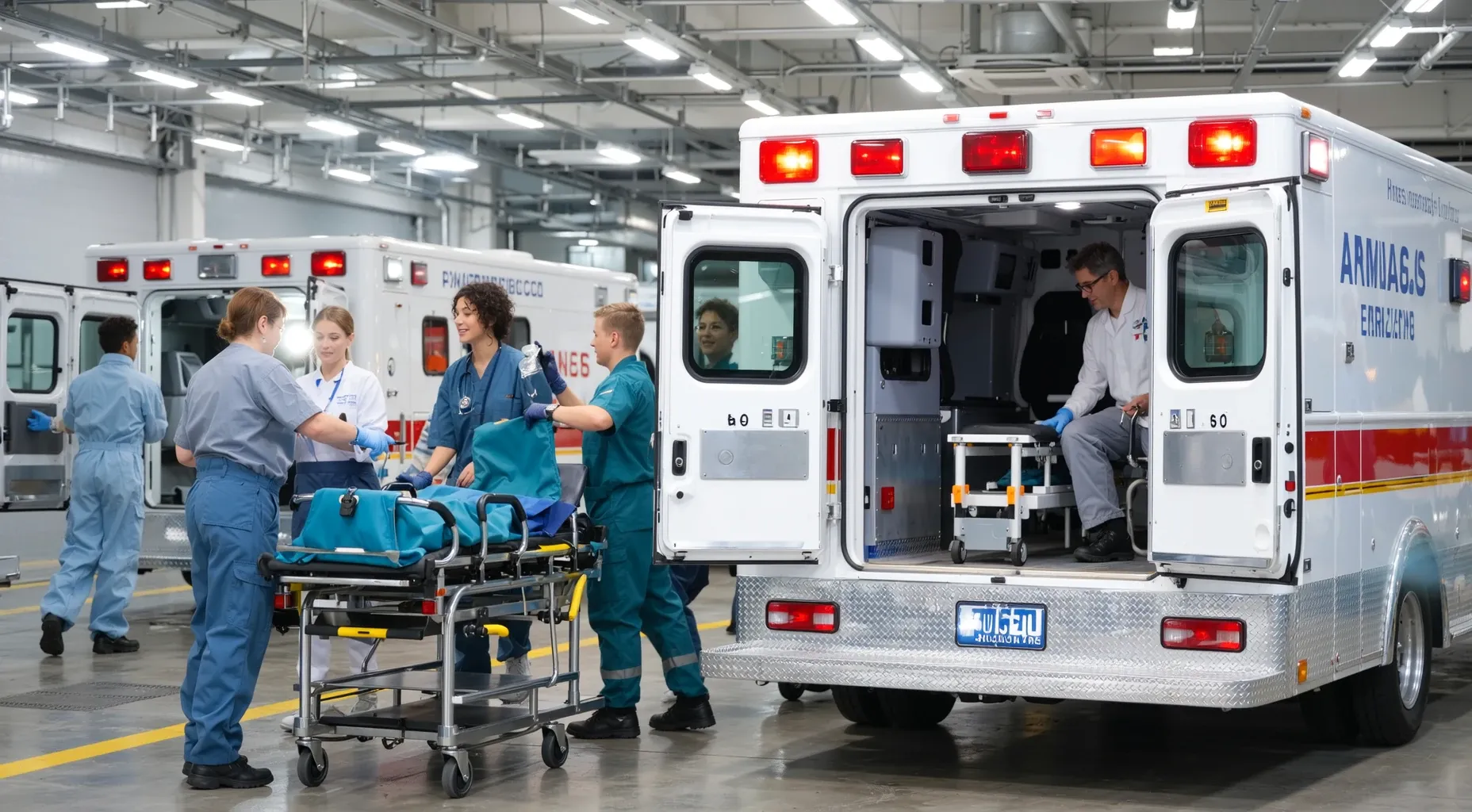
Ambulance Services
Description
This industry comprises establishments primarily engaged in providing transportation of patients by ground or air, along with medical care. These services are often provided during a medical emergency but are not restricted to emergencies. The vehicles are equipped with lifesaving equipment operated by medically trained personnel.
Hierarchy
| Code | Title | Description |
|---|---|---|
| 62 | Health Care and Social Assistance 2-digit sector | The Sector as a Whole The Health Care and Social Assistance sector comprises establishments providing health care and social assistance for individuals. The sector includes both health care and social assistance because it is sometimes difficult to distinguish between the boundaries of these two activities. The industries in this sector are arranged on a continuum starting with establishments providing medical care exclusively, continuing with those providing health care and social assistance, and finally finishing with those providing only social assistance. Establishments in this sector deliver services by trained professionals. All industries in the sector share this commonality of process, namely, labor inputs of health practitioners or social workers with the requisite expertise. Many of the industries in the sector are defined based on the educational degree held by the practitioners included in the industry. Excluded from this sector are yoga and aerobics instruction in Subsector 611, Educational Services, physical fitness facilities in Subsector 713, Amusement, Gambling, and Recreation Industries, and personal fitness training services and non-medical diet and weight reducing centers in Subsector 812, Personal and Laundry Services. Although these can be viewed as health services, these services are not typically delivered by health practitioners. |
| 621 | Ambulatory Health Care Services 3-digit subsector | Industries in the Ambulatory Health Care Services subsector provide health care services directly or indirectly to ambulatory patients and do not usually provide inpatient services. Health practitioners in this subsector provide outpatient services, with the facilities and equipment not usually being the most significant part of the production process. |
| 6219 | Other Ambulatory Health Care Services 4-digit industry group | This industry group comprises establishments primarily engaged in providing ambulatory health care services (except offices of physicians, dentists, and other health practitioners; outpatient care centers; medical laboratories and diagnostic imaging centers; and home health care providers). |
| 62191 | Ambulance Services 5-digit NAICS industry | See industry description for 621910. |
| 621910 | Ambulance Services 6-digit U.S. detail | This industry comprises establishments primarily engaged in providing transportation of patients by ground or air, along with medical care. These services are often provided during a medical emergency but are not restricted to emergencies. The vehicles are equipped with lifesaving equipment operated by medically trained personnel. |
Need a supply chain stack that maps to this industry?
Use this NAICS classification as the starting point, then connect it to Item workflows across inventory, warehousing, order management, fulfillment, and transportation.
Classification References
- 01Establishments primarily engaged in providing transportation of the disabled or elderly (without medical care) are classified in U.S. Industry 485991, Special Needs Transportation.
Index Items
Air ambulance services
Ambulance services, air or ground
Emergency medical transportation services, air or ground
Rescue services, air
Rescue services, medical
How Item Can Help
Optimizes inventory levels for emergency kits and spare parts by tracking real-time locations across multiple depots. This ensures ambulances always have accessible supplies during critical transport missions.
Manages complex order fulfillment workflows to reduce administrative delays during high-volume demand periods. Streamlined digital ordering allows rapid restocking before shifts begin or after large-scale evacuations.
Routes delivery vehicles based on traffic patterns and urgency to minimize transit times for critical patient transport. Efficient logistics planning reduces operational costs and ensures timely arrival at hospitals.
External Resources
Census.gov NAICS Detail
Official US Census Bureau definition and scope for NAICS 621910.
National Ambulance Association
Industry association for emergency medical transportation services in the United States.
Federal Highway Administration - Commercial Motor Vehicle Regulations
Government page detailing the Federal Motor Carrier Safety Administration regulations governing ambulance operations.
American Red Cross - First Aid and CPR Training
Nonprofit organization providing accredited first aid, CPR, and emergency response training programs.
