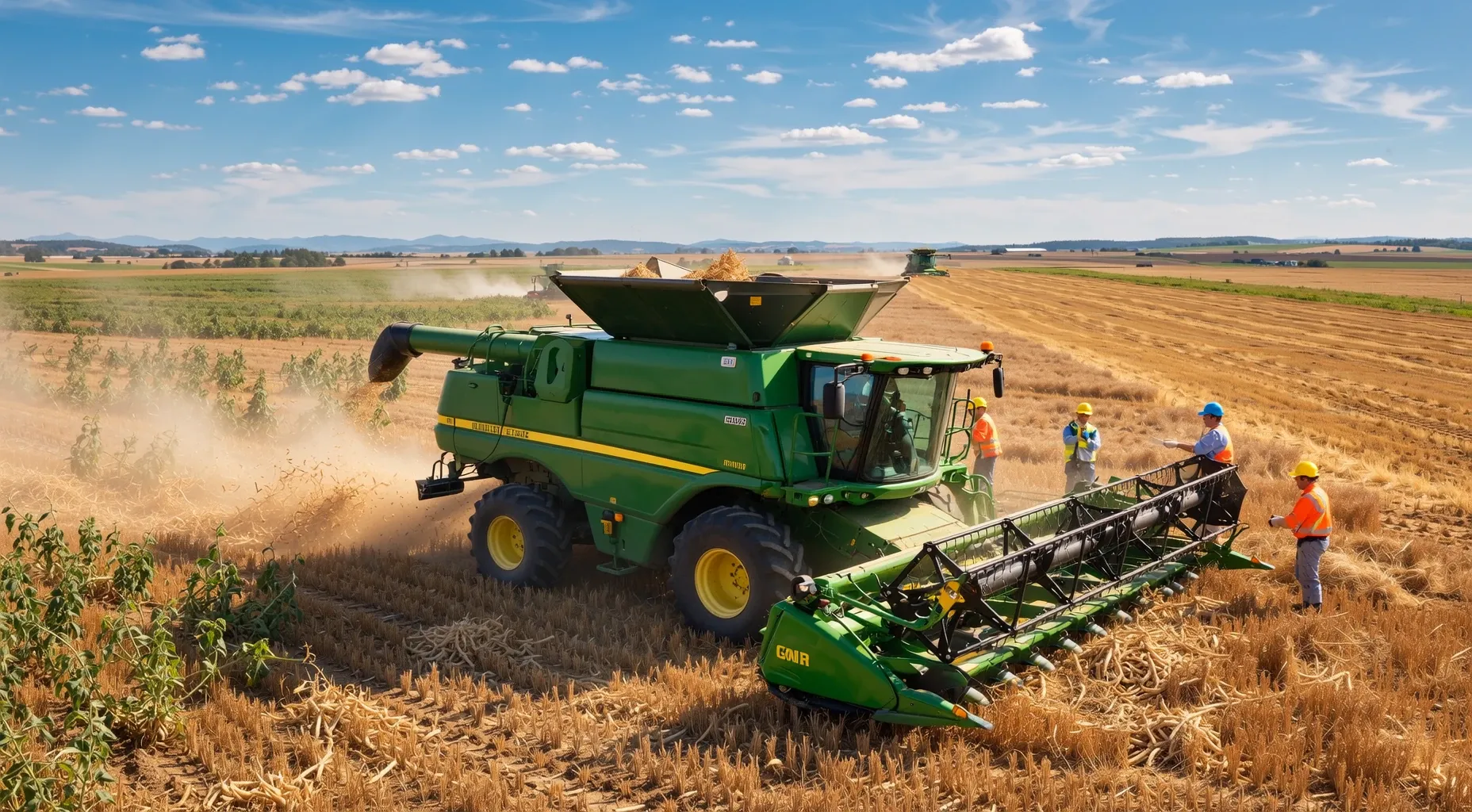
Dry Pea and Bean Farming
Description
Establishments classified under this industry are primarily dedicated to cultivating dry peas, beans, and lentils for processing into products like flour, starch, and protein isolates. These farming operations function as independent business units focused on the production and sale of specific dry legumes. Unlike wet mill processors who convert the crops into value-added goods, these establishments remain in the upstream segment of the agricultural supply chain. The scope of activities typically includes planting, tending, harvesting, and storing the crops for later sale. Operations may involve specialized equipment designed for efficient grain handling and storage. These businesses are often family-owned farms or large agricultural corporations managing vast tracts of land. The scale varies significantly, ranging from small family farms growing modest acreage to massive industrial operations producing millions of tons annually. Geographically, these farms are widespread across regions with suitable climates, though concentrations exist where the crops provide economic stability. Some larger entities may also engage in limited processing activities within their facilities, but the core function remains the cultivation of raw dry legumes for purchase by downstream manufacturers. The economic impact relies heavily on market prices for food and industrial legumes.
Hierarchy
| Code | Title | Description |
|---|---|---|
| 11 | Agriculture, Forestry, Fishing and Hunting 2-digit sector | The Sector as a Whole The Agriculture, Forestry, Fishing and Hunting sector comprises establishments primarily engaged in growing crops, raising animals, harvesting timber, and harvesting fish and other animals from a farm, ranch, or their natural habitats. The establishments in this sector are often described as farms, ranches, dairies, greenhouses, nurseries, orchards, or hatcheries. A farm may consist of a single tract of land or a number of separate tracts which may be held under different tenures. For example, one tract may be owned by the farm operator and another rented. It may be operated by the operator alone or with the assistance of members of the household or hired employees, or it may be operated by a partnership, corporation, or other type of organization. When a landowner has one or more tenants, renters, croppers, or managers, the land operated by each is considered a farm. The sector distinguishes two basic activities: agricultural production and agricultural support activities. Agricultural production includes establishments performing the complete farm or ranch operation, such as farm owner-operators and tenant farm operators. Agricultural support activities include establishments that perform one or more activities associated with farm operation, such as soil preparation, planting, harvesting, and management, on a contract or fee basis. Excluded from the Agriculture, Forestry, Fishing and Hunting sector are establishments primarily engaged in agricultural research (e.g., experimental farms) and government establishments primarily engaged in administering programs for regulating and conserving land, mineral, wildlife, and forest use. These establishments are classified in Industry 54171, Research and Development in the Physical, Engineering, and Life Sciences; and Industry 92412, Administration of Conservation Programs, respectively. |
| 111 | Crop Production 3-digit subsector | Industries in the Crop Production subsector grow crops mainly for food and fiber. The subsector comprises establishments, such as farms, orchards, groves, greenhouses, and nurseries, primarily engaged in growing crops, plants, vines, or trees and their seeds. The industries in this subsector are grouped by similarity of production activity, including biological and physiological characteristics and economic requirements, the length of growing season, degree of crop rotation, extent of input specialization, labor requirements, and capital demands. The production process is typically completed when the raw product or commodity grown reaches the "farm gate" for market, that is, at the point of first sale or price determination. Establishments are classified in the Crop Production subsector when crop production (i.e., value of crops for market) accounts for one-half or more of the establishment's total agricultural production. Within the subsector, establishments are classified in a specific industry when a product or industry family of products (i.e., oilseed and grain farming, vegetable and melon farming, fruit and tree nut farming) account for one-half or more of the establishment's agricultural production. Establishments with one-half or more crop production with no one product or family of products of an industry accounting for one-half of the establishment's agricultural production are treated as general combination crop farming and are classified in Industry 11199, All Other Crop Farming. Industries in the Crop Production subsector include establishments that own, operate, and manage and those that operate and manage. Those that manage only are classified in Subsector 115, Support Activities for Agriculture and Forestry. Establishments that raise aquatic plants in controlled or selected aquatic environments are classified in Subsector 112, Animal Production and Aquaculture. |
| 1111 | Oilseed and Grain Farming 4-digit industry group | This industry group comprises establishments primarily engaged in (1) growing oilseed and/or grain crops and/or (2) producing oilseed and grain seeds. These crops have an annual life cycle and are typically grown in open fields. |
| 11113 | Dry Pea and Bean Farming 5-digit NAICS industry | See industry description for 111130. |
| 111130 | Dry Pea and Bean Farming 6-digit U.S. detail | Establishments classified under this industry are primarily dedicated to cultivating dry peas, beans, and lentils for processing into products like flour, starch, and protein isolates. These farming operations function as independent business units focused on the production and sale of specific dry legumes. Unlike wet mill processors who convert the crops into value-added goods, these establishments remain in the upstream segment of the agricultural supply chain. The scope of activities typically includes planting, tending, harvesting, and storing the crops for later sale. Operations may involve specialized equipment designed for efficient grain handling and storage. These businesses are often family-owned farms or large agricultural corporations managing vast tracts of land. The scale varies significantly, ranging from small family farms growing modest acreage to massive industrial operations producing millions of tons annually. Geographically, these farms are widespread across regions with suitable climates, though concentrations exist where the crops provide economic stability. Some larger entities may also engage in limited processing activities within their facilities, but the core function remains the cultivation of raw dry legumes for purchase by downstream manufacturers. The economic impact relies heavily on market prices for food and industrial legumes. |
Need a supply chain stack that maps to this industry?
Use this NAICS classification as the starting point, then connect it to Item workflows across inventory, warehousing, order management, fulfillment, and transportation.
Classification References
- 01Establishments primarily engaged in growing fresh green beans and peas are classified in U.S. Industry 111219, Other Vegetable (except Potato) and Melon Farming.
Index Items
Bean farming, dry, field and seed production
Cowpea farming, dry, field and seed production
Garbanzo farming, dry, field and seed production
Lentil farming, dry, field and seed production
Lima bean farming, dry, field and seed production
Pea farming, dry, field and seed production
How Item Can Help
Manages the intricate handling of perishable dry goods from harvest to storage, ensuring optimal inventory levels and reducing spoilage risk in temperature-controlled environments.
Automates the coordination of complex multi-destination orders to minimize delays and ensure fresh produce reaches retailers quickly, which is critical for maintaining market competitiveness.
Analyzes historical sales patterns and weather data to predict crop yields and demand spikes, allowing farmers to adjust planting strategies and improve supply chain planning accuracy.
Item.com Tools
External Resources
Census.gov NAICS Detail
Official US Census Bureau definition and scope for NAICS 111130.
Dry Pea and Bean Association
Industry trade association dedicated to promoting and supporting dry pea and bean growers.
USDA Agricultural Statistics Service
Government resource providing historical and current production statistics for dry peas and beans.
American Soybean Association Grain Legume Data
Industry directory and data portal offering insights into grain legume crop trends and market analysis.
