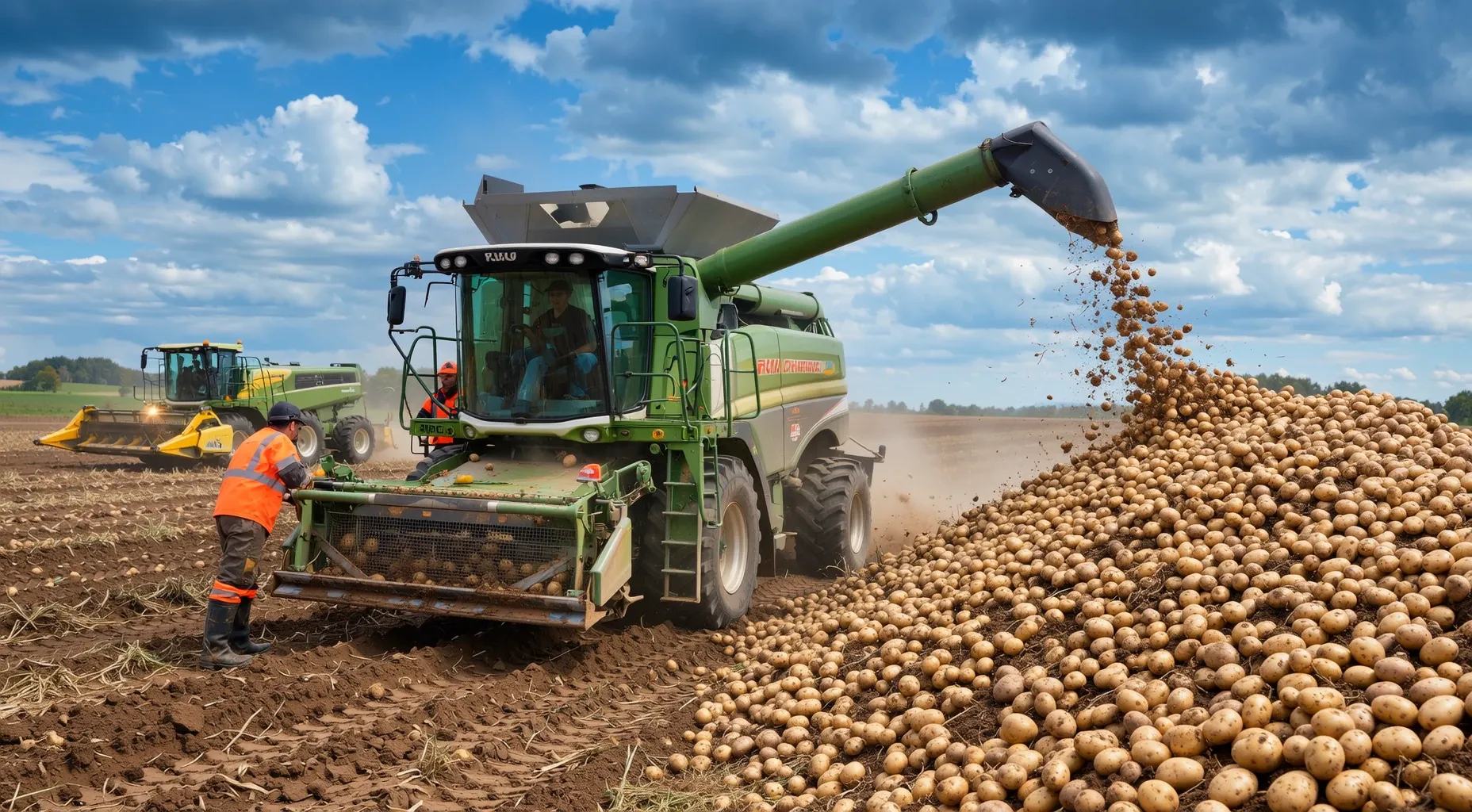
Potato Farming
Description
Establishments in this industry focus on cultivating potato crops for commercial sale or producing seed potatoes intended for replanting. These operations engage in intensive agricultural management, including soil preparation, seeding, irrigation, pest control, and harvesting. The production process often involves specialized techniques to ensure uniform size and quality, particularly for varieties designated as seed stock, which require stringent handling to maintain genetic integrity. Farmers and agricultural corporations operate within this sector, ranging from small family-owned farms to large-scale commercial agribusinesses. Some entities may also offer value-added services such as cleaning, sorting, grading, and packaging at the farm gate before distribution. The scale of operations varies significantly, yet the primary objective remains consistent: generating high-yield, marketable produce. While most potatoes are grown in open fields, some establishments utilize hydroponic or controlled environment systems in specific regions to extend the growing season or meet niche market demands. This sector serves as a critical link in the global food supply chain, supplying fresh produce for supermarkets, restaurants, and processing facilities. Understanding the unique environmental and operational challenges of potato cultivation distinguishes these businesses from other crop producers, requiring specialized knowledge of soil dynamics and crop lifecycle management throughout the year.
Hierarchy
| Code | Title | Description |
|---|---|---|
| 11 | Agriculture, Forestry, Fishing and Hunting 2-digit sector | The Sector as a Whole The Agriculture, Forestry, Fishing and Hunting sector comprises establishments primarily engaged in growing crops, raising animals, harvesting timber, and harvesting fish and other animals from a farm, ranch, or their natural habitats. The establishments in this sector are often described as farms, ranches, dairies, greenhouses, nurseries, orchards, or hatcheries. A farm may consist of a single tract of land or a number of separate tracts which may be held under different tenures. For example, one tract may be owned by the farm operator and another rented. It may be operated by the operator alone or with the assistance of members of the household or hired employees, or it may be operated by a partnership, corporation, or other type of organization. When a landowner has one or more tenants, renters, croppers, or managers, the land operated by each is considered a farm. The sector distinguishes two basic activities: agricultural production and agricultural support activities. Agricultural production includes establishments performing the complete farm or ranch operation, such as farm owner-operators and tenant farm operators. Agricultural support activities include establishments that perform one or more activities associated with farm operation, such as soil preparation, planting, harvesting, and management, on a contract or fee basis. Excluded from the Agriculture, Forestry, Fishing and Hunting sector are establishments primarily engaged in agricultural research (e.g., experimental farms) and government establishments primarily engaged in administering programs for regulating and conserving land, mineral, wildlife, and forest use. These establishments are classified in Industry 54171, Research and Development in the Physical, Engineering, and Life Sciences; and Industry 92412, Administration of Conservation Programs, respectively. |
| 111 | Crop Production 3-digit subsector | Industries in the Crop Production subsector grow crops mainly for food and fiber. The subsector comprises establishments, such as farms, orchards, groves, greenhouses, and nurseries, primarily engaged in growing crops, plants, vines, or trees and their seeds. The industries in this subsector are grouped by similarity of production activity, including biological and physiological characteristics and economic requirements, the length of growing season, degree of crop rotation, extent of input specialization, labor requirements, and capital demands. The production process is typically completed when the raw product or commodity grown reaches the "farm gate" for market, that is, at the point of first sale or price determination. Establishments are classified in the Crop Production subsector when crop production (i.e., value of crops for market) accounts for one-half or more of the establishment's total agricultural production. Within the subsector, establishments are classified in a specific industry when a product or industry family of products (i.e., oilseed and grain farming, vegetable and melon farming, fruit and tree nut farming) account for one-half or more of the establishment's agricultural production. Establishments with one-half or more crop production with no one product or family of products of an industry accounting for one-half of the establishment's agricultural production are treated as general combination crop farming and are classified in Industry 11199, All Other Crop Farming. Industries in the Crop Production subsector include establishments that own, operate, and manage and those that operate and manage. Those that manage only are classified in Subsector 115, Support Activities for Agriculture and Forestry. Establishments that raise aquatic plants in controlled or selected aquatic environments are classified in Subsector 112, Animal Production and Aquaculture. |
| 1112 | Vegetable and Melon Farming 4-digit industry group | Industries in the Crop Production subsector grow crops mainly for food and fiber. The subsector comprises establishments, such as farms, orchards, groves, greenhouses, and nurseries, primarily engaged in growing crops, plants, vines, or trees and their seeds. The industries in this subsector are grouped by similarity of production activity, including biological and physiological characteristics and economic requirements, the length of growing season, degree of crop rotation, extent of input specialization, labor requirements, and capital demands. The production process is typically completed when the raw product or commodity grown reaches the "farm gate" for market, that is, at the point of first sale or price determination. Establishments are classified in the Crop Production subsector when crop production (i.e., value of crops for market) accounts for one-half or more of the establishment's total agricultural production. Within the subsector, establishments are classified in a specific industry when a product or industry family of products (i.e., oilseed and grain farming, vegetable and melon farming, fruit and tree nut farming) account for one-half or more of the establishment's agricultural production. Establishments with one-half or more crop production with no one product or family of products of an industry accounting for one-half of the establishment's agricultural production are treated as general combination crop farming and are classified in Industry 11199, All Other Crop Farming. Industries in the Crop Production subsector include establishments that own, operate, and manage and those that operate and manage. Those that manage only are classified in Subsector 115, Support Activities for Agriculture and Forestry. Establishments that raise aquatic plants in controlled or selected aquatic environments are classified in Subsector 112, Animal Production and Aquaculture. |
| 11121 | Vegetable and Melon Farming 5-digit NAICS industry | This industry comprises establishments primarily engaged in one or more of the following: (1) growing vegetable and/or melon crops; (2) producing vegetable and/or melon seeds; and (3) growing vegetable and/or melon bedding plants. The crops included in this industry have an annual growth cycle and are grown in open fields. Climate and cultural practices limit producing areas but often permit the growing of a combination of crops in a year. |
| 111211 | Potato Farming 6-digit U.S. detail | Establishments in this industry focus on cultivating potato crops for commercial sale or producing seed potatoes intended for replanting. These operations engage in intensive agricultural management, including soil preparation, seeding, irrigation, pest control, and harvesting. The production process often involves specialized techniques to ensure uniform size and quality, particularly for varieties designated as seed stock, which require stringent handling to maintain genetic integrity. Farmers and agricultural corporations operate within this sector, ranging from small family-owned farms to large-scale commercial agribusinesses. Some entities may also offer value-added services such as cleaning, sorting, grading, and packaging at the farm gate before distribution. The scale of operations varies significantly, yet the primary objective remains consistent: generating high-yield, marketable produce. While most potatoes are grown in open fields, some establishments utilize hydroponic or controlled environment systems in specific regions to extend the growing season or meet niche market demands. This sector serves as a critical link in the global food supply chain, supplying fresh produce for supermarkets, restaurants, and processing facilities. Understanding the unique environmental and operational challenges of potato cultivation distinguishes these businesses from other crop producers, requiring specialized knowledge of soil dynamics and crop lifecycle management throughout the year. |
Need a supply chain stack that maps to this industry?
Use this NAICS classification as the starting point, then connect it to Item workflows across inventory, warehousing, order management, fulfillment, and transportation.
Classification References
- 01Establishments primarily engaged in canning or drying potatoes are classified in Industry 31142, Fruit and Vegetable Canning, Pickling, and Drying.
Index Items
Potato farming, field and seed potato production
Sweet potato farming, field and seed potato production
Vegetable and melon farming, potato dominant crop, field and seed production
Vegetable and potato farming, potato dominant crop, field and seed potato production
Yam farming, field and seed production
How Item Can Help
Transportation Management System coordinates the delivery of temperature-sensitive produce from field to market, reducing transit time and maintaining quality during distribution.
Item.com Tools
External Resources
Census.gov NAICS Detail
Official US Census Bureau definition and scope for NAICS 111211.
Potato Growers Association
The primary trade association representing potato producers in North America.
USDA NASS Potato Production Statistics
Official government data on potato harvest, acreage, and yield from the National Agricultural Statistics Service.
National Potato Council
An industry organization focused on research, education, and promoting the potato crop in the United States.
