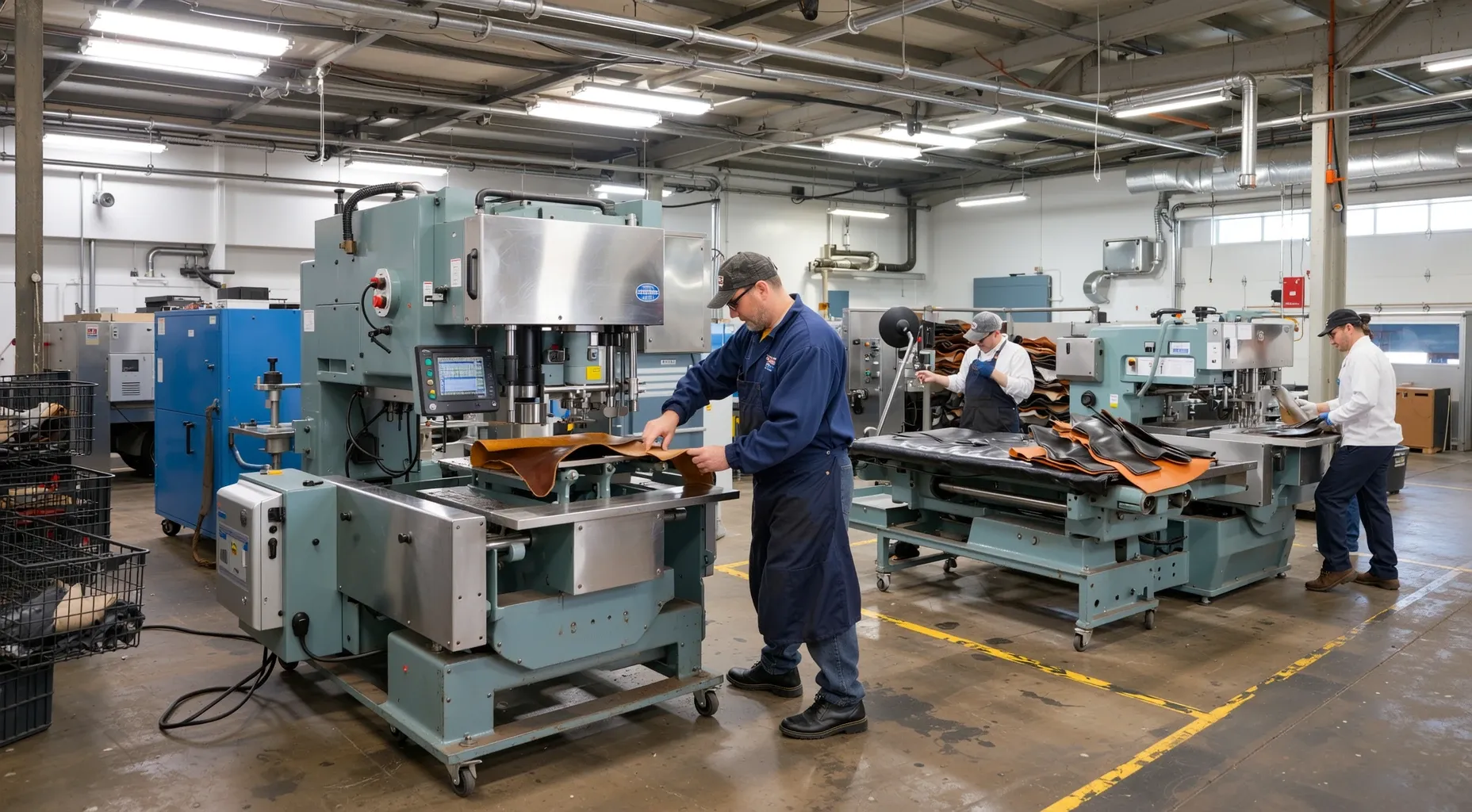
Other Leather and Allied Product Manufacturing
Description
This industry comprises establishments primarily engaged in manufacturing leather products (except footwear and apparel) from purchased leather or leather substitutes (e.g., fabric, plastics). Illustrative Examples: Billfolds, all materials, manufacturing Boot and shoe cut stock and findings, leather, manufacturing Dog furnishings (e.g., collars, harnesses, leashes, muzzles), manufacturing Luggage, all materials, manufacturing Shoe soles, leather, manufacturing Purses, women's, all materials (except metal), manufacturing Toilet kits and cases (except metal) manufacturing Watch bands (except metal) manufacturing Welders' jackets, leggings, and sleeves, leather, manufacturing
Hierarchy
| Code | Title | Description |
|---|---|---|
| 31 | Manufacturing 2-digit sector | The Sector as a Whole The Manufacturing sector comprises establishments engaged in the mechanical, physical, or chemical transformation of materials, substances, or components into new products. The assembling of component parts of manufactured products is considered manufacturing, except in cases where the activity is appropriately classified in Sector 23, Construction. Establishments in the Manufacturing sector are often described as plants, factories, or mills and characteristically use power-driven machines and material handling equipment. However, establishments that transform materials or substances into new products by hand or in the worker's home and those engaged in selling to the general public products made on the same premises from which they are sold, such as bakeries, candy stores, and custom tailors, may also be included in this sector. Manufacturing establishments may process materials or may contract with other establishments to process their materials for them. Both types of establishments are included in manufacturing. Selected industries in the Manufacturing sector are comprised solely of establishments that process materials for other establishments on a contract or fee basis. Beyond these dedicated contract manufacturing industries, establishments that process materials for other establishments are generally classified in the Manufacturing industry of the processed materials. The materials, substances, or components transformed by manufacturing establishments are raw materials that are products of agriculture, forestry, fishing, mining, or quarrying as well as products of other manufacturing establishments. The materials used may be purchased directly from producers, obtained through customary trade channels, or secured without recourse to the market by transferring the product from one establishment to another, under the same ownership. The new product of a manufacturing establishment may be finished in the sense that it is ready for utilization or consumption, or it may be semi-finished to become an input for an establishment engaged in further manufacturing. For example, the product of the alumina refinery is the input used in the primary production of aluminum; primary aluminum is the input to an aluminum wire drawing plant; and aluminum wire is the input for a fabricated wire product manufacturing establishment. The subsectors in the Manufacturing sector generally reflect distinct production processes related to material inputs, production equipment, and employee skills. In the machinery area, where assembling is a key activity, parts and accessories for manufactured products are classified in the industry of the finished manufactured item when they are made for separate sale. For example, an attachment for a piece of metalworking machinery would be classified with metalworking machinery. However, component inputs from other manufacturing establishments are classified based on the production function of the component manufacturer. For example, electronic components are classified in Subsector 334, Computer and Electronic Product Manufacturing, and stampings are classified in Subsector 332, Fabricated Metal Product Manufacturing. Manufacturing establishments often perform one or more activities that are classified outside the Manufacturing sector of NAICS. For instance, almost all manufacturing has some captive research and development or administrative operations, such as accounting, payroll, or management. These captive services are treated the same as captive manufacturing activities. When the services are provided by separate establishments, they are classified in the NAICS sector where such services are primary, not in manufacturing. The boundaries of manufacturing and the other sectors of the classification system can be somewhat blurry. The establishments in the Manufacturing sector are engaged in the transformation of materials into new products. Their output is a new product. However, the definition of what constitutes a new product can be somewhat subjective. As clarification, the following activities are considered manufacturing in NAICS: <table width=100%><tr><td width=10%> </td><td><dl><dt style='padding-left: 10px; text-indent: -10px;'>Milk bottling and pasteurizing;</dt><dt style='padding-left: 10px; text-indent: -10px;'>Water bottling and processing;</dt><dt style='padding-left: 10px; text-indent: -10px;'>Fresh fish packaging (oyster<br/> shucking, fish filleting);</dt><dt style='padding-left: 10px; text-indent: -10px;'>Apparel jobbing (assigning<br/> materials to contract<br/> factories or shops for<br/> fabrication or other contract<br/> operations) as well as<br/> contracting on materials<br/> owned by others;</dt><dt style='padding-left: 10px; text-indent: -10px;'>Printing and related activities;</dt><dt style='padding-left: 10px; text-indent: -10px;'>Ready-mix concrete production;</dt><dt style='padding-left: 10px; text-indent: -10px;'>Leather converting;</dt><dt style='padding-left: 10px; text-indent: -10px;'>Grinding lenses to<br/> prescription;</dt><dt style='padding-left: 10px; text-indent: -10px;'>Wood preserving;</dt><dt style='padding-left: 10px; text-indent: -10px;'>Lapidary work for the trade;</dt></dl></td><td width=10%> </td><td><dl><dt style='padding-left: 10px; text-indent: -10px;'>Electroplating, plating, metal<br/> heat treating, and<br/> polishing for the trade;</dt><dt style='padding-left: 10px; text-indent: -10px;'>Fabricating signs and<br/> advertising displays;</dt><dt style='padding-left: 10px; text-indent: -10px;'>Rebuilding or remanufacturing<br/> machinery (i.e., automotive<br/> parts);</dt><dt style='padding-left: 10px; text-indent: -10px;'>Making manufactured homes<br/> (i.e., mobile homes) or<br/> prefabricated buildings,<br/> whether or not assembling/<br/> erecting at the customers'<br/> site;</dt><dt style='padding-left: 10px; text-indent: -10px;'>Ship repair and renovation;</dt><dt style='padding-left: 10px; text-indent: -10px;'>Machine shops; and</dt><dt style='padding-left: 10px; text-indent: -10px;'>Tire retreading.</dt></dl></td><td width=10%> </td></tr></table> Conversely, there are activities that are sometimes considered manufacturing, but which for NAICS are classified in another sector (i.e., not classified as manufacturing). They include: 1. Logging, classified in Sector 11, Agriculture, Forestry, Fishing and Hunting, is considered a harvesting operation; 2. Beneficiating ores and other minerals, classified in Sector 21, Mining, Quarrying, and Oil and Gas Extraction, is considered part of the activity of mining; 3. Constructing structures, assembling prefabricated buildings, and fabricating at the construction site by contractors are classified in Sector 23, Construction; 4. Breaking bulk and reselling in smaller lots, including packaging, repackaging, or bottling products, such as liquors or chemicals; assembling and selling computers on a custom basis; sorting and reselling scrap; mixing and selling paints to customer order; and cutting metals to customer order for resale are classified in Sector 42, Wholesale Trade, or Sector 44-45, Retail Trade; and 5. Publishing and the combined activity of publishing and printing, classified in Sector 51, Information, transform information into a product for which the value to the consumer lies in the information content, not in the format in which it is distributed (i.e., the book or software compact disc). |
| 316 | Leather and Allied Product Manufacturing 3-digit subsector | Establishments in the Leather and Allied Product Manufacturing subsector transform hides into leather by tanning or curing and fabricating the leather into products for final consumption. This subsector also includes the manufacture of similar products from other materials, including products (except apparel) made from "leather substitutes," such as rubber, plastics, or textiles. Rubber footwear, textile luggage, and plastics purses or wallets are examples of "leather substitute" products included in this subsector. The products made from leather substitutes are included in this subsector because they are made in similar ways leather products are made (e.g., luggage). They are made in the same establishments, so it is not practical to separate them. The inclusion of leather and hide tanning and finishing in this subsector is partly because it is a relatively small industry that has few close neighbors as a production process, partly because leather is an input to some of the other products classified in this subsector, and partly for historical reasons. |
| 3169 | Other Leather and Allied Product Manufacturing 4-digit industry group | Establishments in the Leather and Allied Product Manufacturing subsector transform hides into leather by tanning or curing and fabricating the leather into products for final consumption. This subsector also includes the manufacture of similar products from other materials, including products (except apparel) made from "leather substitutes," such as rubber, plastics, or textiles. Rubber footwear, textile luggage, and plastics purses or wallets are examples of "leather substitute" products included in this subsector. The products made from leather substitutes are included in this subsector because they are made in similar ways leather products are made (e.g., luggage). They are made in the same establishments, so it is not practical to separate them. The inclusion of leather and hide tanning and finishing in this subsector is partly because it is a relatively small industry that has few close neighbors as a production process, partly because leather is an input to some of the other products classified in this subsector, and partly for historical reasons. |
| 31699 | Other Leather and Allied Product Manufacturing 5-digit NAICS industry | See industry description for 316990. |
| 316990 | Other Leather and Allied Product Manufacturing 6-digit U.S. detail | This industry comprises establishments primarily engaged in manufacturing leather products (except footwear and apparel) from purchased leather or leather substitutes (e.g., fabric, plastics). Illustrative Examples: Billfolds, all materials, manufacturing Boot and shoe cut stock and findings, leather, manufacturing Dog furnishings (e.g., collars, harnesses, leashes, muzzles), manufacturing Luggage, all materials, manufacturing Shoe soles, leather, manufacturing Purses, women's, all materials (except metal), manufacturing Toilet kits and cases (except metal) manufacturing Watch bands (except metal) manufacturing Welders' jackets, leggings, and sleeves, leather, manufacturing |
Need a supply chain stack that maps to this industry?
Use this NAICS classification as the starting point, then connect it to Item workflows across inventory, warehousing, order management, fulfillment, and transportation.
Classification References
- 01Manufacturing leather apparel--are classified in Industry 315250, Cut and Sew Apparel Manufacturing (except Contractors);
- 02Manufacturing leather gloves, mittens, belts, and apparel accessories--are classified in Industry 315990, Apparel Accessories and Other Apparel Manufacturing;
- 03Manufacturing footwear--are classified in Industry 316210, Footwear Manufacturing;
- 04Manufacturing nonleather soles--are classified elsewhere based on the primary input material;
- 05Manufacturing small articles made of metal carried on or about the person, including precious metal handbags and purses--are classified in Industry 339910, Jewelry and Silverware Manufacturing; and
- 06Manufacturing leather gaskets--are classified in U.S. Industry 339991, Gasket, Packing, and Sealing Device Manufacturing.
Index Items
Aprons for textile machinery, leather, manufacturing
Aprons, leather (e.g., blacksmith's, welder's), manufacturing
Attache cases, all materials, manufacturing
Bags (i.e., luggage), all materials, manufacturing
Bags, athletic, manufacturing
Belt laces, leather, manufacturing
Belting for machinery, leather, manufacturing
Belts, leather safety, manufacturing
Billfolds (except metal) manufacturing
Binocular cases manufacturing
Blacksmith's aprons, leather, manufacturing
Boot and shoe cut stock and findings, leather, manufacturing
Bows, shoe, leather, manufacturing
Box toes (i.e., shoe cut stock), leather, manufacturing
Boxes, hat (except paper or paperboard), manufacturing
Boxes, leather, manufacturing
Briefcases, all materials, manufacturing
Camera carrying bags, all materials, manufacturing
Caps, heel and toe, leather, manufacturing
Card cases (except metal) manufacturing
Cases, jewelry (except metal), manufacturing
Cases, luggage, manufacturing
Cases, musical instrument, manufacturing
Checkbook covers (except metal) manufacturing
Cigar cases (except metal) manufacturing
Cigarette cases (except metal) manufacturing
Clasps, shoe (leather), manufacturing
Coin purses (except metal) manufacturing
Collars and collar pads (i.e., harness) manufacturing
Collars, dog, manufacturing
Comb cases (except metal) manufacturing
Compacts, solid leather, manufacturing
Corners, luggage, leather, manufacturing
Cosmetic bags (except metal) manufacturing
Counters (i.e., shoe cut stock), leather, manufacturing
Crops, riding, manufacturing
Cut stock for boots and shoes manufacturing
Desk sets, leather, manufacturing
Dog furnishings (e.g., collars, harnesses, leashes, muzzles) manufacturing
Eyeglass cases (except metal) manufacturing
Feed bags for horses manufacturing
Findings, boot and shoe, manufacturing
Handbags, all materials (except precious metal), manufacturing
Handles (e.g., luggage, whip), leather, manufacturing
Harnesses and harness parts, leather, manufacturing
Harnesses, dog, manufacturing
Heel caps, leather or metal, manufacturing
Heel lifts, leather, manufacturing
Heels, boot and shoe, leather, manufacturing
Holsters, leather, manufacturing
Horse boots and muzzles manufacturing
Inner soles, leather, manufacturing
Jackets, welder's, leather, manufacturing
Key cases (except metal) manufacturing
Laces (e.g., shoe), leather, manufacturing
Lashes (i.e., whips) manufacturing
Leashes, dog, manufacturing
Leather belting manufacturing
Leather cut stock for shoe and boot manufacturing
Leather goods, small personal (e.g., coin purses, eyeglass cases, key cases), manufacturing
Leather handbags and purses manufacturing
Leather luggage manufacturing
Leather welting manufacturing
Leggings, welder's, leather, manufacturing
Lifts, heel, leather, manufacturing
Linings, boot and shoe, leather, manufacturing
Luggage, all materials, manufacturing
Mill strapping for textile mills, leather, manufacturing
Musical instrument cases, all materials, manufacturing
Novelties, leather (e.g., cigarette lighter covers, key fobs), manufacturing
Pegs, leather shoe, manufacturing
Personal leather goods (e.g., coin purses, eyeglass cases, key cases), small, manufacturing
Purses (except precious metal) manufacturing
Quarters (i.e., shoe cut stock), leather, manufacturing
Rands (i.e., shoe cut stock), leather, manufacturing
Razor strops manufacturing
Riding crops manufacturing
Saddles and parts, leather, manufacturing
Safety belts, leather, manufacturing
Sample cases, all materials, manufacturing
Satchels, all materials, manufacturing
Seatbelts, leather, manufacturing
Sewing cases (except metal) manufacturing
Shanks, shoe, leather, manufacturing
Shoe kits (i.e., cases), all materials, manufacturing
Shoe soles, leather, manufacturing
Sleeves, welder's, leather, manufacturing
Soles, boot and shoe, leather, manufacturing
Spats, leather, manufacturing
Stays, shoe, leather, manufacturing
Straps, leather, manufacturing
Straps, watch (except metal), manufacturing
Suitcases, all materials, manufacturing
Taps, shoe, leather, manufacturing
Textile leathers (e.g., apron picker leather, mill strapping) manufacturing
Tips, shoe, leather, manufacturing
Tobacco pouches (except metal) manufacturing
Toe caps, leather, manufacturing
Toilet kits and cases (except metal) manufacturing
Tongues, boot and shoe, leather, manufacturing
Top lifts, boot and shoe, leather, manufacturing
Transmission belting, leather, manufacturing
Traveling bags, all materials, manufacturing
Trimmings, shoe, leather, manufacturing
Trunks (i.e., luggage), all materials, manufacturing
Uppers (i.e., shoe cut stock), leather, manufacturing
Valises, all materials, manufacturing
Vamps, leather, manufacturing
Vanity cases, leather, manufacturing
Wallets (except metal) manufacturing
Wardrobe bags (i.e., luggage) manufacturing
Watch bands (except metal) manufacturing
Welders' aprons, leather, manufacturing
Welders' jackets, leggings, and sleeves, leather, manufacturing
Whips, horse, manufacturing
Whipstocks manufacturing
How Item Can Help
Item WMS helps all other leather good and allied product manufacturing operators manage warehouse inventory, track stock movements, and streamline order fulfillment.
Item OMS enables all other leather good and allied product manufacturing businesses to manage multi-channel orders, automate routing, and reduce fulfillment errors.
Item Data Intelligence gives all other leather good and allied product manufacturing companies real-time visibility into logistics KPIs and supply chain performance.
