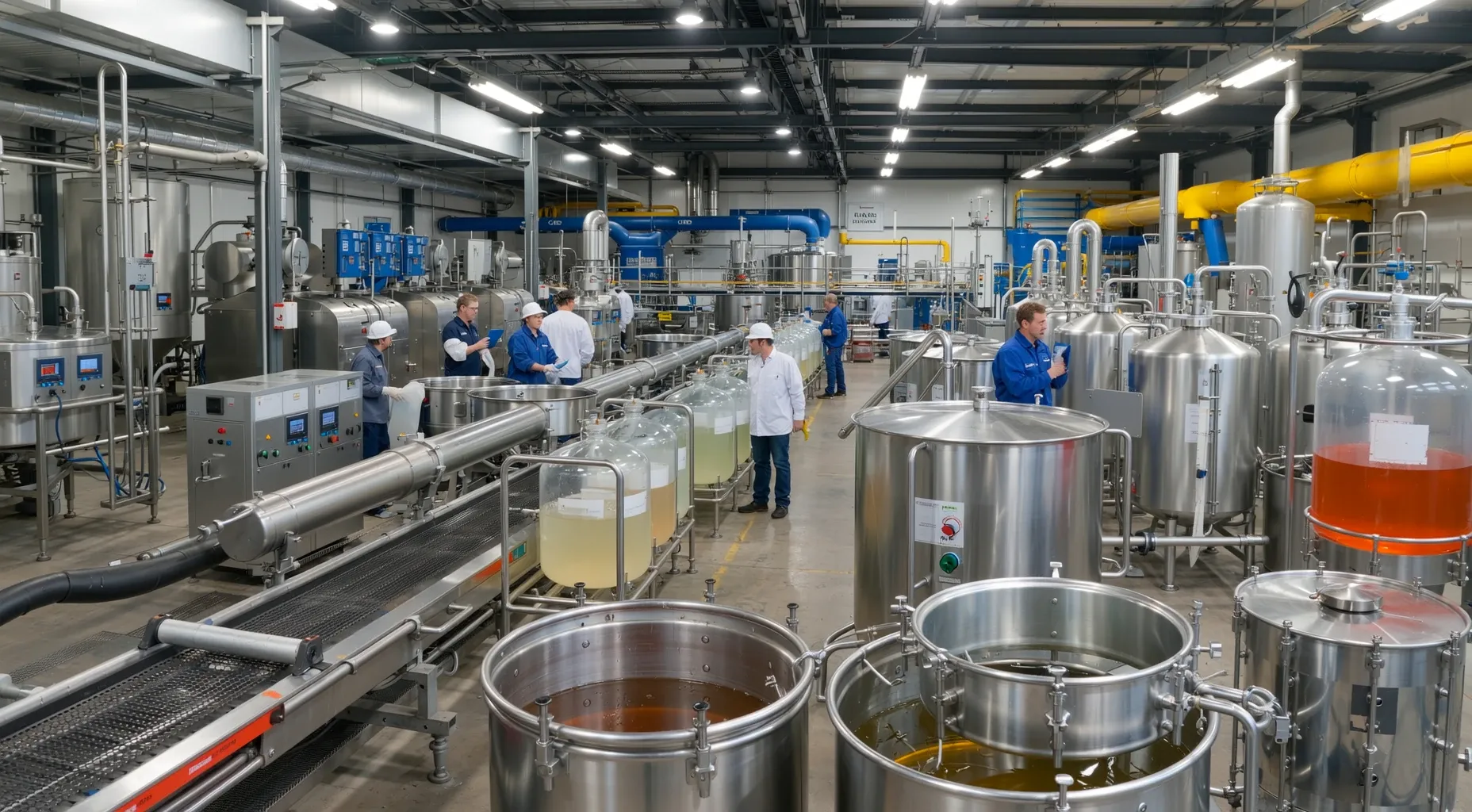
All Other Basic Organic Chemical Manufacturing
Description
This U.S. industry comprises establishments primarily engaged in manufacturing basic organic chemical products (except aromatic petrochemicals, industrial gases, synthetic organic dyes and pigments, gum and wood chemicals, cyclic crudes and intermediates, and ethyl alcohol). Illustrative Examples: Biodiesel fuels not made in petroleum refineries and not blended with petroleum Calcium organic compounds, not specified elsewhere by process, manufacturing Carbon organic compounds, not specified elsewhere by process, manufacturing Enzyme proteins (i.e., basic synthetic chemicals) (except pharmaceutical use) manufacturing Organo-inorganic compound manufacturing Fatty acids (e.g., margaric, oleic, stearic) manufacturing Plasticizers (i.e., basic synthetic chemicals) manufacturing Raw organic waxes manufacturing Refrigerant mixtures and blends manufacturing Silicone (except resins) manufacturing Synthetic sweeteners (i.e., sweetening agents) manufacturing
Hierarchy
| Code | Title | Description |
|---|---|---|
| 32 | Manufacturing 2-digit sector | The Sector as a Whole The Manufacturing sector comprises establishments engaged in the mechanical, physical, or chemical transformation of materials, substances, or components into new products. The assembling of component parts of manufactured products is considered manufacturing, except in cases where the activity is appropriately classified in Sector 23, Construction. Establishments in the Manufacturing sector are often described as plants, factories, or mills and characteristically use power-driven machines and material handling equipment. However, establishments that transform materials or substances into new products by hand or in the worker's home and those engaged in selling to the general public products made on the same premises from which they are sold, such as bakeries, candy stores, and custom tailors, may also be included in this sector. Manufacturing establishments may process materials or may contract with other establishments to process their materials for them. Both types of establishments are included in manufacturing. Selected industries in the Manufacturing sector are comprised solely of establishments that process materials for other establishments on a contract or fee basis. Beyond these dedicated contract manufacturing industries, establishments that process materials for other establishments are generally classified in the Manufacturing industry of the processed materials. The materials, substances, or components transformed by manufacturing establishments are raw materials that are products of agriculture, forestry, fishing, mining, or quarrying as well as products of other manufacturing establishments. The materials used may be purchased directly from producers, obtained through customary trade channels, or secured without recourse to the market by transferring the product from one establishment to another, under the same ownership. The new product of a manufacturing establishment may be finished in the sense that it is ready for utilization or consumption, or it may be semi-finished to become an input for an establishment engaged in further manufacturing. For example, the product of the alumina refinery is the input used in the primary production of aluminum; primary aluminum is the input to an aluminum wire drawing plant; and aluminum wire is the input for a fabricated wire product manufacturing establishment. The subsectors in the Manufacturing sector generally reflect distinct production processes related to material inputs, production equipment, and employee skills. In the machinery area, where assembling is a key activity, parts and accessories for manufactured products are classified in the industry of the finished manufactured item when they are made for separate sale. For example, an attachment for a piece of metalworking machinery would be classified with metalworking machinery. However, component inputs from other manufacturing establishments are classified based on the production function of the component manufacturer. For example, electronic components are classified in Subsector 334, Computer and Electronic Product Manufacturing, and stampings are classified in Subsector 332, Fabricated Metal Product Manufacturing. Manufacturing establishments often perform one or more activities that are classified outside the Manufacturing sector of NAICS. For instance, almost all manufacturing has some captive research and development or administrative operations, such as accounting, payroll, or management. These captive services are treated the same as captive manufacturing activities. When the services are provided by separate establishments, they are classified in the NAICS sector where such services are primary, not in manufacturing. The boundaries of manufacturing and the other sectors of the classification system can be somewhat blurry. The establishments in the Manufacturing sector are engaged in the transformation of materials into new products. Their output is a new product. However, the definition of what constitutes a new product can be somewhat subjective. As clarification, the following activities are considered manufacturing in NAICS: <table width=100%><tr><td width=10%> </td><td><dl><dt style='padding-left: 10px; text-indent: -10px;'>Milk bottling and pasteurizing;</dt><dt style='padding-left: 10px; text-indent: -10px;'>Water bottling and processing;</dt><dt style='padding-left: 10px; text-indent: -10px;'>Fresh fish packaging (oyster<br/> shucking, fish filleting);</dt><dt style='padding-left: 10px; text-indent: -10px;'>Apparel jobbing (assigning<br/> materials to contract<br/> factories or shops for<br/> fabrication or other contract<br/> operations) as well as<br/> contracting on materials<br/> owned by others;</dt><dt style='padding-left: 10px; text-indent: -10px;'>Printing and related activities;</dt><dt style='padding-left: 10px; text-indent: -10px;'>Ready-mix concrete production;</dt><dt style='padding-left: 10px; text-indent: -10px;'>Leather converting;</dt><dt style='padding-left: 10px; text-indent: -10px;'>Grinding lenses to<br/> prescription;</dt><dt style='padding-left: 10px; text-indent: -10px;'>Wood preserving;</dt><dt style='padding-left: 10px; text-indent: -10px;'>Lapidary work for the trade;</dt></dl></td><td width=10%> </td><td><dl><dt style='padding-left: 10px; text-indent: -10px;'>Electroplating, plating, metal<br/> heat treating, and<br/> polishing for the trade;</dt><dt style='padding-left: 10px; text-indent: -10px;'>Fabricating signs and<br/> advertising displays;</dt><dt style='padding-left: 10px; text-indent: -10px;'>Rebuilding or remanufacturing<br/> machinery (i.e., automotive<br/> parts);</dt><dt style='padding-left: 10px; text-indent: -10px;'>Making manufactured homes<br/> (i.e., mobile homes) or<br/> prefabricated buildings,<br/> whether or not assembling/<br/> erecting at the customers'<br/> site;</dt><dt style='padding-left: 10px; text-indent: -10px;'>Ship repair and renovation;</dt><dt style='padding-left: 10px; text-indent: -10px;'>Machine shops; and</dt><dt style='padding-left: 10px; text-indent: -10px;'>Tire retreading.</dt></dl></td><td width=10%> </td></tr></table> Conversely, there are activities that are sometimes considered manufacturing, but which for NAICS are classified in another sector (i.e., not classified as manufacturing). They include: 1. Logging, classified in Sector 11, Agriculture, Forestry, Fishing and Hunting, is considered a harvesting operation; 2. Beneficiating ores and other minerals, classified in Sector 21, Mining, Quarrying, and Oil and Gas Extraction, is considered part of the activity of mining; 3. Constructing structures, assembling prefabricated buildings, and fabricating at the construction site by contractors are classified in Sector 23, Construction; 4. Breaking bulk and reselling in smaller lots, including packaging, repackaging, or bottling products, such as liquors or chemicals; assembling and selling computers on a custom basis; sorting and reselling scrap; mixing and selling paints to customer order; and cutting metals to customer order for resale are classified in Sector 42, Wholesale Trade, or Sector 44-45, Retail Trade; and 5. Publishing and the combined activity of publishing and printing, classified in Sector 51, Information, transform information into a product for which the value to the consumer lies in the information content, not in the format in which it is distributed (i.e., the book or software compact disc). |
| 325 | Chemical Manufacturing 3-digit subsector | The Chemical Manufacturing subsector is based on the transformation of organic and inorganic raw materials by a chemical process and the formulation of products. This subsector distinguishes the production of basic chemicals that comprise the first industry group from the production of intermediate and end products produced by further processing of basic chemicals that make up the remaining industry groups. This subsector does not include all industries transforming raw materials by a chemical process. It is common for some chemical processing to occur during mining operations. These beneficiating operations, such as copper concentrating, are classified in Sector 21, Mining, Quarrying, and Oil and Gas Extraction. Furthermore, the refining of crude petroleum is included in Subsector 324, Petroleum and Coal Products Manufacturing. In addition, the manufacturing of aluminum oxide is included in Subsector 331, Primary Metal Manufacturing; and beverage distilleries are classified in Subsector 312, Beverage and Tobacco Product Manufacturing. As is the case of these two activities, the grouping of industries into subsectors may take into account the association of the activities performed with other activities in the subsector. |
| 3251 | Basic Chemical Manufacturing 4-digit industry group | This industry group comprises establishments primarily engaged in manufacturing chemicals using basic processes, such as thermal cracking and distillation. Chemicals manufactured in this industry group are usually separate chemical elements or separate chemically-defined compounds. |
| 32519 | Other Basic Organic Chemical Manufacturing 5-digit NAICS industry | This industry comprises establishments primarily engaged in manufacturing basic organic chemicals (except petrochemicals, industrial gases, and synthetic dyes and pigments). Illustrative Examples: Biodiesel fuels not made in petroleum refineries and not blended with petroleum Carbon organic compounds, not specified elsewhere by process, manufacturing Cyclic intermediates made from refined petroleum or natural gas (except aromatic petrochemicals) Enzyme proteins (i.e., basic synthetic chemicals) (except pharmaceutical use) manufacturing Gum and wood chemicals manufacturing Fatty acids (e.g., margaric, oleic, stearic) manufacturing Organo-inorganic compound manufacturing Plasticizers (i.e., basic synthetic chemical) manufacturing Silicone (except resins) manufacturing Synthetic sweeteners (i.e., sweetening agents) manufacturing |
| 325199 | All Other Basic Organic Chemical Manufacturing 6-digit U.S. detail | This U.S. industry comprises establishments primarily engaged in manufacturing basic organic chemical products (except aromatic petrochemicals, industrial gases, synthetic organic dyes and pigments, gum and wood chemicals, cyclic crudes and intermediates, and ethyl alcohol). Illustrative Examples: Biodiesel fuels not made in petroleum refineries and not blended with petroleum Calcium organic compounds, not specified elsewhere by process, manufacturing Carbon organic compounds, not specified elsewhere by process, manufacturing Enzyme proteins (i.e., basic synthetic chemicals) (except pharmaceutical use) manufacturing Organo-inorganic compound manufacturing Fatty acids (e.g., margaric, oleic, stearic) manufacturing Plasticizers (i.e., basic synthetic chemicals) manufacturing Raw organic waxes manufacturing Refrigerant mixtures and blends manufacturing Silicone (except resins) manufacturing Synthetic sweeteners (i.e., sweetening agents) manufacturing |
Need a supply chain stack that maps to this industry?
Use this NAICS classification as the starting point, then connect it to Item workflows across inventory, warehousing, order management, fulfillment, and transportation.
Classification References
- 01Manufacturing aromatic petrochemicals from refined petroleum or natural gas--are classified in Industry 325110, Petrochemical Manufacturing;
- 02Manufacturing aromatic petrochemicals or biodiesel fuels by refining crude petroleum--are classified in Industry 324110, Petroleum Refineries;
- 03Blending purchased biodiesel fuels and purchased refined petroleum--are classified in U.S. Industry 324199, All Other Petroleum and Coal Products Manufacturing;
- 04Manufacturing organic industrial gases--are classified in Industry 325120, Industrial Gas Manufacturing;
- 05Manufacturing synthetic organic dyes and pigments--are classified in Industry 325130, Synthetic Dye and Pigment Manufacturing;
- 06Manufacturing ethyl alcohol--are classified in U.S. Industry 325193, Ethyl Alcohol Manufacturing;
- 07Manufacturing organic insecticidal, herbicidal, fungicidal, and pesticidal preparations--are classified in Industry 325320, Pesticide and Other Agricultural Chemical Manufacturing;
- 08Manufacturing elastomers--are classified in Industry 32521, Resin and Synthetic Rubber Manufacturing;
- 09Manufacturing urea--are classified in U.S. Industry 325311, Nitrogenous Fertilizer Manufacturing;
- 10Manufacturing pharmaceuticals, medicines, and dietary supplements--are classified in Industry Group 3254, Pharmaceutical and Medicine Manufacturing;
- 11Manufacturing natural glycerin--are classified in U.S. Industry 325611, Soap and Other Detergent Manufacturing; and
- 12Manufacturing natural food colorings--are classified in U.S. Industry 311942, Spice and Extract Manufacturing.
Index Items
Accelerators (i.e., basic synthetic chemical) manufacturing
Acetaldehyde manufacturing
Acetates, not specified elsewhere by process, manufacturing
Acetic acid manufacturing
Acetic anhydride manufacturing
Acetin manufacturing
Acetone, synthetic, manufacturing
Acid esters, not specified elsewhere by process, manufacturing
Acids, organic, not specified elsewhere by process, manufacturing
Acrolein manufacturing
Acrylonitrile manufacturing
Adipic acid esters or amines manufacturing
Adipic acid manufacturing
Adiponitrile manufacturing
Aldehydes manufacturing
Alginates (e.g., calcium, potassium, sodium) manufacturing
Alginic acid manufacturing
Amyl acetate manufacturing
Biodiesel fuels not made in petroleum refineries and not blended with petroleum
Biofuels not made in petroleum refineries and not blended with petroleum
Bleaching agents, organic, manufacturing
Bromochloromethane manufacturing
Butadiene made from alcohol
Butyl acetate manufacturing
Calcium citrate manufacturing
Calcium organic compounds, not specified elsewhere by process, manufacturing
Calcium oxalate manufacturing
Camphor, synthetic, manufacturing
Caprolactam manufacturing
Carbinol manufacturing
Carbon organic compounds, not specified elsewhere by process, manufacturing
Carbon tetrachloride manufacturing
Cellulose acetate (except resins) manufacturing
Cetyl alcohol manufacturing
Chloral manufacturing
Chloroacetic acid manufacturing
Chloroform manufacturing
Chloropicrin manufacturing
Citral manufacturing
Citrates, not specified elsewhere by process, manufacturing
Citric acid manufacturing
Citronellal manufacturing
Coumarin manufacturing
Cream of tartar manufacturing
Decahydronaphthalene manufacturing
Diethylene glycol manufacturing
Dimethyl divinyl acetylene (di-isopropenyl acetylene) manufacturing
Dimethylhydrazine manufacturing
Enzyme proteins (i.e., basic synthetic chemicals) (except pharmaceutical use) manufacturing
Essential oils, synthetic, manufacturing
Esters, not specified elsewhere by process, manufacturing
Ethyl acetate, synthetic, manufacturing
Ethyl butyrate manufacturing
Ethyl cellulose (except resins) manufacturing
Ethyl chloride manufacturing
Ethyl ether manufacturing
Ethyl formate manufacturing
Ethyl nitrite manufacturing
Ethyl perhydrophenanthrene manufacturing
Ethylene glycol ether manufacturing
Ethylene glycol manufacturing
Ethylene oxide manufacturing
Fatty acid esters and amines manufacturing
Fatty acids (e.g., margaric, oleic, stearic) manufacturing
Fatty alcohols manufacturing
Flavoring materials (i.e., basic synthetic chemicals such as coumarin) manufacturing
Formaldehyde manufacturing
Formalin manufacturing
Formic acid manufacturing
Fuel propellants, solid organic, not specified elsewhere by process, manufacturing
Geraniol manufacturing
Glycerin (i.e., glycerol), synthetic, manufacturing
Halogenated hydrocarbon derivatives (except aromatic) manufacturing
Heterocyclic chemicals, not specified elsewhere by process, manufacturing
Hexadecanol manufacturing
Hexamethylenediamine manufacturing
Hexamethylenetetramine manufacturing
Hexanol manufacturing
Ionone manufacturing
Isopropyl alcohol manufacturing
Ketone compounds, not specified elsewhere by process, manufacturing
Lactic acid manufacturing
Lauric acid esters and amines manufacturing
Linoleic acid esters and amines manufacturing
Malonic dinitrile manufacturing
Margaric acid manufacturing
Metallic soap manufacturing
Methyl alcohol (i.e., methanol), synthetic, manufacturing
Methyl chloride manufacturing
Methyl perhydrofluorine manufacturing
Methyl salicylate manufacturing
Methylamine manufacturing
Methylene chloride manufacturing
Monomethylparaminophenol sulfate manufacturing
Monosodium glutamate manufacturing
Naphthenic acid soaps manufacturing
Natural nonfood coloring manufacturing
Nitrous ether manufacturing
Oleic acid (i.e., red oil) manufacturing
Oleic acid esters manufacturing
Organo-inorganic compound manufacturing
Oxalates (e.g., ammonium oxalate, ethyl oxalate, sodium oxalate) manufacturing
Oxalic acid manufacturing
Palmitic acid esters and amines manufacturing
Pentaerythritol manufacturing
Perchloroethylene manufacturing
Perfume materials (i.e., basic synthetic chemicals, such as terpineol) manufacturing
Peroxides, organic, manufacturing
Phosgene manufacturing
Phosphoric acid esters manufacturing
Phthalate acid manufacturing
Plasticizers (i.e., basic synthetic chemicals) manufacturing
Polyhydric alcohol esters and amines manufacturing
Polyhydric alcohols manufacturing
Potassium bitartrate manufacturing
Potassium organic compounds, not specified elsewhere by process, manufacturing
Propylcarbinol manufacturing
Propylene glycol manufacturing
Raw organic waxes manufacturing
Red oil (i.e., oleic acid) manufacturing
Refrigerant mixtures and blends manufacturing
Saccharin manufacturing
Salicylic acid (except medicinal) manufacturing
Sebacic acid esters manufacturing
Sebacic acid manufacturing
Silicone (except resins) manufacturing
Sodium acetate manufacturing
Sodium alginate manufacturing
Sodium benzoate manufacturing
Sodium glutamate manufacturing
Sodium organic compounds, not specified elsewhere by process, manufacturing
Sodium pentachlorophenate manufacturing
Sodium sulfoxalate formaldehyde manufacturing
Sorbitol manufacturing
Stearic acid esters manufacturing
Stearic acid manufacturing
Stearic acid salts manufacturing
Sugar substitutes (i.e., synthetic sweeteners blended with other ingredients) made in synthetic sweetener establishments
Synthetic sweeteners (i.e., sweetening agents) manufacturing
Tanning agents, synthetic organic, manufacturing
Tartaric acid manufacturing
Tartrates, not specified elsewhere by process, manufacturing
Tear gas manufacturing
Terpineol manufacturing
Tert-butylated bis (p-phenoxyphenyl) ether fluid manufacturing
Tetrachloroethylene manufacturing
Tetraethyl lead manufacturing
Thioglycolic acid manufacturing
Transesterification of vegetable oils to produce fuels or fuel additives
Trichloroethylene manufacturing
Trichlorophenoxyacetic acid manufacturing
Tricresyl phosphate manufacturing
Tridecyl alcohol manufacturing
Triphenyl phosphate manufacturing
Vanillin, synthetic, manufacturing
Vinyl acetate (except resins) manufacturing
Wood alcohol, synthetic, manufacturing
How Item Can Help
Item.com's Warehouse Management System optimizes inventory accuracy for bulk chemical storage by providing real-time location tracking and automated reordering alerts, which is critical for meeting strict safety and regulatory compliance standards in organic chemical manufacturing.
The Order Management System streamlines the complex fulfillment of hazardous material shipments by integrating with carrier capabilities to generate compliant documentation and manage delivery windows for time-sensitive raw materials or finished products.
Advanced analytics and predictive modeling within the Data Intelligence platform help manufacturers identify bottlenecks in the chemical processing pipeline and forecast raw material demand fluctuations to reduce production waste and operational costs.
Item.com Tools
External Resources
Census.gov NAICS Detail
Official US Census Bureau definition and scope for NAICS 325199.
Institution of Chemical Engineers
Industry insights and analysis on basic organic chemical manufacturing trends and market data.
U.S. Bureau of Labor Statistics
Official government statistics on employment, wages, and industry demographics for basic organic chemical manufacturing.
International Organization of Chemical Producers
Global trade association providing resources, data, and news on organic chemical production and sustainability.
