Sheet Metal Work Manufacturing
Description
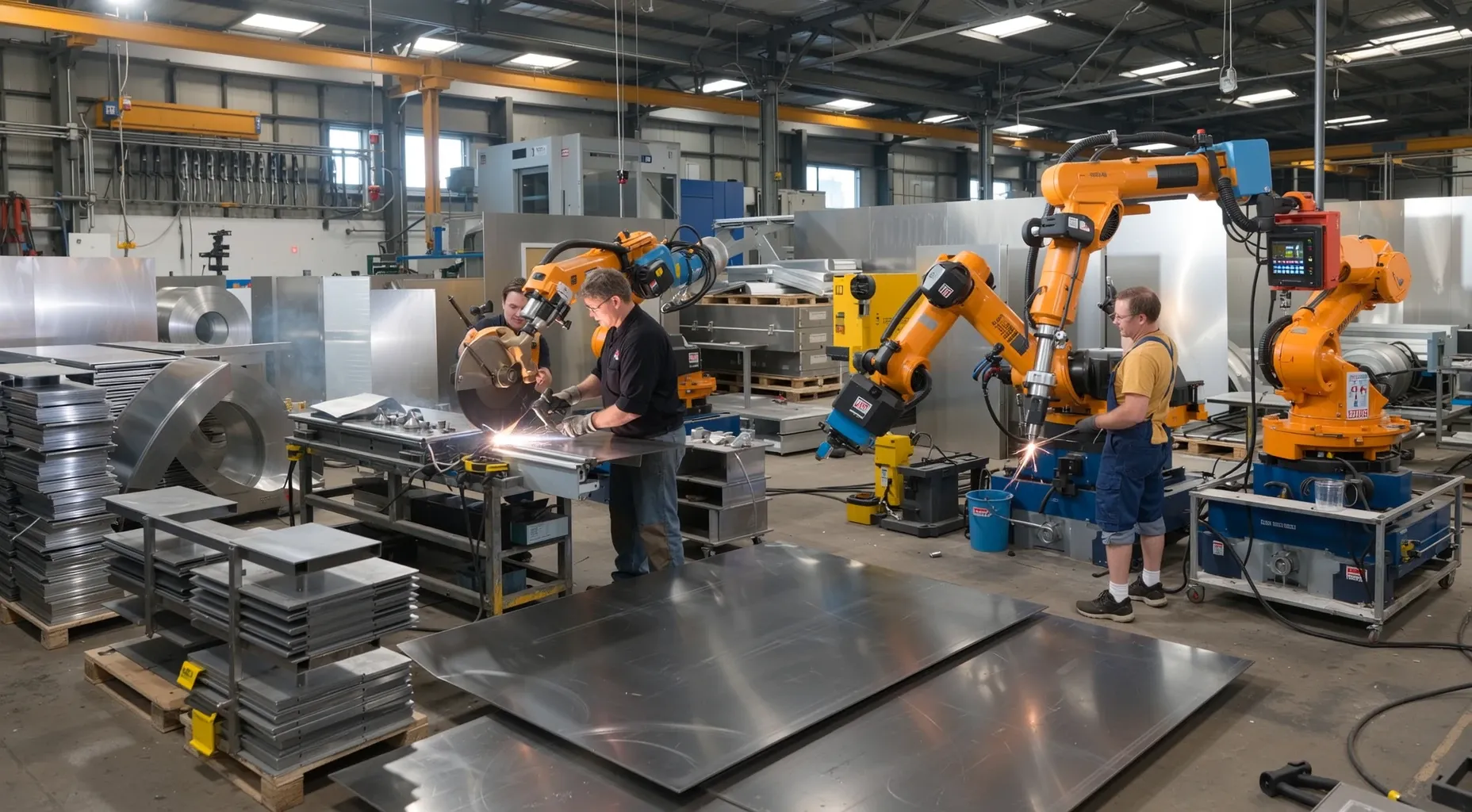
Establishments in this sector specialize in fabricating metal components that fall outside the scope of stamping production. The core activity involves processing metal sheets, plates, or coils into various three-dimensional shapes through cutting, bending, welding, and assembling. Unlike mass production lines driven by automated presses, these businesses often handle low-volume, high-mix projects requiring skilled labor to adapt machinery for custom specifications. Operators typically work with non-ferrous materials such as aluminum, copper, stainless steel, or titanium alongside carbon steel alloys to meet diverse client requirements. The manufacturing process includes initial layout, marking, and precise shearing of raw stock before forming operations take place. Advanced techniques like vacuum forming or rotary die bending are common for achieving complex curves and angles. Many facilities also perform finishing services such as polishing, coating, or powder application to protect the final product. These enterprises vary significantly in scale, ranging from small workshops employing a handful of technicians to larger contract manufacturers operating sophisticated robotics and CNC lathes. They often serve industrial clients including automotive, aerospace, and construction sectors by delivering bespoke metal parts for machinery and structures. The ability to provide design assistance and rapid prototyping distinguishes these manufacturers in a competitive marketplace.
Hierarchy
| Code | Title | Description |
|---|---|---|
| 33 | Manufacturing 2-digit sector | The Sector as a Whole The Manufacturing sector comprises establishments engaged in the mechanical, physical, or chemical transformation of materials, substances, or components into new products. The assembling of component parts of manufactured products is considered manufacturing, except in cases where the activity is appropriately classified in Sector 23, Construction. Establishments in the Manufacturing sector are often described as plants, factories, or mills and characteristically use power-driven machines and material handling equipment. However, establishments that transform materials or substances into new products by hand or in the worker's home and those engaged in selling to the general public products made on the same premises from which they are sold, such as bakeries, candy stores, and custom tailors, may also be included in this sector. Manufacturing establishments may process materials or may contract with other establishments to process their materials for them. Both types of establishments are included in manufacturing. Selected industries in the Manufacturing sector are comprised solely of establishments that process materials for other establishments on a contract or fee basis. Beyond these dedicated contract manufacturing industries, establishments that process materials for other establishments are generally classified in the Manufacturing industry of the processed materials. The materials, substances, or components transformed by manufacturing establishments are raw materials that are products of agriculture, forestry, fishing, mining, or quarrying as well as products of other manufacturing establishments. The materials used may be purchased directly from producers, obtained through customary trade channels, or secured without recourse to the market by transferring the product from one establishment to another, under the same ownership. The new product of a manufacturing establishment may be finished in the sense that it is ready for utilization or consumption, or it may be semi-finished to become an input for an establishment engaged in further manufacturing. For example, the product of the alumina refinery is the input used in the primary production of aluminum; primary aluminum is the input to an aluminum wire drawing plant; and aluminum wire is the input for a fabricated wire product manufacturing establishment. The subsectors in the Manufacturing sector generally reflect distinct production processes related to material inputs, production equipment, and employee skills. In the machinery area, where assembling is a key activity, parts and accessories for manufactured products are classified in the industry of the finished manufactured item when they are made for separate sale. For example, an attachment for a piece of metalworking machinery would be classified with metalworking machinery. However, component inputs from other manufacturing establishments are classified based on the production function of the component manufacturer. For example, electronic components are classified in Subsector 334, Computer and Electronic Product Manufacturing, and stampings are classified in Subsector 332, Fabricated Metal Product Manufacturing. Manufacturing establishments often perform one or more activities that are classified outside the Manufacturing sector of NAICS. For instance, almost all manufacturing has some captive research and development or administrative operations, such as accounting, payroll, or management. These captive services are treated the same as captive manufacturing activities. When the services are provided by separate establishments, they are classified in the NAICS sector where such services are primary, not in manufacturing. The boundaries of manufacturing and the other sectors of the classification system can be somewhat blurry. The establishments in the Manufacturing sector are engaged in the transformation of materials into new products. Their output is a new product. However, the definition of what constitutes a new product can be somewhat subjective. As clarification, the following activities are considered manufacturing in NAICS: <table width=100%><tr><td width=10%> </td><td><dl><dt style='padding-left: 10px; text-indent: -10px;'>Milk bottling and pasteurizing;</dt><dt style='padding-left: 10px; text-indent: -10px;'>Water bottling and processing;</dt><dt style='padding-left: 10px; text-indent: -10px;'>Fresh fish packaging (oyster<br/> shucking, fish filleting);</dt><dt style='padding-left: 10px; text-indent: -10px;'>Apparel jobbing (assigning<br/> materials to contract<br/> factories or shops for<br/> fabrication or other contract<br/> operations) as well as<br/> contracting on materials<br/> owned by others;</dt><dt style='padding-left: 10px; text-indent: -10px;'>Printing and related activities;</dt><dt style='padding-left: 10px; text-indent: -10px;'>Ready-mix concrete production;</dt><dt style='padding-left: 10px; text-indent: -10px;'>Leather converting;</dt><dt style='padding-left: 10px; text-indent: -10px;'>Grinding lenses to<br/> prescription;</dt><dt style='padding-left: 10px; text-indent: -10px;'>Wood preserving;</dt><dt style='padding-left: 10px; text-indent: -10px;'>Lapidary work for the trade;</dt></dl></td><td width=10%> </td><td><dl><dt style='padding-left: 10px; text-indent: -10px;'>Electroplating, plating, metal<br/> heat treating, and<br/> polishing for the trade;</dt><dt style='padding-left: 10px; text-indent: -10px;'>Fabricating signs and<br/> advertising displays;</dt><dt style='padding-left: 10px; text-indent: -10px;'>Rebuilding or remanufacturing<br/> machinery (i.e., automotive<br/> parts);</dt><dt style='padding-left: 10px; text-indent: -10px;'>Making manufactured homes<br/> (i.e., mobile homes) or<br/> prefabricated buildings,<br/> whether or not assembling/<br/> erecting at the customers'<br/> site;</dt><dt style='padding-left: 10px; text-indent: -10px;'>Ship repair and renovation;</dt><dt style='padding-left: 10px; text-indent: -10px;'>Machine shops; and</dt><dt style='padding-left: 10px; text-indent: -10px;'>Tire retreading.</dt></dl></td><td width=10%> </td></tr></table> Conversely, there are activities that are sometimes considered manufacturing, but which for NAICS are classified in another sector (i.e., not classified as manufacturing). They include: 1. Logging, classified in Sector 11, Agriculture, Forestry, Fishing and Hunting, is considered a harvesting operation; 2. Beneficiating ores and other minerals, classified in Sector 21, Mining, Quarrying, and Oil and Gas Extraction, is considered part of the activity of mining; 3. Constructing structures, assembling prefabricated buildings, and fabricating at the construction site by contractors are classified in Sector 23, Construction; 4. Breaking bulk and reselling in smaller lots, including packaging, repackaging, or bottling products, such as liquors or chemicals; assembling and selling computers on a custom basis; sorting and reselling scrap; mixing and selling paints to customer order; and cutting metals to customer order for resale are classified in Sector 42, Wholesale Trade, or Sector 44-45, Retail Trade; and 5. Publishing and the combined activity of publishing and printing, classified in Sector 51, Information, transform information into a product for which the value to the consumer lies in the information content, not in the format in which it is distributed (i.e., the book or software compact disc). |
| 332 | Fabricated Metal Product Manufacturing 3-digit subsector | Industries in the Fabricated Metal Product Manufacturing subsector transform metal into intermediate or end products, other than machinery, computers and electronics, and metal furniture, or treat metals and metal formed products fabricated elsewhere. Important fabricated metal processes are forging, stamping, bending, forming, and machining, used to shape individual pieces of metal; and other processes, such as welding and assembling, used to join separate parts together. Establishments in this subsector may use one of these processes or a combination of these processes. The NAICS structure for this subsector distinguishes the forging and stamping processes in a single industry. The remaining industries in the subsector group establishments based on similar combinations of processes used to make products. The manufacturing performed in the Fabricated Metal Product Manufacturing subsector begins with manufactured metal shapes. The establishments in this subsector further fabricate the purchased metal shapes into a product. For instance, the Spring and Wire Product Manufacturing industry starts with wire and fabricates such items. Within the Manufacturing sector there are other establishments that make the same products made by this subsector; only these establishments begin production further back in the production process. These establishments have a more integrated operation. For instance, one establishment may manufacture steel, draw it into wire, and make wire products in the same establishment. Such operations are classified in the Primary Metal Manufacturing subsector. |
| 3323 | Architectural and Structural Metals Manufacturing 4-digit industry group | This industry group comprises establishments primarily engaged in manufacturing one or more of the following: (1) prefabricated metal buildings, panels, and sections; (2) structural metal products; (3) metal plate work products; (4) metal framed windows (i.e., typically using purchased glass) and metal doors; (5) sheet metal work; and (6) ornamental and architectural metal products. |
| 33232 | Ornamental and Architectural Metal Products Manufacturing 5-digit NAICS industry | This industry comprises establishments primarily engaged in manufacturing one or more of the following: (1) metal framed windows (i.e., typically using purchased glass) and metal doors; (2) sheet metal work; and (3) ornamental and architectural metal products. |
| 332322 | Sheet Metal Work Manufacturing 6-digit U.S. detail | Establishments in this sector specialize in fabricating metal components that fall outside the scope of stamping production. The core activity involves processing metal sheets, plates, or coils into various three-dimensional shapes through cutting, bending, welding, and assembling. Unlike mass production lines driven by automated presses, these businesses often handle low-volume, high-mix projects requiring skilled labor to adapt machinery for custom specifications. Operators typically work with non-ferrous materials such as aluminum, copper, stainless steel, or titanium alongside carbon steel alloys to meet diverse client requirements. The manufacturing process includes initial layout, marking, and precise shearing of raw stock before forming operations take place. Advanced techniques like vacuum forming or rotary die bending are common for achieving complex curves and angles. Many facilities also perform finishing services such as polishing, coating, or powder application to protect the final product. These enterprises vary significantly in scale, ranging from small workshops employing a handful of technicians to larger contract manufacturers operating sophisticated robotics and CNC lathes. They often serve industrial clients including automotive, aerospace, and construction sectors by delivering bespoke metal parts for machinery and structures. The ability to provide design assistance and rapid prototyping distinguishes these manufacturers in a competitive marketplace. |
Need a supply chain stack that maps to this industry?
Use this NAICS classification as the starting point, then connect it to Item workflows across inventory, warehousing, order management, fulfillment, and transportation.
Classification References
- 01Manufacturing sheet metal bins, vats, and light tanks--are classified in U.S. Industry 332439, Other Metal Container Manufacturing;
- 02Manufacturing metal cans, lids, and ends--are classified in U.S. Industry 332431, Metal Can Manufacturing;
- 03Fabricating sheet metal work on site--are classified in Subsector 238, Specialty Trade Contractors;
- 04Manufacturing metal stampings (except automotive, coins) and custom roll forming products--are classified in Industry 33211, Forging and Stamping;
- 05Manufacturing automotive stampings--are classified in Industry 336370, Motor Vehicle Metal Stamping; and
- 06Stamping coins--are classified in Industry 339910, Jewelry and Silverware Manufacturing.
Index Items
Air cowls, sheet metal (except stampings), manufacturing
Awnings, sheet metal (except stampings), manufacturing
Canopies, sheet metal (except stampings), manufacturing
Casings, sheet metal (except stampings), manufacturing
Coal chutes, sheet metal (except stampings), manufacturing
Concrete forms, sheet metal (except stampings), manufacturing
Cornices, sheet metal (except stampings), manufacturing
Cowls, sheet metal (except stampings), manufacturing
Culverts, sheet metal (except stampings), manufacturing
Dampers, sheet metal (except stampings), manufacturing
Door hoods, sheet metal (except stampings), manufacturing
Downspouts, sheet metal (except stampings), manufacturing
Ducts, sheet metal, manufacturing
Eaves, sheet metal (except stampings), manufacturing
Elbows for conductor pipe, hot air ducts, and stovepipe, sheet metal (except stampings), manufacturing
Flooring, sheet metal (except stampings), manufacturing
Flues, stove and furnace, sheet metal (except stampings), manufacturing
Flumes, sheet metal (except stampings), manufacturing
Forms, concrete, sheet metal (except stampings), manufacturing
Furnace casings, sheet metal (except stampings), manufacturing
Furnace flues, sheet metal (except stampings), manufacturing
Guardrails, highway, sheet metal (except stampings), manufacturing
Gutters, sheet metal (except custom roll formed), manufacturing
Hampers, laundry, sheet metal (except stampings), manufacturing
Highway guardrails, sheet metal (except stampings), manufacturing
Hoods, range (except household-type), sheet metal (except stampings), manufacturing
Irrigation pipe, sheet metal (except stampings), manufacturing
Joists, sheet metal (except stampings), manufacturing
Louvers, sheet metal (except stampings), manufacturing
Machine guards, sheet metal (except stampings), manufacturing
Mail chutes, sheet metal (except stampings), manufacturing
Pile shells, sheet metal (except stampings), manufacturing
Pipe, sheet metal (except stampings), manufacturing
Radiator shields and enclosures, sheet metal (except stampings), manufacturing
Roof deck, sheet metal (except stampings), manufacturing
Roof ventilators, sheet metal (except stampings), manufacturing
Roofing, sheet metal (except stampings), manufacturing
Sheet metal work (except stampings) manufacturing
Siding, sheet metal (except stampings), manufacturing
Spouts, sheet metal (except stampings), manufacturing
Stove boards, sheet metal (except stampings), manufacturing
Stove pipes and flues, sheet metal (except stampings), manufacturing
Studs, sheet metal (except stampings), manufacturing
Troughs, elevator, sheet metal (except stampings), manufacturing
Wells, light, sheet metal (except stampings), manufacturing
How Item Can Help
Omnichash's WMS optimizes inventory levels for high-volume raw sheet materials and finished metal products while tracking real-time stock across multiple distribution centers. It reduces picking errors and speeds up order fulfillment for just-in-time manufacturing schedules.
The OMS streamlines complex ordering workflows by consolidating requests from various retail and industrial clients into a single digital interface. It enables rapid order routing and prioritization, ensuring timely production dispatch for diverse sheet metal job sizes.
TMS coordinates efficient last-mile delivery of heavy and bulky metal goods, optimizing routes to minimize fuel costs and delivery times. It provides drivers with GPS tracking to monitor shipment status, ensuring critical metal components arrive on schedule at customer locations.
