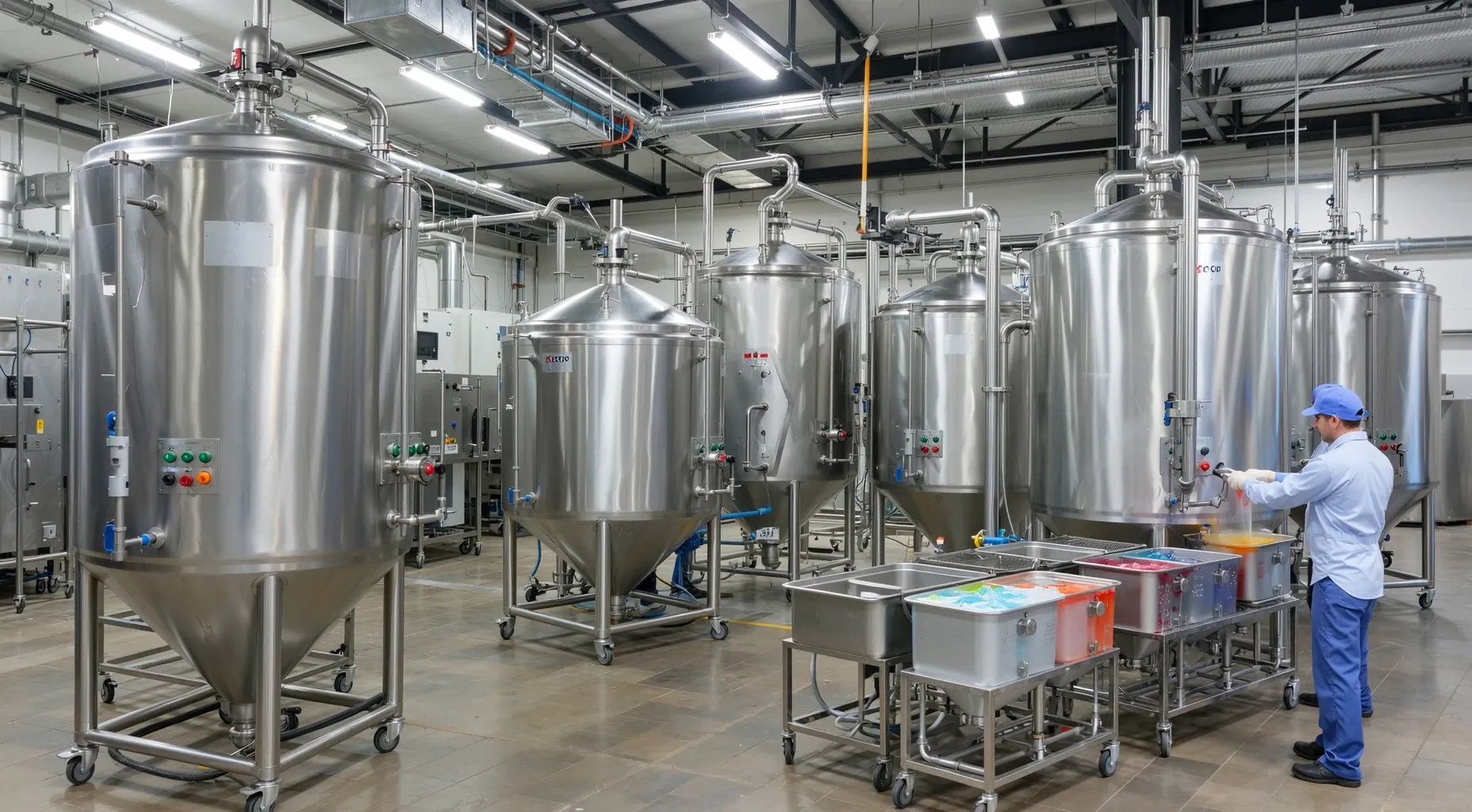
フレーバーシロップおよび濃度製造
Description
フレーバーシロップおよび濃度製造セクターの施設は、炭酸飲料業界向けに大量の液体フレーバーを製造することに特化しています。これらの事業は、炭酸飲料や大規模なソフトドリンクの生産における基礎となる成分として機能する、複雑なフレーバープロファイルを作成することに重点を置いています。主なプロセスは、厳格な衛生条件下で砂糖、水、天然または人工のフレーバー剤を混合することであり、これによって一貫性と安全性が確保されます。典型的な事業活動には、大量の混合、ろ過、滅菌、および大きな産業用容器にパッケージングして輸送施設に備え付けることが含まれます。メーカーは、変化する消費者の味のトレンドや規制要件に対応するために、研究開発にも取り組むことがあります。オペレーターは、多国籍ブランドの濃度を製造する大規模な企業から、特定の市場セグメント向けのニッチなフレーバーに焦点を当てる小規模な専門企業まで、さまざまです。事業規模は、連続生産ラインと、主要な飲料メーカーに供給するために必要な大量の生産量という理由から、通常は非常に大きくなります。地理的な範囲は様々で、一部の生産者は地元のディストリビューターにサービスを提供していますが、他の企業は世界的なサプライチェーンを維持しています。この業界は、世界中で毎日消費される数百万の炭酸飲料の味を定義する、食品製造の重要なサプライヤーとして、依然として重要な役割を果たしています。革新と品質基準の維持能力は、炭酸飲料市場全体の競争力を直接的に左右します。
Hierarchy
| Code | Title | Description |
|---|---|---|
| 31 | Manufacturing 2-digit sector | The Sector as a Whole The Manufacturing sector comprises establishments engaged in the mechanical, physical, or chemical transformation of materials, substances, or components into new products. The assembling of component parts of manufactured products is considered manufacturing, except in cases where the activity is appropriately classified in Sector 23, Construction. Establishments in the Manufacturing sector are often described as plants, factories, or mills and characteristically use power-driven machines and material handling equipment. However, establishments that transform materials or substances into new products by hand or in the worker's home and those engaged in selling to the general public products made on the same premises from which they are sold, such as bakeries, candy stores, and custom tailors, may also be included in this sector. Manufacturing establishments may process materials or may contract with other establishments to process their materials for them. Both types of establishments are included in manufacturing. Selected industries in the Manufacturing sector are comprised solely of establishments that process materials for other establishments on a contract or fee basis. Beyond these dedicated contract manufacturing industries, establishments that process materials for other establishments are generally classified in the Manufacturing industry of the processed materials. The materials, substances, or components transformed by manufacturing establishments are raw materials that are products of agriculture, forestry, fishing, mining, or quarrying as well as products of other manufacturing establishments. The materials used may be purchased directly from producers, obtained through customary trade channels, or secured without recourse to the market by transferring the product from one establishment to another, under the same ownership. The new product of a manufacturing establishment may be finished in the sense that it is ready for utilization or consumption, or it may be semi-finished to become an input for an establishment engaged in further manufacturing. For example, the product of the alumina refinery is the input used in the primary production of aluminum; primary aluminum is the input to an aluminum wire drawing plant; and aluminum wire is the input for a fabricated wire product manufacturing establishment. The subsectors in the Manufacturing sector generally reflect distinct production processes related to material inputs, production equipment, and employee skills. In the machinery area, where assembling is a key activity, parts and accessories for manufactured products are classified in the industry of the finished manufactured item when they are made for separate sale. For example, an attachment for a piece of metalworking machinery would be classified with metalworking machinery. However, component inputs from other manufacturing establishments are classified based on the production function of the component manufacturer. For example, electronic components are classified in Subsector 334, Computer and Electronic Product Manufacturing, and stampings are classified in Subsector 332, Fabricated Metal Product Manufacturing. Manufacturing establishments often perform one or more activities that are classified outside the Manufacturing sector of NAICS. For instance, almost all manufacturing has some captive research and development or administrative operations, such as accounting, payroll, or management. These captive services are treated the same as captive manufacturing activities. When the services are provided by separate establishments, they are classified in the NAICS sector where such services are primary, not in manufacturing. The boundaries of manufacturing and the other sectors of the classification system can be somewhat blurry. The establishments in the Manufacturing sector are engaged in the transformation of materials into new products. Their output is a new product. However, the definition of what constitutes a new product can be somewhat subjective. As clarification, the following activities are considered manufacturing in NAICS: <table width=100%><tr><td width=10%> </td><td><dl><dt style='padding-left: 10px; text-indent: -10px;'>Milk bottling and pasteurizing;</dt><dt style='padding-left: 10px; text-indent: -10px;'>Water bottling and processing;</dt><dt style='padding-left: 10px; text-indent: -10px;'>Fresh fish packaging (oyster<br/> shucking, fish filleting);</dt><dt style='padding-left: 10px; text-indent: -10px;'>Apparel jobbing (assigning<br/> materials to contract<br/> factories or shops for<br/> fabrication or other contract<br/> operations) as well as<br/> contracting on materials<br/> owned by others;</dt><dt style='padding-left: 10px; text-indent: -10px;'>Printing and related activities;</dt><dt style='padding-left: 10px; text-indent: -10px;'>Ready-mix concrete production;</dt><dt style='padding-left: 10px; text-indent: -10px;'>Leather converting;</dt><dt style='padding-left: 10px; text-indent: -10px;'>Grinding lenses to<br/> prescription;</dt><dt style='padding-left: 10px; text-indent: -10px;'>Wood preserving;</dt><dt style='padding-left: 10px; text-indent: -10px;'>Lapidary work for the trade;</dt></dl></td><td width=10%> </td><td><dl><dt style='padding-left: 10px; text-indent: -10px;'>Electroplating, plating, metal<br/> heat treating, and<br/> polishing for the trade;</dt><dt style='padding-left: 10px; text-indent: -10px;'>Fabricating signs and<br/> advertising displays;</dt><dt style='padding-left: 10px; text-indent: -10px;'>Rebuilding or remanufacturing<br/> machinery (i.e., automotive<br/> parts);</dt><dt style='padding-left: 10px; text-indent: -10px;'>Making manufactured homes<br/> (i.e., mobile homes) or<br/> prefabricated buildings,<br/> whether or not assembling/<br/> erecting at the customers'<br/> site;</dt><dt style='padding-left: 10px; text-indent: -10px;'>Ship repair and renovation;</dt><dt style='padding-left: 10px; text-indent: -10px;'>Machine shops; and</dt><dt style='padding-left: 10px; text-indent: -10px;'>Tire retreading.</dt></dl></td><td width=10%> </td></tr></table> Conversely, there are activities that are sometimes considered manufacturing, but which for NAICS are classified in another sector (i.e., not classified as manufacturing). They include: 1. Logging, classified in Sector 11, Agriculture, Forestry, Fishing and Hunting, is considered a harvesting operation; 2. Beneficiating ores and other minerals, classified in Sector 21, Mining, Quarrying, and Oil and Gas Extraction, is considered part of the activity of mining; 3. Constructing structures, assembling prefabricated buildings, and fabricating at the construction site by contractors are classified in Sector 23, Construction; 4. Breaking bulk and reselling in smaller lots, including packaging, repackaging, or bottling products, such as liquors or chemicals; assembling and selling computers on a custom basis; sorting and reselling scrap; mixing and selling paints to customer order; and cutting metals to customer order for resale are classified in Sector 42, Wholesale Trade, or Sector 44-45, Retail Trade; and 5. Publishing and the combined activity of publishing and printing, classified in Sector 51, Information, transform information into a product for which the value to the consumer lies in the information content, not in the format in which it is distributed (i.e., the book or software compact disc). |
| 311 | Food Manufacturing 3-digit subsector | Industries in the Food Manufacturing subsector transform livestock and agricultural products into products for intermediate or final consumption. The industry groups are distinguished by the raw materials (generally of animal or vegetable origin) processed into food products. The food products manufactured in these establishments are typically sold to wholesalers or retailers for distribution to consumers, but establishments primarily engaged in retailing bakery and candy products made on the premises not for immediate consumption are included. Establishments primarily engaged in manufacturing beverages are classified in Subsector 312, Beverage and Tobacco Product Manufacturing. |
| 3119 | Other Food Manufacturing 4-digit industry group | This industry group comprises establishments primarily engaged in manufacturing food (except animal food; grain and oilseed milling; sugar and confectionery products; preserved fruits, vegetables, and specialty foods; dairy products; meat products; seafood products; and bakery products and tortillas). This industry group includes industries with different production processes, such as snack food manufacturing; coffee and tea manufacturing; concentrate, syrup, condiment, and spice manufacturing; and, in general, an entire range of other miscellaneous food product manufacturing. |
| 31193 | Flavoring Syrup and Concentrate Manufacturing 5-digit NAICS industry | Flavoring Syrup and Concentrate Manufacturing |
| 311930 | フレーバーシロップおよび濃度製造 6-digit U.S. detail | フレーバーシロップおよび濃度製造セクターの施設は、炭酸飲料業界向けに大量の液体フレーバーを製造することに特化しています。これらの事業は、炭酸飲料や大規模なソフトドリンクの生産における基礎となる成分として機能する、複雑なフレーバープロファイルを作成することに重点を置いています。主なプロセスは、厳格な衛生条件下で砂糖、水、天然または人工のフレーバー剤を混合することであり、これによって一貫性と安全性が確保されます。典型的な事業活動には、大量の混合、ろ過、滅菌、および大きな産業用容器にパッケージングして輸送施設に備え付けることが含まれます。メーカーは、変化する消費者の味のトレンドや規制要件に対応するために、研究開発にも取り組むことがあります。オペレーターは、多国籍ブランドの濃度を製造する大規模な企業から、特定の市場セグメント向けのニッチなフレーバーに焦点を当てる小規模な専門企業まで、さまざまです。事業規模は、連続生産ラインと、主要な飲料メーカーに供給するために必要な大量の生産量という理由から、通常は非常に大きくなります。地理的な範囲は様々で、一部の生産者は地元のディストリビューターにサービスを提供していますが、他の企業は世界的なサプライチェーンを維持しています。この業界は、世界中で毎日消費される数百万の炭酸飲料の味を定義する、食品製造の重要なサプライヤーとして、依然として重要な役割を果たしています。革新と品質基準の維持能力は、炭酸飲料市場全体の競争力を直接的に左右します。 |
Need a supply chain stack that maps to this industry?
Use this NAICS classification as the starting point, then connect it to Item workflows across inventory, warehousing, order management, fulfillment, and transportation.
Classification References
- 01チョコレートシロップの製造--は31135、チョコレートおよび菓子製造業に分類されます。
- 02香辛料および天然食品着色料(コーヒーおよび肉を除く)の製造--は、U.S. Industry 311942、スパイスおよび抽出品製造業に分類されます。
- 03コーヒー抽出物および/またはコーヒーベースのシロップの製造--は、311920、コーヒーおよび紅茶製造業に分類されます。
- 04屠殺または購入された carcasses からの液体肉抽出物の製造--は、U.S. Industry 31161、動物の屠殺および加工業に分類されます。
- 05液体肉抽出物を他の材料と混合して缶詰のグレービーを製造--は、U.S. Industry 311422、特殊缶詰業に分類されます。
- 06粉末飲料ミックス(コーヒー、紅茶、チョコレート、またはミルクベースを除く)、コーンシロップから作られるテーブルシロップ、または純粋なメープルを除く甘味料シロップの製造--は、U.S. Industry 311999、その他の食品製造業に分類されます。
- 07メープルシロップをメープルシロップに濃縮--は、U.S. Industry 111998、その他の農業業に分類されます。
- 08天然の食品以外の着色料の製造--は、U.S. Industry 325199、その他の基本有機化学製造業に分類されます。
Index Items
飲料ベースの製造
飲料風味(コーヒーベースを除く)の製造
飲料シロップ(コーヒーベースを除く)の製造
濃縮液、飲料(冷凍フルーツジュースを除く)、製造
濃縮液、風味(コーヒーベースを除く)、製造
風味濃縮液(コーヒーベースを除く)の製造
ソフトドリンク用のペースト、パウダー、およびシロップ
フルーツシロップ、風味、製造
ソフトドリンク用シロップ製造
ソフトドリンク濃縮液(すなわち、シロップ)の製造
シロップ、飲料、製造
シロップ、風味(コーヒーベースを除く)、製造
How Item Can Help
The Warehouse Management System optimizes inventory levels for perishable syrup concentrates by tracking expiry dates and automating First-Expiry-First-Out processes to prevent waste. It also improves picking accuracy during high-volume orders for diverse flavor profiles through barcode scanning and real-time stock visibility.
Order Management Systems streamline the complex fulfillment of custom blend requests and bulk industrial contracts by automatically allocating resources based on SKU availability and supplier lead times. This integration ensures rapid order processing for both small-batch artisan flavors and large-scale manufacturing clients.
Data Intelligence tools analyze sales trends across different flavor varieties to predict seasonal demand spikes, enabling proactive raw material procurement. By identifying bottlenecks in production schedules, companies can reduce downtime and maintain consistent quality standards for their flavor concentrates.
Item.com Tools
External Resources
Census.gov NAICS Detail
Official US Census Bureau definition and scope for NAICS 311930.
National Institute of Food and Agriculture
USDA data page on flavoring syrup and concentrate manufacturing statistics and industry overview.
National Sweeteners Association
Trade association supporting the sweetener industry which is closely linked to flavoring syrup production.
Flavor and Fragrance Association
Industry association that covers the broader flavor manufacturing sector including syrups and concentrates.
