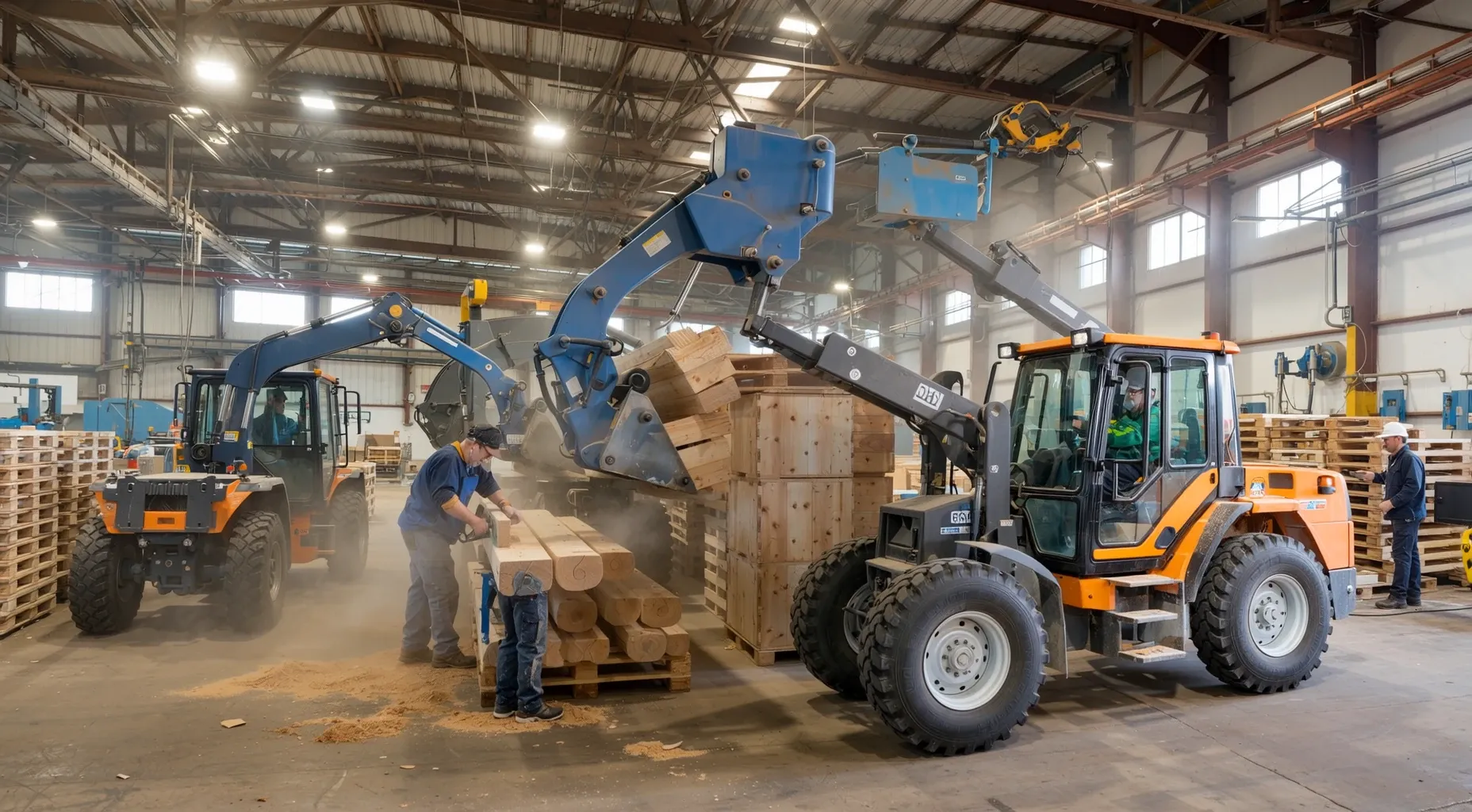
木製コンテナおよびパレット製造
Description
主に木製パレット、木製箱、およびその他のコンテナの製造に従事する企業は、物流およびサプライチェーン効率において重要な役割を果たしています。これらの施設は、原材料である木材を、輸送および保管中の商品保護用に設計された、耐久性があり、標準化された包装ソリューションに変換します。主な事業活動には、木材の調達、特定の寸法に加工し、国際輸送の安全基準を満たすために、熱処理または化学防腐剤を適用することが含まれます。作業員は、切断、組み立て、および固定のために、プランヤー、エッジグルー、およびプレスなどの重機を操作し、最終製品を梱包およびシールします。 典型的なオペレーターは、単一製品ラインに焦点を当てた小規模な家族経営の店から、グローバルな小売ネットワークをサービスする大規模な産業プラントまでさまざまです。一部の企業は、大量輸送用の木製パレットに特化していますが、他の企業は、箱や特定の機械用途用のカスタム部品を含む、混合された在庫を製造しています。この業界は、国内および輸入された木材資源の両方を使用する、より広範な木材製品製造セクター内で運営されています。生産規模は大きく異なり、小規模な生産者は、地元の商人に供給し、大規模な複合施設は、年間数百万個の単位を輸出市場に供給しています。このセクターは、強度と耐久性に関する厳格な業界仕様を満たしながら、手頃な価格で生分解可能な包装オプションの入手を保証し、持続可能なビジネス慣行をサポートしています。 主な事業活動には、木製パレット、箱、およびコンテナ部品の製造が含まれます。中小企業や大企業がこのセクターで運営しており、原材料である木材を使用して、輸送および保管の運用に必要な耐久性のある包装を作成しています。 木製コンテナおよびパレット製造セクターは、堅牢なパレット、箱、および関連する木製部品を含む、不可欠な物流インフラを専門としています。この業界は、主に持続可能な木材資源と最新の機械を使用する、中小規模の製造業者に依存しています。サプライチェーンの重要な要素として、これらの施設は、効率的な商品移動、保管、および輸送中の保護を保証します。その出力は、製品の完全性を維持しながら、小売、卸売、および産業流通ネットワークをサポートする、信頼できる包装ソリューションを提供します。その運営を理解することは、グローバル貿易における物流効率を最適化するために不可欠です。 このセクターの企業は、木材は腐食しやすく変動する材料であるため、物流およびサプライチェーンの考慮事項が重要です。サプライヤーは、昆虫および火災の安全基準を満たす、適切な規制基準を満たす、未処理または処理された木材の安定した供給を保証する必要があります。輸送物流も同様に重要であり、完成したパレットおよび箱は、専用の輸送機器および戦略的な在庫配置を必要とする、大量の貨物です。効果的なサプライチェーン管理には、農村部の資源から製造施設への木材の移動、および完成品のポート、鉄道、および倉庫の目的地への流通ネットワークを調整することが含まれます。これにより、広範な貨物エコシステムにおける遅延を最小限に抑えることができます。
Hierarchy
| Code | Title | Description |
|---|---|---|
| 32 | Manufacturing 2-digit sector | The Sector as a Whole The Manufacturing sector comprises establishments engaged in the mechanical, physical, or chemical transformation of materials, substances, or components into new products. The assembling of component parts of manufactured products is considered manufacturing, except in cases where the activity is appropriately classified in Sector 23, Construction. Establishments in the Manufacturing sector are often described as plants, factories, or mills and characteristically use power-driven machines and material handling equipment. However, establishments that transform materials or substances into new products by hand or in the worker's home and those engaged in selling to the general public products made on the same premises from which they are sold, such as bakeries, candy stores, and custom tailors, may also be included in this sector. Manufacturing establishments may process materials or may contract with other establishments to process their materials for them. Both types of establishments are included in manufacturing. Selected industries in the Manufacturing sector are comprised solely of establishments that process materials for other establishments on a contract or fee basis. Beyond these dedicated contract manufacturing industries, establishments that process materials for other establishments are generally classified in the Manufacturing industry of the processed materials. The materials, substances, or components transformed by manufacturing establishments are raw materials that are products of agriculture, forestry, fishing, mining, or quarrying as well as products of other manufacturing establishments. The materials used may be purchased directly from producers, obtained through customary trade channels, or secured without recourse to the market by transferring the product from one establishment to another, under the same ownership. The new product of a manufacturing establishment may be finished in the sense that it is ready for utilization or consumption, or it may be semi-finished to become an input for an establishment engaged in further manufacturing. For example, the product of the alumina refinery is the input used in the primary production of aluminum; primary aluminum is the input to an aluminum wire drawing plant; and aluminum wire is the input for a fabricated wire product manufacturing establishment. The subsectors in the Manufacturing sector generally reflect distinct production processes related to material inputs, production equipment, and employee skills. In the machinery area, where assembling is a key activity, parts and accessories for manufactured products are classified in the industry of the finished manufactured item when they are made for separate sale. For example, an attachment for a piece of metalworking machinery would be classified with metalworking machinery. However, component inputs from other manufacturing establishments are classified based on the production function of the component manufacturer. For example, electronic components are classified in Subsector 334, Computer and Electronic Product Manufacturing, and stampings are classified in Subsector 332, Fabricated Metal Product Manufacturing. Manufacturing establishments often perform one or more activities that are classified outside the Manufacturing sector of NAICS. For instance, almost all manufacturing has some captive research and development or administrative operations, such as accounting, payroll, or management. These captive services are treated the same as captive manufacturing activities. When the services are provided by separate establishments, they are classified in the NAICS sector where such services are primary, not in manufacturing. The boundaries of manufacturing and the other sectors of the classification system can be somewhat blurry. The establishments in the Manufacturing sector are engaged in the transformation of materials into new products. Their output is a new product. However, the definition of what constitutes a new product can be somewhat subjective. As clarification, the following activities are considered manufacturing in NAICS: <table width=100%><tr><td width=10%> </td><td><dl><dt style='padding-left: 10px; text-indent: -10px;'>Milk bottling and pasteurizing;</dt><dt style='padding-left: 10px; text-indent: -10px;'>Water bottling and processing;</dt><dt style='padding-left: 10px; text-indent: -10px;'>Fresh fish packaging (oyster<br/> shucking, fish filleting);</dt><dt style='padding-left: 10px; text-indent: -10px;'>Apparel jobbing (assigning<br/> materials to contract<br/> factories or shops for<br/> fabrication or other contract<br/> operations) as well as<br/> contracting on materials<br/> owned by others;</dt><dt style='padding-left: 10px; text-indent: -10px;'>Printing and related activities;</dt><dt style='padding-left: 10px; text-indent: -10px;'>Ready-mix concrete production;</dt><dt style='padding-left: 10px; text-indent: -10px;'>Leather converting;</dt><dt style='padding-left: 10px; text-indent: -10px;'>Grinding lenses to<br/> prescription;</dt><dt style='padding-left: 10px; text-indent: -10px;'>Wood preserving;</dt><dt style='padding-left: 10px; text-indent: -10px;'>Lapidary work for the trade;</dt></dl></td><td width=10%> </td><td><dl><dt style='padding-left: 10px; text-indent: -10px;'>Electroplating, plating, metal<br/> heat treating, and<br/> polishing for the trade;</dt><dt style='padding-left: 10px; text-indent: -10px;'>Fabricating signs and<br/> advertising displays;</dt><dt style='padding-left: 10px; text-indent: -10px;'>Rebuilding or remanufacturing<br/> machinery (i.e., automotive<br/> parts);</dt><dt style='padding-left: 10px; text-indent: -10px;'>Making manufactured homes<br/> (i.e., mobile homes) or<br/> prefabricated buildings,<br/> whether or not assembling/<br/> erecting at the customers'<br/> site;</dt><dt style='padding-left: 10px; text-indent: -10px;'>Ship repair and renovation;</dt><dt style='padding-left: 10px; text-indent: -10px;'>Machine shops; and</dt><dt style='padding-left: 10px; text-indent: -10px;'>Tire retreading.</dt></dl></td><td width=10%> </td></tr></table> Conversely, there are activities that are sometimes considered manufacturing, but which for NAICS are classified in another sector (i.e., not classified as manufacturing). They include: 1. Logging, classified in Sector 11, Agriculture, Forestry, Fishing and Hunting, is considered a harvesting operation; 2. Beneficiating ores and other minerals, classified in Sector 21, Mining, Quarrying, and Oil and Gas Extraction, is considered part of the activity of mining; 3. Constructing structures, assembling prefabricated buildings, and fabricating at the construction site by contractors are classified in Sector 23, Construction; 4. Breaking bulk and reselling in smaller lots, including packaging, repackaging, or bottling products, such as liquors or chemicals; assembling and selling computers on a custom basis; sorting and reselling scrap; mixing and selling paints to customer order; and cutting metals to customer order for resale are classified in Sector 42, Wholesale Trade, or Sector 44-45, Retail Trade; and 5. Publishing and the combined activity of publishing and printing, classified in Sector 51, Information, transform information into a product for which the value to the consumer lies in the information content, not in the format in which it is distributed (i.e., the book or software compact disc). |
| 321 | Wood Container and Pallet Manufacturing 3-digit subsector | This subsector includes establishments primarily engaged in manufacturing wood containers and pallets. These products are typically made from wood and are used for packaging and transporting goods. The manufacturing process involves cutting, shaping, and assembling wood pieces to create the desired container or pallet design. The finished products are then used by businesses for shipping and storage purposes. This subsector is a vital part of the broader manufacturing sector, providing essential support for the movement of goods across various industries. |
| 3219 | Other Wood Product Manufacturing 4-digit industry group | This industry group comprises establishments primarily engaged in manufacturing wood products (except establishments operating sawmills and wood preservation facilities; and establishments manufacturing veneer, plywood, or engineered wood products). |
| 32192 | Wood Container and Pallet Manufacturing 5-digit NAICS industry | This industry includes establishments that manufacture wood containers and pallets. These products are typically made from wood and are used for packaging and transporting goods. The manufacturing process involves cutting, shaping, and assembling wood pieces to create the desired container or pallet design. The finished products are then used by businesses for shipping and storage purposes. This industry is a vital part of the broader manufacturing sector, providing essential support for the movement of goods across various industries. |
| 321920 | 木製コンテナおよびパレット製造 6-digit U.S. detail | 主に木製パレット、木製箱、およびその他のコンテナの製造に従事する企業は、物流およびサプライチェーン効率において重要な役割を果たしています。これらの施設は、原材料である木材を、輸送および保管中の商品保護用に設計された、耐久性があり、標準化された包装ソリューションに変換します。主な事業活動には、木材の調達、特定の寸法に加工し、国際輸送の安全基準を満たすために、熱処理または化学防腐剤を適用することが含まれます。作業員は、切断、組み立て、および固定のために、プランヤー、エッジグルー、およびプレスなどの重機を操作し、最終製品を梱包およびシールします。 典型的なオペレーターは、単一製品ラインに焦点を当てた小規模な家族経営の店から、グローバルな小売ネットワークをサービスする大規模な産業プラントまでさまざまです。一部の企業は、大量輸送用の木製パレットに特化していますが、他の企業は、箱や特定の機械用途用のカスタム部品を含む、混合された在庫を製造しています。この業界は、国内および輸入された木材資源の両方を使用する、より広範な木材製品製造セクター内で運営されています。生産規模は大きく異なり、小規模な生産者は、地元の商人に供給し、大規模な複合施設は、年間数百万個の単位を輸出市場に供給しています。このセクターは、強度と耐久性に関する厳格な業界仕様を満たしながら、手頃な価格で生分解可能な包装オプションの入手を保証し、持続可能なビジネス慣行をサポートしています。 主な事業活動には、木製パレット、箱、およびコンテナ部品の製造が含まれます。中小企業や大企業がこのセクターで運営しており、原材料である木材を使用して、輸送および保管の運用に必要な耐久性のある包装を作成しています。 木製コンテナおよびパレット製造セクターは、堅牢なパレット、箱、および関連する木製部品を含む、不可欠な物流インフラを専門としています。この業界は、主に持続可能な木材資源と最新の機械を使用する、中小規模の製造業者に依存しています。サプライチェーンの重要な要素として、これらの施設は、効率的な商品移動、保管、および輸送中の保護を保証します。その出力は、製品の完全性を維持しながら、小売、卸売、および産業流通ネットワークをサポートする、信頼できる包装ソリューションを提供します。その運営を理解することは、グローバル貿易における物流効率を最適化するために不可欠です。 このセクターの企業は、木材は腐食しやすく変動する材料であるため、物流およびサプライチェーンの考慮事項が重要です。サプライヤーは、昆虫および火災の安全基準を満たす、適切な規制基準を満たす、未処理または処理された木材の安定した供給を保証する必要があります。輸送物流も同様に重要であり、完成したパレットおよび箱は、専用の輸送機器および戦略的な在庫配置を必要とする、大量の貨物です。効果的なサプライチェーン管理には、農村部の資源から製造施設への木材の移動、および完成品のポート、鉄道、および倉庫の目的地への流通ネットワークを調整することが含まれます。これにより、広範な貨物エコシステムにおける遅延を最小限に抑えることができます。 |
Need a supply chain stack that maps to this industry?
Use this NAICS classification as the starting point, then connect it to Item workflows across inventory, warehousing, order management, fulfillment, and transportation.
Classification References
- 01主に木製の埋葬用棺を製造する事業所は、U.S. Industry 339995、埋葬用棺製造に分類されます。
Index Items
弾薬ケース、木材、製造
樽のヘッディングとステーブの製造
樽、木材、コープド、製造
木製のバスケット(例:丸いステーブ、ベニア)、製造
ベリー用箱、木材、ワイヤーで結束、製造
ベリー用カップ、ベニアとスプライント、製造
箱のクロート、木材、製造
箱のシェイク製造
タバコ箱、木材または一部木材、製造
ジュエリー用箱、木材または一部木材、製造
木製のバスケット、製造
木製のバスケット、プレーンまたは布で覆われ、釘またはロックコーナー、製造
木製のバケツ、コープド、製造
輸送用ケース、木材、ワイヤーで結束、製造
木製のパッキングケース、釘またはロックコーナー、製造
木製の輸送ケース、釘またはロックコーナー、製造
木製のカスク、コープド、製造
ツール用チェスト、木材、製造
鶏舎(例:バスケット)、木材、ワイヤーで結束、輸送用鶏、製造
タバコ箱、木材と一部木材、製造
コンテナ、木材、製造
コープエージ製造
コープエージ在庫(例:ヘッディング、ホープ、ステーブ)の製造
コープエージ在庫ミル
コープドのトンの製造
バスケット(例:ベリー、バター、果物、野菜)を木材で製造、ワイヤーで結束
合板のドラム、製造
輸送用ドラム、木材、ワイヤーで結束、製造
卵用ケース、木材、製造
フィークンとキット、木材、コープド、製造
フラット、木材、温室、製造
果物用バスケット、ベニアとスプライント、製造
果物用バスケット、木材、ワイヤーで結束、製造
ヘッディング、樽(例:コープエージ在庫)、木材、製造
タバコ hogshead在庫、製造
タバコ hogsheads、製造
木製のホープ、スライスまたはスプリット、製造
ホットトブ、コープド、製造
ケグ、木材、コープド、製造
パッキングケース、木材、釘またはロックコーナー、製造
パッキングバスケット、木材、製造
木製のバケツ、コープド、製造
木製のパイルコンテナ、木材または金属の組み合わせ、製造
パイルパーツ、木材、製造
木製のパイル、木材または金属の組み合わせ、製造
丸いステーブバスケット(例:果物、野菜)の製造
輸送用ケースとドラム、木材、ワイヤーで結束、製造
輸送用ケース、木材、釘またはロックコーナー、製造
輸送用バスケット、木材、製造
シェイク、ボックス、製造
スライドとパイル、木材または金属の組み合わせ、製造
フルーツと野菜用のスプライントバスケット、製造
ステーブ、樽、スライスまたはスプリット、製造
タンク、木材、コープド、製造
タバコ hogshead在庫、製造
タバコ hogsheads、製造
ツールチェスト、木材、製造
トレイ、キャリア、木材、製造
野菜用バスケット、ベニアとスプライント、製造
野菜用バスケット、木材、ワイヤーで結束、製造
ベニアバスケット、フルーツと野菜用、製造
How Item Can Help
Automates the high-volume palletization and labeling of wood containers by guiding workers through optimized stacking patterns that maximize load density and minimize manual handling errors.
Provides real-time visibility into inventory levels across warehouses and distribution centers to quickly alert managers when stock of specific container types runs low during peak shipping seasons.
Calculates the most fuel-efficient and time-saving routing for freight carriers transporting heavy wooden pallets, while dynamically adjusting delivery windows based on traffic and road conditions.
Item.com Tools
External Resources
Census.gov NAICS Detail
Official US Census Bureau definition and scope for NAICS 321920.
American Wood Council
National trade association representing the lumber and wood products industry including pallet and container makers.
United States Census Bureau NAICS Detail
Official government statistics page defining manufacturing codes for wood container and pallet production.
Pallet & Truckload Logistics Association
Industry trade group focused on pallet logistics and manufacturing standards and certification.
