Other Basic Inorganic Chemical Manufacturing
Description
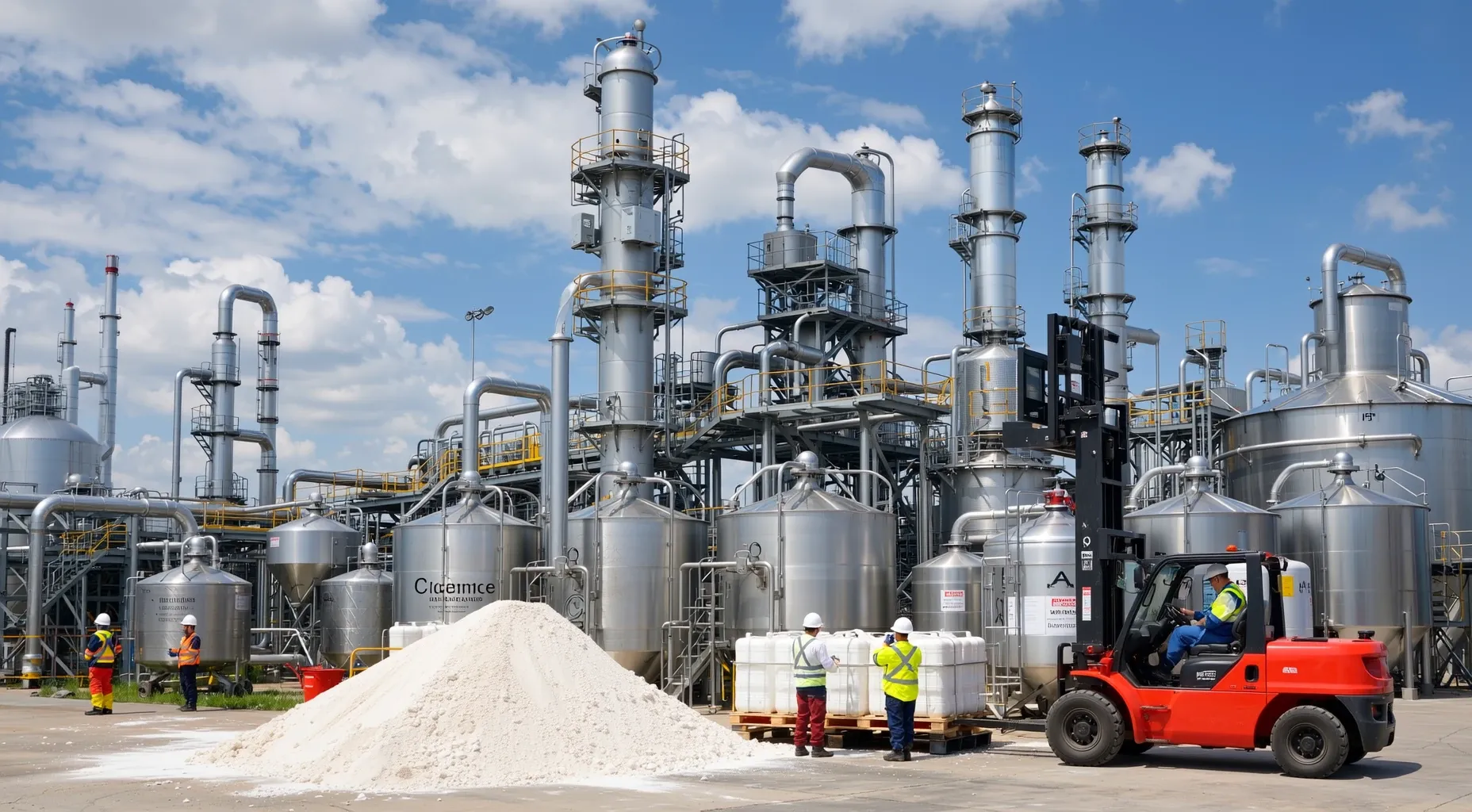
This industry comprises establishments primarily engaged in manufacturing basic inorganic chemicals (except industrial gases and synthetic dyes and pigments). Illustrative Examples: Alkalies manufacturing Aluminum compounds, not specified elsewhere by process, manufacturing Carbides (e.g., baron, calcium, silicon, tungsten) manufacturing Carbon black manufacturing Chlorine manufacturing Hydrochloric acid manufacturing Potassium inorganic compounds, not specified elsewhere by process, manufacturing Radioactive isotopes manufacturing Sulfides and sulfites manufacturing Sulfuric acid manufacturing
Hierarchy
| Code | Title | Description |
|---|---|---|
| 32 | Manufacturing 2-digit sector | The Sector as a Whole The Manufacturing sector comprises establishments engaged in the mechanical, physical, or chemical transformation of materials, substances, or components into new products. The assembling of component parts of manufactured products is considered manufacturing, except in cases where the activity is appropriately classified in Sector 23, Construction. Establishments in the Manufacturing sector are often described as plants, factories, or mills and characteristically use power-driven machines and material handling equipment. However, establishments that transform materials or substances into new products by hand or in the worker's home and those engaged in selling to the general public products made on the same premises from which they are sold, such as bakeries, candy stores, and custom tailors, may also be included in this sector. Manufacturing establishments may process materials or may contract with other establishments to process their materials for them. Both types of establishments are included in manufacturing. Selected industries in the Manufacturing sector are comprised solely of establishments that process materials for other establishments on a contract or fee basis. Beyond these dedicated contract manufacturing industries, establishments that process materials for other establishments are generally classified in the Manufacturing industry of the processed materials. The materials, substances, or components transformed by manufacturing establishments are raw materials that are products of agriculture, forestry, fishing, mining, or quarrying as well as products of other manufacturing establishments. The materials used may be purchased directly from producers, obtained through customary trade channels, or secured without recourse to the market by transferring the product from one establishment to another, under the same ownership. The new product of a manufacturing establishment may be finished in the sense that it is ready for utilization or consumption, or it may be semi-finished to become an input for an establishment engaged in further manufacturing. For example, the product of the alumina refinery is the input used in the primary production of aluminum; primary aluminum is the input to an aluminum wire drawing plant; and aluminum wire is the input for a fabricated wire product manufacturing establishment. The subsectors in the Manufacturing sector generally reflect distinct production processes related to material inputs, production equipment, and employee skills. In the machinery area, where assembling is a key activity, parts and accessories for manufactured products are classified in the industry of the finished manufactured item when they are made for separate sale. For example, an attachment for a piece of metalworking machinery would be classified with metalworking machinery. However, component inputs from other manufacturing establishments are classified based on the production function of the component manufacturer. For example, electronic components are classified in Subsector 334, Computer and Electronic Product Manufacturing, and stampings are classified in Subsector 332, Fabricated Metal Product Manufacturing. Manufacturing establishments often perform one or more activities that are classified outside the Manufacturing sector of NAICS. For instance, almost all manufacturing has some captive research and development or administrative operations, such as accounting, payroll, or management. These captive services are treated the same as captive manufacturing activities. When the services are provided by separate establishments, they are classified in the NAICS sector where such services are primary, not in manufacturing. The boundaries of manufacturing and the other sectors of the classification system can be somewhat blurry. The establishments in the Manufacturing sector are engaged in the transformation of materials into new products. Their output is a new product. However, the definition of what constitutes a new product can be somewhat subjective. As clarification, the following activities are considered manufacturing in NAICS: <table width=100%><tr><td width=10%> </td><td><dl><dt style='padding-left: 10px; text-indent: -10px;'>Milk bottling and pasteurizing;</dt><dt style='padding-left: 10px; text-indent: -10px;'>Water bottling and processing;</dt><dt style='padding-left: 10px; text-indent: -10px;'>Fresh fish packaging (oyster<br/> shucking, fish filleting);</dt><dt style='padding-left: 10px; text-indent: -10px;'>Apparel jobbing (assigning<br/> materials to contract<br/> factories or shops for<br/> fabrication or other contract<br/> operations) as well as<br/> contracting on materials<br/> owned by others;</dt><dt style='padding-left: 10px; text-indent: -10px;'>Printing and related activities;</dt><dt style='padding-left: 10px; text-indent: -10px;'>Ready-mix concrete production;</dt><dt style='padding-left: 10px; text-indent: -10px;'>Leather converting;</dt><dt style='padding-left: 10px; text-indent: -10px;'>Grinding lenses to<br/> prescription;</dt><dt style='padding-left: 10px; text-indent: -10px;'>Wood preserving;</dt><dt style='padding-left: 10px; text-indent: -10px;'>Lapidary work for the trade;</dt></dl></td><td width=10%> </td><td><dl><dt style='padding-left: 10px; text-indent: -10px;'>Electroplating, plating, metal<br/> heat treating, and<br/> polishing for the trade;</dt><dt style='padding-left: 10px; text-indent: -10px;'>Fabricating signs and<br/> advertising displays;</dt><dt style='padding-left: 10px; text-indent: -10px;'>Rebuilding or remanufacturing<br/> machinery (i.e., automotive<br/> parts);</dt><dt style='padding-left: 10px; text-indent: -10px;'>Making manufactured homes<br/> (i.e., mobile homes) or<br/> prefabricated buildings,<br/> whether or not assembling/<br/> erecting at the customers'<br/> site;</dt><dt style='padding-left: 10px; text-indent: -10px;'>Ship repair and renovation;</dt><dt style='padding-left: 10px; text-indent: -10px;'>Machine shops; and</dt><dt style='padding-left: 10px; text-indent: -10px;'>Tire retreading.</dt></dl></td><td width=10%> </td></tr></table> Conversely, there are activities that are sometimes considered manufacturing, but which for NAICS are classified in another sector (i.e., not classified as manufacturing). They include: 1. Logging, classified in Sector 11, Agriculture, Forestry, Fishing and Hunting, is considered a harvesting operation; 2. Beneficiating ores and other minerals, classified in Sector 21, Mining, Quarrying, and Oil and Gas Extraction, is considered part of the activity of mining; 3. Constructing structures, assembling prefabricated buildings, and fabricating at the construction site by contractors are classified in Sector 23, Construction; 4. Breaking bulk and reselling in smaller lots, including packaging, repackaging, or bottling products, such as liquors or chemicals; assembling and selling computers on a custom basis; sorting and reselling scrap; mixing and selling paints to customer order; and cutting metals to customer order for resale are classified in Sector 42, Wholesale Trade, or Sector 44-45, Retail Trade; and 5. Publishing and the combined activity of publishing and printing, classified in Sector 51, Information, transform information into a product for which the value to the consumer lies in the information content, not in the format in which it is distributed (i.e., the book or software compact disc). |
| 325 | Chemical Manufacturing 3-digit subsector | The Chemical Manufacturing subsector is based on the transformation of organic and inorganic raw materials by a chemical process and the formulation of products. This subsector distinguishes the production of basic chemicals that comprise the first industry group from the production of intermediate and end products produced by further processing of basic chemicals that make up the remaining industry groups. This subsector does not include all industries transforming raw materials by a chemical process. It is common for some chemical processing to occur during mining operations. These beneficiating operations, such as copper concentrating, are classified in Sector 21, Mining, Quarrying, and Oil and Gas Extraction. Furthermore, the refining of crude petroleum is included in Subsector 324, Petroleum and Coal Products Manufacturing. In addition, the manufacturing of aluminum oxide is included in Subsector 331, Primary Metal Manufacturing; and beverage distilleries are classified in Subsector 312, Beverage and Tobacco Product Manufacturing. As is the case of these two activities, the grouping of industries into subsectors may take into account the association of the activities performed with other activities in the subsector. |
| 3251 | Basic Chemical Manufacturing 4-digit industry group | This industry group comprises establishments primarily engaged in manufacturing chemicals using basic processes, such as thermal cracking and distillation. Chemicals manufactured in this industry group are usually separate chemical elements or separate chemically-defined compounds. |
| 32518 | Other Basic Inorganic Chemical Manufacturing 5-digit NAICS industry | See industry description for 325180. |
| 325180 | Other Basic Inorganic Chemical Manufacturing 6-digit U.S. detail | This industry comprises establishments primarily engaged in manufacturing basic inorganic chemicals (except industrial gases and synthetic dyes and pigments). Illustrative Examples: Alkalies manufacturing Aluminum compounds, not specified elsewhere by process, manufacturing Carbides (e.g., baron, calcium, silicon, tungsten) manufacturing Carbon black manufacturing Chlorine manufacturing Hydrochloric acid manufacturing Potassium inorganic compounds, not specified elsewhere by process, manufacturing Radioactive isotopes manufacturing Sulfides and sulfites manufacturing Sulfuric acid manufacturing |
Need a supply chain stack that maps to this industry?
Use this NAICS classification as the starting point, then connect it to Item workflows across inventory, warehousing, order management, fulfillment, and transportation.
Classification References
- 01Manufacturing industrial gases--are classified in Industry 325120, Industrial Gas Manufacturing;
- 02Manufacturing inorganic dyes and pigments--are classified in Industry 325130, Synthetic Dye and Pigment Manufacturing;
- 03Manufacturing household bleaches--are classified in U.S. Industry 325612, Polish and Other Sanitation Good Manufacturing;
- 04Mining and/or beneficiating alkalies--are classified in Industry 212390, Other Nonmetallic Mineral Mining and Quarrying;
- 05Manufacturing chlorine preparations (e.g., for swimming pools)--are classified in U.S. Industry 325998, All Other Miscellaneous Chemical Product and Preparation Manufacturing;
- 06Manufacturing nitrogenous and phosphoric fertilizers and fertilizer materials--are classified in Industry 32531, Fertilizer and Compost Manufacturing;
- 07Manufacturing pharmaceuticals, medicines, and dietary supplements--are classified in Industry Group 3254, Pharmaceutical and Medicine Manufacturing;
- 08Manufacturing aluminum oxide (alumina)--are classified in U.S. Industry 331313, Alumina Refining and Primary Aluminum Production;
- 09Manufacturing inorganic insecticidal, herbicidal, fungicidal and pesticidal preparations--are classified in Industry 325320, Pesticide and Other Agricultural Chemical Manufacturing; and
- 10Manufacturing photographic chemicals--are classified in U.S. Industry 325992, Photographic Film, Paper, Plate, Chemical, and Copy Toner Manufacturing.
Index Items
Alkalies manufacturing
Aluminum chloride manufacturing
Aluminum compounds, not specified elsewhere by process, manufacturing
Aluminum hydroxide (i.e., alumina trihydrate) manufacturing
Aluminum sulfate manufacturing
Alums (e.g., aluminum ammonium sulfate, aluminum potassium sulfate) manufacturing
Ammonium chloride manufacturing
Ammonium compounds, not specified elsewhere by process, manufacturing
Ammonium hydroxide manufacturing
Ammonium molybdate manufacturing
Ammonium perchlorate manufacturing
Ammonium thiosulfate manufacturing
Animal black manufacturing
Antimony oxide (except pigments) manufacturing
Arsenates (except insecticides) manufacturing
Arsenic compounds, not specified elsewhere by process, manufacturing
Arsenites (except insecticides) manufacturing
Barium compounds, not specified elsewhere by process, manufacturing
Barium hydroxide manufacturing
Beryllium oxide manufacturing
Bleaching agents, inorganic, manufacturing
Bone black manufacturing
Borax (i.e., sodium borate) manufacturing
Boric acid manufacturing
Boron compounds, not specified elsewhere by process, manufacturing
Borosilicate manufacturing
Bromine manufacturing
Calcium carbide, chloride, and hypochlorite manufacturing
Calcium hypochlorite manufacturing
Calcium inorganic compounds, not specified elsewhere by process, manufacturing
Carbides (e.g., boron, calcium, silicon, tungsten) manufacturing
Carbon black manufacturing
Carbon disulfide manufacturing
Carbon inorganic compounds manufacturing
Carbonic acid manufacturing
Caustic potash manufacturing
Caustic soda (i.e., sodium hydroxide) manufacturing
Cerium salts manufacturing
Cesium and cesium compounds, not specified elsewhere by process, manufacturing
Channel black manufacturing
Chloride of lime manufacturing
Chlorine compounds, not specified elsewhere by process, manufacturing
Chlorine dioxide manufacturing
Chlorine manufacturing
Chlorosulfonic acid manufacturing
Chromic acid manufacturing
Chromium compounds, not specified elsewhere by process, manufacturing
Chromium oxide manufacturing
Chromium salts manufacturing
Cobalt 60 (i.e., radioactive cobalt) manufacturing
Cobalt chloride manufacturing
Cobalt compounds, not specified elsewhere by process, manufacturing
Cobalt sulfate manufacturing
Copper chloride manufacturing
Copper compounds, not specified elsewhere by process, manufacturing
Copper iodide manufacturing
Copper sulfate manufacturing
Cyanides manufacturing
Deuterium oxide (i.e., heavy water) manufacturing
Dichromates manufacturing
Ferric chloride manufacturing
Ferric oxide manufacturing
Ferrocyanides manufacturing
Fluoboric acid manufacturing
Fluorine manufacturing
Fuel propellants, solid inorganic, not specified elsewhere by process, manufacturing
Furnace black manufacturing
Glauber's salt manufacturing
Heavy water (i.e., deuterium oxide) manufacturing
Hydrazine manufacturing
Hydrochloric acid manufacturing
Hydrocyanic acid manufacturing
Hydrofluoric acid manufacturing
Hydrofluosilicic acid manufacturing
Hydrogen peroxide manufacturing
Hydrogen sulfide manufacturing
Hydrosulfites manufacturing
Hypochlorites manufacturing
Hypophosphites manufacturing
Indium chloride manufacturing
Iodides manufacturing
Iodine, crude or resublimed, manufacturing
Iron compounds, not specified elsewhere by process, manufacturing
Iron sulphate manufacturing
Lamp black manufacturing
Lead oxides (except pigments) manufacturing
Lead silicate manufacturing
Lithium compounds, not specified elsewhere by process, manufacturing
Magnesium carbonate manufacturing
Magnesium chloride manufacturing
Magnesium compounds, not specified elsewhere by process, manufacturing
Manganese dioxide manufacturing
Mercury chloride manufacturing
Mercury compounds, not specified elsewhere by process, manufacturing
Mercury oxide manufacturing
Nickel ammonium sulfate manufacturing
Nickel carbonate manufacturing
Nickel compounds, not specified elsewhere by process, manufacturing
Nickel sulfate manufacturing
Nuclear fuel scrap reprocessing
Nuclear fuels, inorganic, manufacturing
Oleum (i.e., fuming sulfuric acid) manufacturing
Perchloric acid manufacturing
Peroxides, inorganic, manufacturing
Phosphorus compounds, not specified elsewhere by process, manufacturing
Phosphorus oxychloride manufacturing
Potassium aluminum sulfate manufacturing
Potassium bichromate and chromate manufacturing
Potassium bromide manufacturing
Potassium carbonate manufacturing
Potassium chlorate manufacturing
Potassium chloride manufacturing
Potassium cyanide manufacturing
Potassium hydroxide (i.e., caustic potash) manufacturing
Potassium hypochlorate manufacturing
Potassium inorganic compounds, not specified elsewhere by process, manufacturing
Potassium iodide manufacturing
Potassium nitrate manufacturing
Potassium permanganate manufacturing
Potassium salts manufacturing
Potassium sulfate manufacturing
Radioactive elements manufacturing
Radioactive isotopes manufacturing
Radium chloride manufacturing
Radium luminous compounds manufacturing
Rare earth compounds, not specified elsewhere by process, manufacturing
Rare earth salts manufacturing
Sal soda (i.e., washing soda) manufacturing
Selenium compounds, not specified elsewhere by process, manufacturing
Selenium dioxide manufacturing
Silica gel manufacturing
Silica, amorphous, manufacturing
Silicofluorides manufacturing
Silver bromide manufacturing
Silver chloride manufacturing
Silver compounds, not specified elsewhere by process, manufacturing
Silver nitrate manufacturing
Soda ash manufacturing
Sodium aluminate manufacturing
Sodium aluminum sulfate manufacturing
Sodium antimoniate manufacturing
Sodium arsenite (except insecticides) manufacturing
Sodium bicarbonate manufacturing
Sodium bichromate and chromate manufacturing
Sodium borate manufacturing
Sodium borohydride manufacturing
Sodium bromide manufacturing
Sodium carbonate (i.e., soda ash) manufacturing
Sodium chlorate manufacturing
Sodium cyanide manufacturing
Sodium hydrosulfite manufacturing
Sodium hydroxide (i.e., caustic soda) manufacturing
Sodium hypochlorite manufacturing
Sodium inorganic compounds, not specified elsewhere by process, manufacturing
Sodium molybdate manufacturing
Sodium perborate manufacturing
Sodium peroxide manufacturing
Sodium phosphate manufacturing
Sodium polyphosphate manufacturing
Sodium silicate (i.e., water glass) manufacturing
Sodium silicofluoride manufacturing
Sodium stannate manufacturing
Sodium sulfate manufacturing
Sodium tetraborate manufacturing
Sodium thiosulfate manufacturing
Sodium tungstate manufacturing
Sodium uranate manufacturing
Solid fuel propellants, inorganic, not specified elsewhere by process, manufacturing
Stannic and stannous chloride manufacturing
Strontium carbonate manufacturing
Strontium compounds, not specified elsewhere by process, manufacturing
Strontium nitrate manufacturing
Sulfides and sulfites manufacturing
Sulfocyanides manufacturing
Sulfur and sulfur compounds, not specified elsewhere by process, manufacturing
Sulfur chloride manufacturing
Sulfur dioxide manufacturing
Sulfur hexafluoride gas manufacturing
Sulfur recovering or refining (except from sour natural gas)
Sulfuric acid manufacturing
Tanning agents, inorganic, manufacturing
Thiocyanate manufacturing
Tin chloride manufacturing
Tin compounds, not specified elsewhere by process, manufacturing
Tin oxide manufacturing
Tin salts manufacturing
Titanium dioxide manufacturing
Tungstates (e.g., ammonium tungstate, sodium tungstate) manufacturing
Tungsten compounds, not specified elsewhere by process, manufacturing
Uranium compounds, not specified elsewhere by process, manufacturing
Uranium oxide manufacturing
Uranium, enriched, manufacturing
Zinc ammonium chloride manufacturing
Zinc chloride manufacturing
Zinc compounds, not specified elsewhere by process, manufacturing
Zinc hydrosulfite (i.e., zinc dithionite) manufacturing
Zinc oxide (except pigments) manufacturing
Zinc sulfide manufacturing
How Item Can Help
Analyzes historical production yields and safety data to predict maintenance needs and optimize batch sizes while ensuring adherence to strict environmental standards.
Item.com Tools
External Resources
Census.gov NAICS Detail
Official US Census Bureau definition and scope for NAICS 325180.
American Chemistry Council - Inorganic Chemicals Division
A trade association dedicated to the recycling and reuse of inorganic chemicals, representing manufacturers in this sector.
EPA Nontargeted Monitoring Program for Inorganic Chemicals
A US government agency page providing resources and data on monitoring environmental releases of basic inorganic chemicals.
Industrial Chemicals Database - Chemical Abstracts Service
A directory of inorganic chemicals and compounds maintained by the National Center for Biotechnology Information (NIH).
