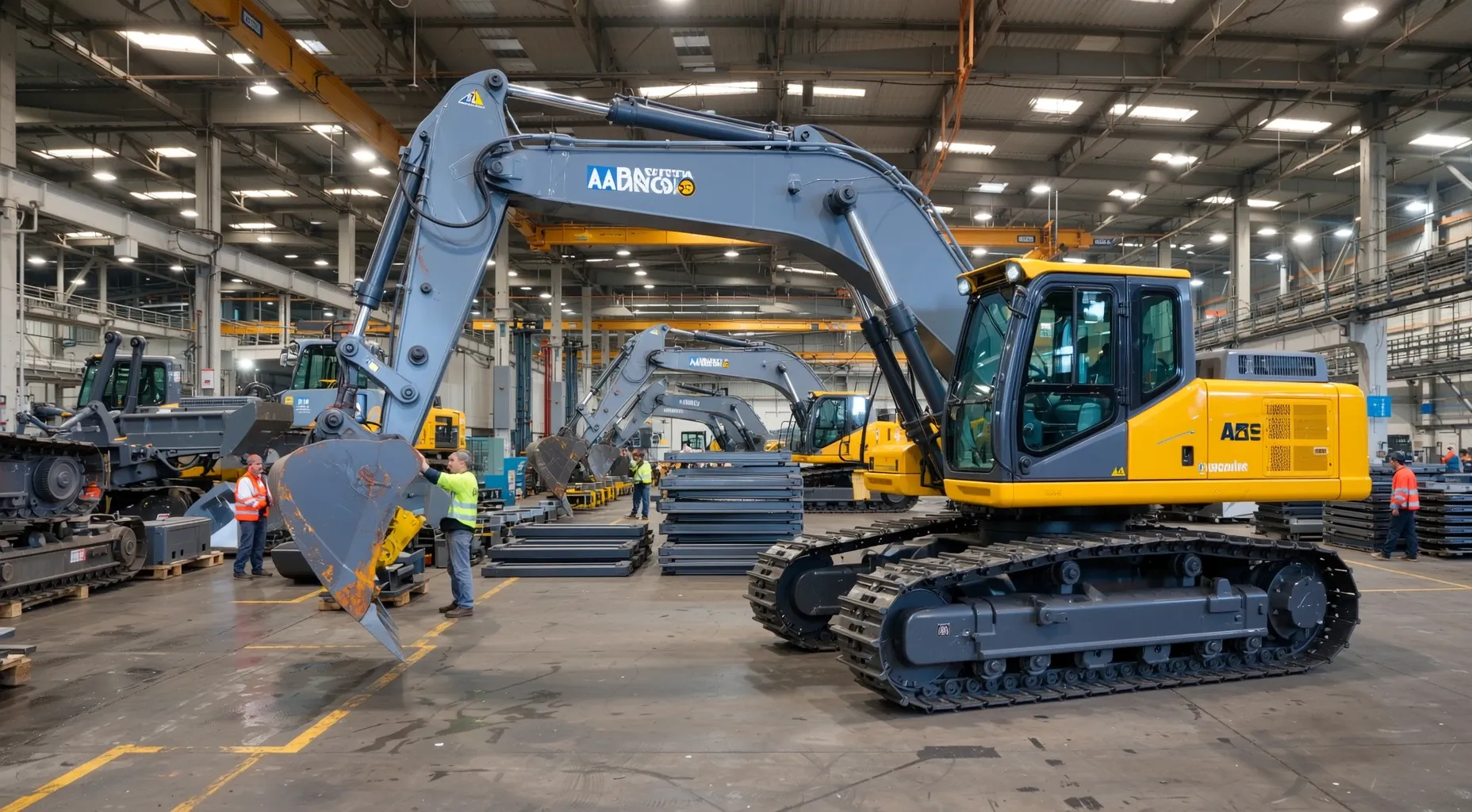
建設機械製造
説明
この産業は、主に建設機械、露天掘り機械、伐採機器の製造に従事する事業所から構成されています。 具体例: バックホー製造 ブルドーザー製造 建設用および露天掘り用ロックドリルビット製造 建設用トラクターおよびアタッチメント製造 オフロードトラック製造 杭打ち設備製造 携帯型破砕、粉砕、選別機械製造 動力式ポストホールディガー製造 ロードグレーダー製造 露天掘り機械(掘削を除く)製造
階層
| コード | タイトル | 説明 |
|---|---|---|
| 33 | Construction Machinery Manufacturing 2桁セクター | The Sector as a Whole The Construction Machinery sector comprises establishments engaged in the mechanical, physical, or chemical transformation of materials, substances, or components into new products. The assembling of component parts of manufactured products is considered manufacturing, except in cases where the activity is appropriately classified in Sector 23, Construction. Establishments in the Construction Machinery sector are often described as plants, factories, or mills and characteristically use power-driven machines and material handling equipment. However, establishments that transform materials or substances into new products by hand or in the worker's home and those engaged in selling to the general public products made on the same premises from which they are sold, such as bakeries, candy stores, and custom tailors, may also be included in this sector. Manufacturing establishments may process materials or may contract with other establishments to process their materials for them. Both types of establishments are included in manufacturing. Selected industries in the Manufacturing sector are comprised solely of establishments that process materials for other establishments on a contract or fee basis. Beyond these dedicated contract manufacturing industries, establishments that process materials for other establishments are generally classified in the Manufacturing industry of the processed materials. The materials, substances, or components transformed by manufacturing establishments are raw materials that are products of agriculture, forestry, fishing, mining, or quarrying as well as products of other manufacturing establishments. The materials used may be purchased directly from producers, obtained through customary trade channels, or secured without recourse to the market by transferring the product from one establishment to another, under the same ownership. The new product of a manufacturing establishment may be finished in the sense that it is ready for utilization or consumption, or it may be semi-finished to become an input for an establishment engaged in further manufacturing. For example, the product of the alumina refinery is the input used in the primary production of aluminum; primary aluminum is the input to an aluminum wire drawing plant; and aluminum wire is the input for a fabricated wire product manufacturing establishment. The subsectors in the Manufacturing sector generally reflect distinct production processes related to material inputs, production equipment, and employee skills. In the machinery area, where assembling is a key activity, parts and accessories for manufactured products are classified in the industry of the finished manufactured item when they are made for separate sale. For example, an attachment for a piece of metalworking machinery would be classified with metalworking machinery. However, component inputs from other manufacturing establishments are classified based on the production function of the component manufacturer. For example, electronic components are classified in Subsector 334, Computer and Electronic Product Manufacturing, and stampings are classified in Subsector 332, Fabricated Metal Product Manufacturing. Manufacturing establishments often perform one or more activities that are classified outside the Manufacturing sector of NAICS. For instance, almost all manufacturing has some captive research and development or administrative operations, such as accounting, payroll, or management. These captive services are treated the same as captive manufacturing activities. When the services are provided by separate establishments, they are classified in the NAICS sector where such services are primary, not in manufacturing. The boundaries of manufacturing and the other sectors of the classification system can be somewhat blurry. The establishments in the Manufacturing sector are engaged in the transformation of materials into new products. Their output is a new product. However, the definition of what constitutes a new product can be somewhat subjective. As clarification, the following activities are considered manufacturing in NAICS: <table width=100%><tr><td width=10%> </td><td><dl><dt style='padding-left: 10px; text-indent: -10px;'>Milk bottling and pasteurizing;</dt><dt style='padding-left: 10px; text-indent: -10px;'>Water bottling and processing;</dt><dt style='padding-left: 10px; text-indent: -10px;'>Fresh fish packaging (oyster<br/> shucking, fish filleting);</dt><dt style='padding-left: 10px; text-indent: -10px;'>Apparel jobbing (assigning<br/> materials to contract<br/> factories or shops for<br/> fabrication or other contract<br/> operations) as well as<br/> contracting on materials<br/> owned by others;</dt><dt style='padding-left: 10px; text-indent: -10px;'>Printing and related activities;</dt><dt style='padding-left: 10px; text-indent: -10px;'>Ready-mix concrete production;</dt><dt style='padding-left: 10px; text-indent: -10px;'>Leather converting;</dt><dt style='padding-left: 10px; text-indent: -10px;'>Grinding lenses to<br/> prescription;</dt><dt style='padding-left: 10px; text-indent: -10px;'>Wood preserving;</dt><dt style='padding-left: 10px; text-indent: -10px;'>Lapidary work for the trade;</dt></dl></td><td width=10%> </td><td><dl><dt style='padding-left: 10px; text-indent: -10px;'>Electroplating, plating, metal<br/> heat treating, and<br/> polishing for the trade;</dt><dt style='padding-left: 10px; text-indent: -10px;'>Fabricating signs and<br/> advertising displays;</dt><dt style='padding-left: 10px; text-indent: -10px;'>Rebuilding or remanufacturing<br/> machinery (i.e., automotive<br/> parts);</dt><dt style='padding-left: 10px; text-indent: -10px;'>Making manufactured homes<br/> (i.e., mobile homes) or<br/> prefabricated buildings,<br/> whether or not assembling/<br/> erecting at the customers'<br/> site;</dt><dt style='padding-left: 10px; text-indent: -10px;'>Ship repair and renovation;</dt><dt style='padding-left: 10px; text-indent: -10px;'>Machine shops; and</dt><dt style='padding-left: 10px; text-indent: -10px;'>Tire retreading.</dt></dl></td><td width=10%> </td></tr></table Conversely, there are activities that are sometimes considered manufacturing, but which for NAICS are classified in another sector (i.e., not classified as manufacturing). They include: 1. Logging, classified in Sector 11, Agriculture, Forestry, Fishing and Hunting, is considered a harvesting operation; 2. Beneficiating ores and other minerals, classified in Sector 21, Mining, Quarrying, and Oil and Gas Extraction, is considered part of the activity of mining; 3. Constructing structures, assembling prefabricated buildings, and fabricating at the construction site by contractors are classified in Sector 23, Construction; 4. Breaking bulk and reselling in smaller lots, including packaging, repackaging, or bottling products, such as liquors or chemicals; assembling and selling computers on a custom basis; sorting and reselling scrap; mixing and selling paints to customer order; and cutting metals to customer order for resale are classified in Sector 42, Wholesale Trade, or Sector 44-45, Retail Trade; and 5. Publishing and the combined activity of publishing and printing, classified in Sector 51, Information, transform information into a product for which the value to the consumer lies in the information content, not in the format in which it is distributed (i.e., the book or software compact disc). |
| 333 | Construction Machinery Manufacturing 3桁サブセクター | Industries in the Construction Machinery subsector create end products that apply mechanical force, for example, the application of gears and levers, to perform work. Some important processes for the manufacture of machinery are forging, stamping, bending, forming, and machining that are used to shape individual pieces of metal. Processes, such as welding and assembling are used to join separate parts together. Although these processes are similar to those used in metal fabricating establishments, machinery manufacturing is different because it typically employs multiple metal forming processes in manufacturing the various parts of the machine. Moreover, complex assembly operations are an inherent part of the production process. In general, design considerations are very important in machinery production. Establishments specialize in making machinery designed for particular applications. Thus, design is considered to be part of the production process for the purpose of implementing NAICS. The NAICS structure reflects this by defining industries and industry groups that make machinery for different applications. A broad distinction exists between machinery that is generally used in a variety of industrial applications (i.e., general purpose machinery) and machinery that is designed to be used in a particular industry (i.e., special purpose machinery). Three industry groups consist of special purpose machinery--Agriculture, Construction, and Mining Machinery Manufacturing; Industrial Machinery Manufacturing; and Commercial and Service Industry Machinery Manufacturing. The other industry groups make general purpose machinery: Ventilation, Heating, Air-Conditioning, and Commercial Refrigeration Equipment Manufacturing; Metalworking Machinery Manufacturing; Engine, Turbine, and Power Transmission Equipment Manufacturing; and Other General Purpose Machinery Manufacturing. |
| 3331 | Construction Machinery Manufacturing 4桁産業グループ | This industry group comprises establishments primarily engaged in manufacturing one or more of the following: (1) farm machinery and equipment, power mowing equipment, and other powered home lawn and garden equipment; (2) construction machinery, surface mining machinery, and logging equipment; and (3) oil and gas field and underground mining machinery and equipment. |
| 33312 | Construction Machinery Manufacturing 5桁NAICS産業 | See industry description for 333120. |
| 333120 | 建設機械製造 6桁米国詳細コード | この産業は、主に建設機械、露天掘り機械、伐採機器の製造に従事する事業所から構成されています。 具体例: バックホー製造 ブルドーザー製造 建設用および露天掘り用ロックドリルビット製造 建設用トラクターおよびアタッチメント製造 オフロードトラック製造 杭打ち設備製造 携帯型破砕、粉砕、選別機械製造 動力式ポストホールディガー製造 ロードグレーダー製造 露天掘り機械(掘削を除く)製造 |
この業界に対応したサプライチェーン基盤が必要ですか?
このNAICS分類を出発点にし、在庫、倉庫、受注管理、フルフィルメント、輸送にわたるItemワークフローへ接続できます。
分類参照
- 01掘削および地下採掘機械および機器の製造--は産業33313、鉱業および石油・ガス探査機械の製造に分類されます。
- 02産業用プラントのオーバーヘッドトラベルクレーンおよびホイスト、トラック型クレーンおよびホイスト、ウィンチ、航空作業プラットフォーム、および自動車リサイクルホイストの製造--は産業33392、物資搬送機器の製造に分類されます。
- 03鉄道のレール、バラスト配分機、およびその他の鉄道軌道敷設機器の製造--は産業336510、鉄道車両の製造に分類されます。
索引項目
集石スプレッダーの製造
アスファルト屋根の建設機械の製造
掘削機(鉱業用を除く)の製造
バックホーの製造
ビット、岩盤掘削機、建設および露天掘削用、製造
グラダー、スクレーパー、ブルドーザー、および雪除け用のブレードの製造
バケットおよびスクリーター歯の製造
バケット、掘削機(例:クランシェル、コンクリート、ドラッグスクレーパー、ドラッグライン、シャベル)の製造
ブルドーザーの製造
建設機械用のキャブの製造
チップパー、ポータブル、商業用(例:ブラシ、枝、ログ)の製造
コンクリート仕上げ機械の製造
コンクリート銃打ち装置の製造
コンクリート混合機械、ポータブル、製造
建設機械の製造
建設用トラクターおよびアタッチメントの製造
クレーン、建設用、製造
粉砕機械、ポータブル、製造
粉砕、粉砕、およびスクリーニング機械、ポータブル、製造
溝掘り機およびトレンチ掘り機、自走式、製造
クローラー式ドレッジ、製造
道路建設および道路維持用ドラッグ、製造
浚渫機械の製造
掘削機(例:パワーショベル)の製造
ピリング機械、製造
道路建設用グラダーアタッチメントの製造
グラダー、道路、製造
ハンマーミル機械(すなわち、岩および鉱石粉砕機)、ポータブル、製造
道路ラインマーキング機械の製造
ジャックハンマーの製造
建設用土地準備機械、製造
ショベル、ショベル、製造
ログデバッキング機械、ポータブル、製造
ログスプリッター、ポータブル、製造
ミキサー、コンクリート、ポータブル、製造
モルタルミキサー、ポータブル、製造
オフハイストラックの製造
舗装機械の製造
ピル駆動装置の製造
プランヤー、ビチューメン、製造
プロー、建設用(例:掘削、グラディング)、製造
ポストホールダイガー、パワード、製造
岩盤砕機、ポータブル、製造
岩盤掘削機、建設および露天掘削用、製造
ローラー、道路建設および維持機械、製造
サンドミキサーの製造
スクリーター、道路、製造
スクレーパー、建設用、製造
スクリーニング機械、ポータブル、製造
ショベルローダーの製造
ショベル、パワー、製造
スラグミキサー、ポータブル、製造
スノープローアタッチメント(除雪用、庭用を除く)の製造
露天掘削機械(掘削を除く)の製造
タンパー、パワード、製造
トラクターおよびアタッチメント、建設用、製造
トラクター、クローラー、製造
トレンチ掘り機、製造
トラック、オフハイス、製造
コンクリートビブレーターの製造
Itemが支援できること
倉庫管理システムは、複雑な機械部品や原材料の膨大な在庫状況をリアルタイムで可視化し、ジャストインタイム製造のニーズに対して高い精度を保証します。大型機器の保管レイアウトを最適化し、ピッキングおよび梱包プロセスを合理化することで、フルフィルメントサイクルを短縮します。
オーダー管理システムは、販売チャネルを統合し、エンドユーザーと産業B2Bバイヤーの両方にシームレスな購買体験を提供します。複数の拠点にわたる注文ルーティングとフルフィルメントを自動化することで、製造業者が大量かつ緊急の建設機械の注文を効率的に処理できるようにします。
このツールは、生産データとサプライチェーンの指標を分析し、故障が発生する前に機械のダウンタイムを予測し、メンテナンススケジュールを最適化します。製造ラインのボトルネックを特定し、鋼材および油圧部品の生産における廃棄物を削減しつつ生産量を増やすためのプロセス改善を提案します。
