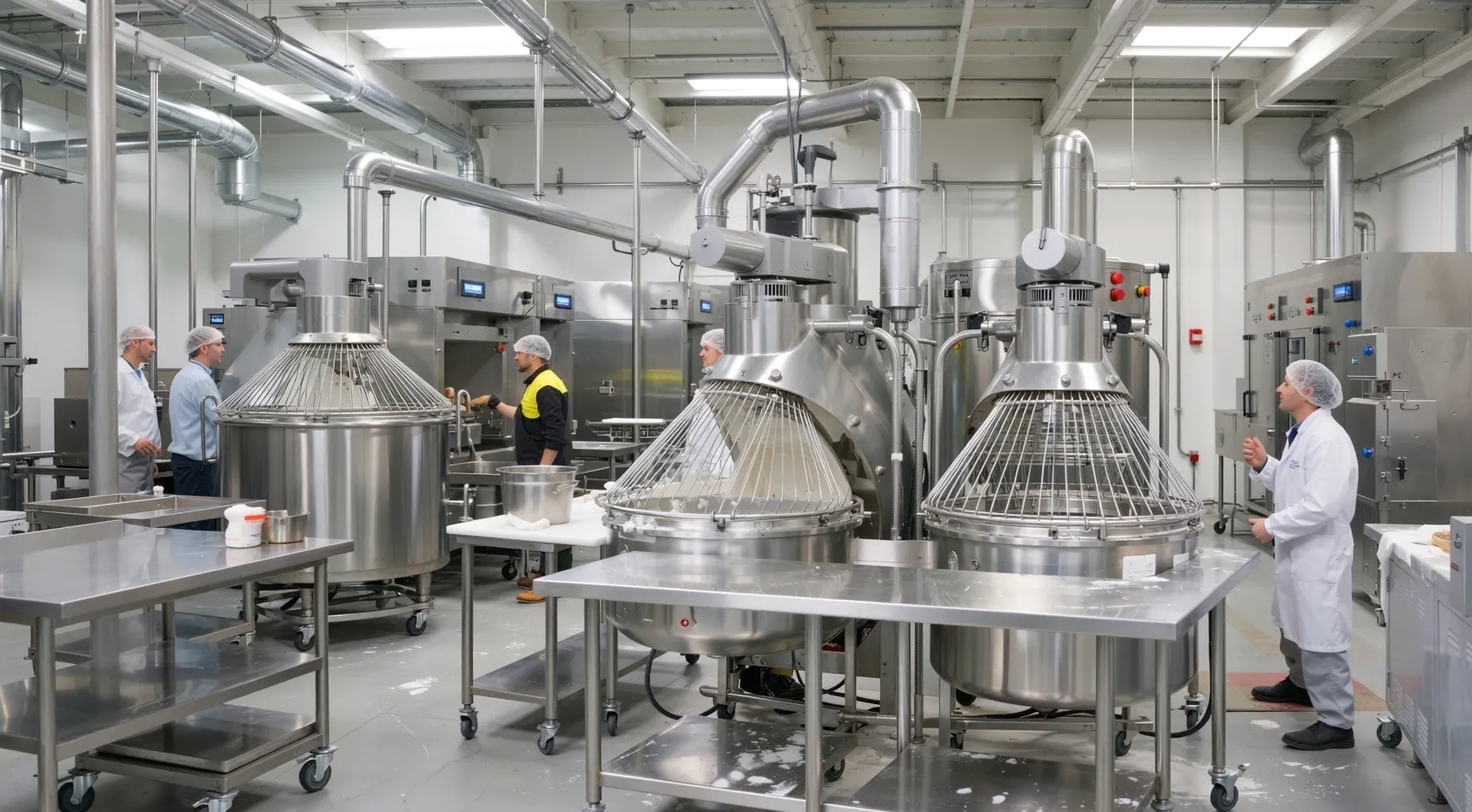
Food Product Machinery Manufacturing
Description
This U.S. industry comprises establishments primarily engaged in manufacturing food and beverage manufacturing-type machinery and equipment, such as dairy product plant machinery and equipment (e.g., homogenizers, pasteurizers, ice cream freezers), bakery machinery and equipment (e.g., dough mixers, bake ovens, pastry rolling machines), meat and poultry processing and preparation machinery, and other commercial food products machinery (e.g., slicers, choppers, and mixers).
Hierarchy
| Code | Title | Description |
|---|---|---|
| 33 | Manufacturing 2-digit sector | The Sector as a Whole The Manufacturing sector comprises establishments engaged in the mechanical, physical, or chemical transformation of materials, substances, or components into new products. The assembling of component parts of manufactured products is considered manufacturing, except in cases where the activity is appropriately classified in Sector 23, Construction. Establishments in the Manufacturing sector are often described as plants, factories, or mills and characteristically use power-driven machines and material handling equipment. However, establishments that transform materials or substances into new products by hand or in the worker's home and those engaged in selling to the general public products made on the same premises from which they are sold, such as bakeries, candy stores, and custom tailors, may also be included in this sector. Manufacturing establishments may process materials or may contract with other establishments to process their materials for them. Both types of establishments are included in manufacturing. Selected industries in the Manufacturing sector are comprised solely of establishments that process materials for other establishments on a contract or fee basis. Beyond these dedicated contract manufacturing industries, establishments that process materials for other establishments are generally classified in the Manufacturing industry of the processed materials. The materials, substances, or components transformed by manufacturing establishments are raw materials that are products of agriculture, forestry, fishing, mining, or quarrying as well as products of other manufacturing establishments. The materials used may be purchased directly from producers, obtained through customary trade channels, or secured without recourse to the market by transferring the product from one establishment to another, under the same ownership. The new product of a manufacturing establishment may be finished in the sense that it is ready for utilization or consumption, or it may be semi-finished to become an input for an establishment engaged in further manufacturing. For example, the product of the alumina refinery is the input used in the primary production of aluminum; primary aluminum is the input to an aluminum wire drawing plant; and aluminum wire is the input for a fabricated wire product manufacturing establishment. The subsectors in the Manufacturing sector generally reflect distinct production processes related to material inputs, production equipment, and employee skills. In the machinery area, where assembling is a key activity, parts and accessories for manufactured products are classified in the industry of the finished manufactured item when they are made for separate sale. For example, an attachment for a piece of metalworking machinery would be classified with metalworking machinery. However, component inputs from other manufacturing establishments are classified based on the production function of the component manufacturer. For example, electronic components are classified in Subsector 334, Computer and Electronic Product Manufacturing, and stampings are classified in Subsector 332, Fabricated Metal Product Manufacturing. Manufacturing establishments often perform one or more activities that are classified outside the Manufacturing sector of NAICS. For instance, almost all manufacturing has some captive research and development or administrative operations, such as accounting, payroll, or management. These captive services are treated the same as captive manufacturing activities. When the services are provided by separate establishments, they are classified in the NAICS sector where such services are primary, not in manufacturing. The boundaries of manufacturing and the other sectors of the classification system can be somewhat blurry. The establishments in the Manufacturing sector are engaged in the transformation of materials into new products. Their output is a new product. However, the definition of what constitutes a new product can be somewhat subjective. As clarification, the following activities are considered manufacturing in NAICS: <table width=100%><tr><td width=10%> </td><td><dl><dt style='padding-left: 10px; text-indent: -10px;'>Milk bottling and pasteurizing;</dt><dt style='padding-left: 10px; text-indent: -10px;'>Water bottling and processing;</dt><dt style='padding-left: 10px; text-indent: -10px;'>Fresh fish packaging (oyster<br/> shucking, fish filleting);</dt><dt style='padding-left: 10px; text-indent: -10px;'>Apparel jobbing (assigning<br/> materials to contract<br/> factories or shops for<br/> fabrication or other contract<br/> operations) as well as<br/> contracting on materials<br/> owned by others;</dt><dt style='padding-left: 10px; text-indent: -10px;'>Printing and related activities;</dt><dt style='padding-left: 10px; text-indent: -10px;'>Ready-mix concrete production;</dt><dt style='padding-left: 10px; text-indent: -10px;'>Leather converting;</dt><dt style='padding-left: 10px; text-indent: -10px;'>Grinding lenses to<br/> prescription;</dt><dt style='padding-left: 10px; text-indent: -10px;'>Wood preserving;</dt><dt style='padding-left: 10px; text-indent: -10px;'>Lapidary work for the trade;</dt></dl></td><td width=10%> </td><td><dl><dt style='padding-left: 10px; text-indent: -10px;'>Electroplating, plating, metal<br/> heat treating, and<br/> polishing for the trade;</dt><dt style='padding-left: 10px; text-indent: -10px;'>Fabricating signs and<br/> advertising displays;</dt><dt style='padding-left: 10px; text-indent: -10px;'>Rebuilding or remanufacturing<br/> machinery (i.e., automotive<br/> parts);</dt><dt style='padding-left: 10px; text-indent: -10px;'>Making manufactured homes<br/> (i.e., mobile homes) or<br/> prefabricated buildings,<br/> whether or not assembling/<br/> erecting at the customers'<br/> site;</dt><dt style='padding-left: 10px; text-indent: -10px;'>Ship repair and renovation;</dt><dt style='padding-left: 10px; text-indent: -10px;'>Machine shops; and</dt><dt style='padding-left: 10px; text-indent: -10px;'>Tire retreading.</dt></dl></td><td width=10%> </td></tr></table> Conversely, there are activities that are sometimes considered manufacturing, but which for NAICS are classified in another sector (i.e., not classified as manufacturing). They include: 1. Logging, classified in Sector 11, Agriculture, Forestry, Fishing and Hunting, is considered a harvesting operation; 2. Beneficiating ores and other minerals, classified in Sector 21, Mining, Quarrying, and Oil and Gas Extraction, is considered part of the activity of mining; 3. Constructing structures, assembling prefabricated buildings, and fabricating at the construction site by contractors are classified in Sector 23, Construction; 4. Breaking bulk and reselling in smaller lots, including packaging, repackaging, or bottling products, such as liquors or chemicals; assembling and selling computers on a custom basis; sorting and reselling scrap; mixing and selling paints to customer order; and cutting metals to customer order for resale are classified in Sector 42, Wholesale Trade, or Sector 44-45, Retail Trade; and 5. Publishing and the combined activity of publishing and printing, classified in Sector 51, Information, transform information into a product for which the value to the consumer lies in the information content, not in the format in which it is distributed (i.e., the book or software compact disc). |
| 333 | Machinery Manufacturing 3-digit subsector | Industries in the Machinery Manufacturing subsector create end products that apply mechanical force, for example, the application of gears and levers, to perform work. Some important processes for the manufacture of machinery are forging, stamping, bending, forming, and machining that are used to shape individual pieces of metal. Processes, such as welding and assembling are used to join separate parts together. Although these processes are similar to those used in metal fabricating establishments, machinery manufacturing is different because it typically employs multiple metal forming processes in manufacturing the various parts of the machine. Moreover, complex assembly operations are an inherent part of the production process. In general, design considerations are very important in machinery production. Establishments specialize in making machinery designed for particular applications. Thus, design is considered to be part of the production process for the purpose of implementing NAICS. The NAICS structure reflects this by defining industries and industry groups that make machinery for different applications. A broad distinction exists between machinery that is generally used in a variety of industrial applications (i.e., general purpose machinery) and machinery that is designed to be used in a particular industry (i.e., special purpose machinery). Three industry groups consist of special purpose machinery--Agriculture, Construction, and Mining Machinery Manufacturing; Industrial Machinery Manufacturing; and Commercial and Service Industry Machinery Manufacturing. The other industry groups make general purpose machinery: Ventilation, Heating, Air-Conditioning, and Commercial Refrigeration Equipment Manufacturing; Metalworking Machinery Manufacturing; Engine, Turbine, and Power Transmission Equipment Manufacturing; and Other General Purpose Machinery Manufacturing. |
| 3332 | Industrial Machinery Manufacturing 4-digit industry group | Industries in the Machinery Manufacturing subsector create end products that apply mechanical force, for example, the application of gears and levers, to perform work. Some important processes for the manufacture of machinery are forging, stamping, bending, forming, and machining that are used to shape individual pieces of metal. Processes, such as welding and assembling are used to join separate parts together. Although these processes are similar to those used in metal fabricating establishments, machinery manufacturing is different because it typically employs multiple metal forming processes in manufacturing the various parts of the machine. Moreover, complex assembly operations are an inherent part of the production process. In general, design considerations are very important in machinery production. Establishments specialize in making machinery designed for particular applications. Thus, design is considered to be part of the production process for the purpose of implementing NAICS. The NAICS structure reflects this by defining industries and industry groups that make machinery for different applications. A broad distinction exists between machinery that is generally used in a variety of industrial applications (i.e., general purpose machinery) and machinery that is designed to be used in a particular industry (i.e., special purpose machinery). Three industry groups consist of special purpose machinery--Agriculture, Construction, and Mining Machinery Manufacturing; Industrial Machinery Manufacturing; and Commercial and Service Industry Machinery Manufacturing. The other industry groups make general purpose machinery: Ventilation, Heating, Air-Conditioning, and Commercial Refrigeration Equipment Manufacturing; Metalworking Machinery Manufacturing; Engine, Turbine, and Power Transmission Equipment Manufacturing; and Other General Purpose Machinery Manufacturing. |
| 33324 | Industrial Machinery Manufacturing 5-digit NAICS industry | This industry comprises establishments primarily engaged in manufacturing industrial machinery, such as food and beverage manufacturing machinery, semiconductor manufacturing machinery, sawmill and woodworking machinery (except handheld), machinery for making paper and paper products, printing and binding machinery and equipment, textile making machinery, and machinery for making plastics and rubber products. |
| 333241 | Food Product Machinery Manufacturing 6-digit U.S. detail | This U.S. industry comprises establishments primarily engaged in manufacturing food and beverage manufacturing-type machinery and equipment, such as dairy product plant machinery and equipment (e.g., homogenizers, pasteurizers, ice cream freezers), bakery machinery and equipment (e.g., dough mixers, bake ovens, pastry rolling machines), meat and poultry processing and preparation machinery, and other commercial food products machinery (e.g., slicers, choppers, and mixers). |
Need a supply chain stack that maps to this industry?
Use this NAICS classification as the starting point, then connect it to Item workflows across inventory, warehousing, order management, fulfillment, and transportation.
Classification References
- 01Manufacturing food and beverage packaging machinery--are classified in U.S. Industry 333993, Packaging Machinery Manufacturing;
- 02Manufacturing commercial and industrial refrigeration and freezer equipment--are classified in U.S. Industry 333415, Air-Conditioning and Warm Air Heating Equipment and Commercial and Industrial Refrigeration Equipment Manufacturing; and
- 03Manufacturing commercial-type cooking and food warming equipment--are classified in Industry 333310, Commercial and Service Industry Machinery Manufacturing.
Index Items
Bakery machinery and equipment manufacturing
Bakery ovens manufacturing
Bread slicing machinery manufacturing
Brewery machinery manufacturing
Butter processing machinery manufacturing
Cheese processing machinery manufacturing
Chewing gum machinery manufacturing
Chocolate processing machinery manufacturing
Cider presses manufacturing
Coffee roasting and grinding machinery (i.e., food manufacturing-type) manufacturing
Condensed and evaporated milk machinery manufacturing
Confectionery machinery manufacturing
Corn popping machinery (i.e., food manufacturing-type) manufacturing
Cracker making machinery manufacturing
Cream separators, industrial, manufacturing
Dairy product plant machinery and equipment
Distilling equipment, beverage, manufacturing
Dough mixing machinery (i.e., food manufacturing-type) manufacturing
Dry milk processing machinery manufacturing
Flour milling machinery manufacturing
Food choppers, grinders, mixers, and slicers (i.e., food manufacturing-type) manufacturing
Food dehydrating equipment (except household-type) manufacturing
Food product machinery manufacturing
Grading, cleaning, and sorting machinery (i.e., food manufacturing-type) manufacturing
Grain milling machinery manufacturing
Homogenizing machinery, food, manufacturing
Ice cream making machinery manufacturing
Juice extractors (i.e., food manufacturing-type) manufacturing
Malt milling machinery manufacturing
Meat and poultry processing and preparation machinery
Meat grinders, food-type, manufacturing
Milk processing (except farm-type) machinery manufacturing
Oilseed crushing and extracting machinery manufacturing
Ovens, bakery, manufacturing
Pasta making machinery (i.e., food manufacturing-type) manufacturing
Pasteurizing equipment, food, manufacturing
Peanut roasting machines (i.e., food manufacturing-type) manufacturing
Presses (i.e., food manufacturing-type) manufacturing
Roasting machinery manufacturing
Sieves and screening equipment (i.e., food manufacturing-type) manufacturing
Sifting machine (i.e., food manufacturing-type) manufacturing
Slicing machinery (i.e., food manufacturing-type) manufacturing
Stuffer, sausage machinery, manufacturing
Sugar refining machinery manufacturing
Vegetable oil processing machinery manufacturing
How Item Can Help
Item.com's Warehouse Management System optimizes inventory tracking for perishable food products, ensuring accurate stock levels and reducing spoilage risks through real-time updates.
The Order Management System streamlines order processing for manufacturers by integrating production schedules with customer demand, enabling faster fulfillment and automated order routing.
Advanced analytics tools analyze market trends and supplier performance to forecast raw material needs, helping manufacturers reduce costs and maintain consistent product quality.
Item.com Tools
External Resources
Census.gov NAICS Detail
Official US Census Bureau definition and scope for NAICS 333241.
Association for Food Equipment Manufacturers
Primary trade association representing manufacturers of food production equipment and machinery.
U.S. Census Bureau NAICS 333241 Page
Official government classification page defining the scope and statistics for food product machinery manufacturing.
GSA General Schedule Commercial Items Catalog
Federal procurement resource listing specific food product machinery codes and commercial items for government contracts.