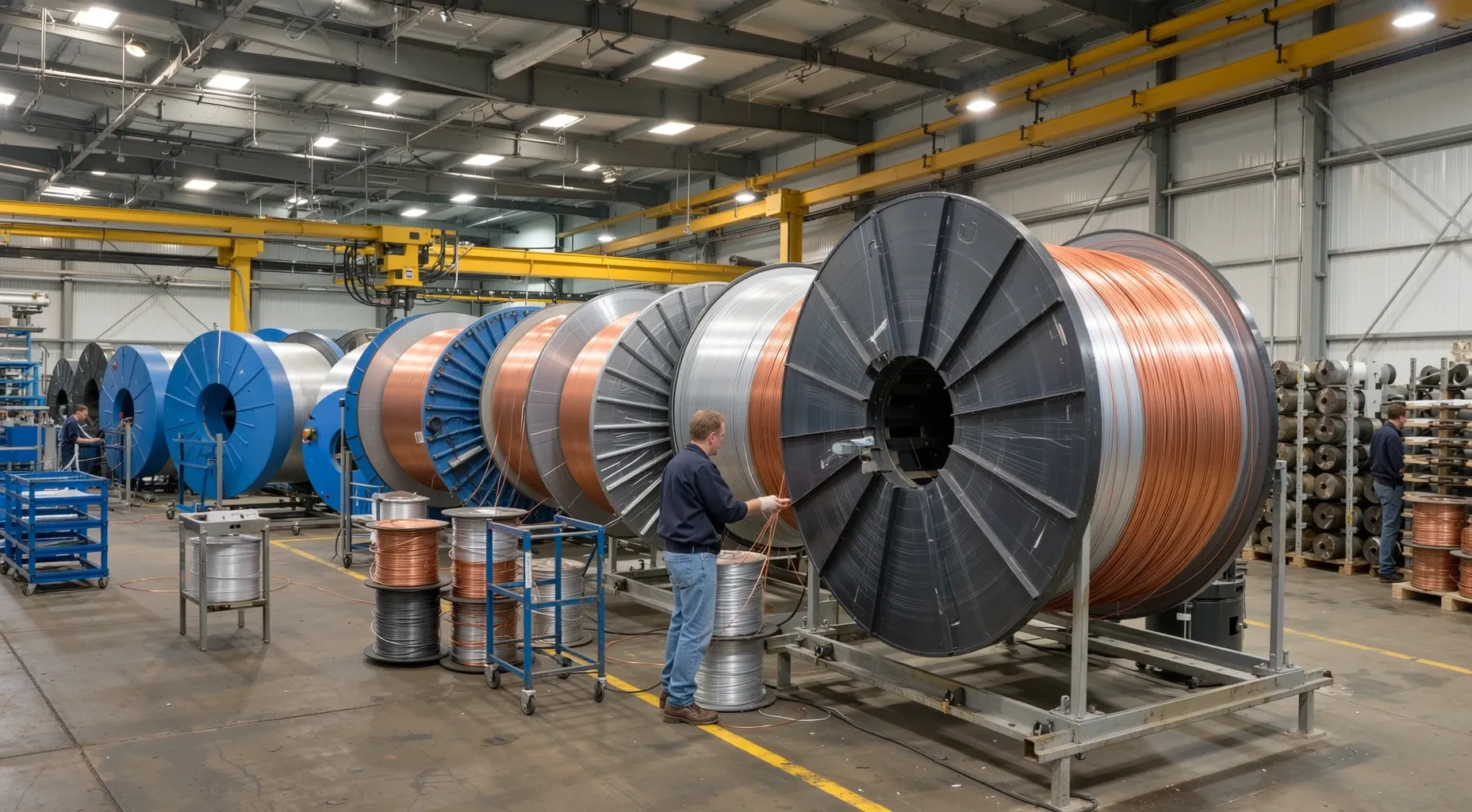
その他の通信およびエネルギー用ワイヤー製造
Description
このセクターの企業は、鉄鋼を必要としない金属で作られた絶縁ワイヤーとケーブルの製造に焦点を当てています。ワイヤーの製造を自社で行うのではなく、他の施設から購入したワイヤーを使用します。典型的な事業活動には、導電性のコアを押し出し、プラスチック、ゴム、または繊維などのさまざまな絶縁材料を適用して、特定の産業の要件を満たすことが含まれます。これらの事業活動には、通常、電気的な完全性と安全性を確保するための複雑なテストと巻き取りプロセスが含まれており、それらが配布されます。これらの事業活動には、航空宇宙または医療用途のニッチなカスタム注文を専門とする小規模な家族経営のワークショップと、広範な住宅または産業市場向けの大量の住宅または産業ソリューションを提供する大規模な製造企業の両方が含まれます。これらの事業の規模は大きく異なり、特殊な機械に少額の資本を投資した施設から、連続生産を可能にする大規模な産業プラントまであります。地理的には、この産業は米国全体に広がっており、強力な電気インフラと化学製造のサポートがある地域に集中しています。このセグメントは、電気モーター、照明、通信、およびさまざまな経済セクターにおける再生可能エネルギーシステムに必要なコンポーネントを供給することにより、国の電力グリッドと通信ネットワークにとって不可欠です。
Hierarchy
| Code | Title | Description |
|---|---|---|
| 33 | Manufacturing 2-digit sector | The Sector as a Whole The Manufacturing sector comprises establishments engaged in the mechanical, physical, or chemical transformation of materials, substances, or components into new products. The assembling of component parts of manufactured products is considered manufacturing, except in cases where the activity is appropriately classified in Sector 23, Construction. Establishments in the Manufacturing sector are often described as plants, factories, or mills and characteristically use power-driven machines and material handling equipment. However, establishments that transform materials or substances into new products by hand or in the worker's home and those engaged in selling to the general public products made on the same premises from which they are sold, such as bakeries, candy stores, and custom tailors, may also be included in this sector. Manufacturing establishments may process materials or may contract with other establishments to process their materials for them. Both types of establishments are included in manufacturing. Selected industries in the Manufacturing sector are comprised solely of establishments that process materials for other establishments on a contract or fee basis. Beyond these dedicated contract manufacturing industries, establishments that process materials for other establishments are generally classified in the Manufacturing industry of the processed materials. The materials, substances, or components transformed by manufacturing establishments are raw materials that are products of agriculture, forestry, fishing, mining, or quarrying as well as products of other manufacturing establishments. The materials used may be purchased directly from producers, obtained through customary trade channels, or secured without recourse to the market by transferring the product from one establishment to another, under the same ownership. The new product of a manufacturing establishment may be finished in the sense that it is ready for utilization or consumption, or it may be semi-finished to become an input for an establishment engaged in further manufacturing. For example, the product of the alumina refinery is the input used in the primary production of aluminum; primary aluminum is the input to an aluminum wire drawing plant; and aluminum wire is the input for a fabricated wire product manufacturing establishment. The subsectors in the Manufacturing sector generally reflect distinct production processes related to material inputs, production equipment, and employee skills. In the machinery area, where assembling is a key activity, parts and accessories for manufactured products are classified in the industry of the finished manufactured item when they are made for separate sale. For example, an attachment for a piece of metalworking machinery would be classified with metalworking machinery. However, component inputs from other manufacturing establishments are classified based on the production function of the component manufacturer. For example, electronic components are classified in Subsector 334, Computer and Electronic Product Manufacturing, and stampings are classified in Subsector 332, Fabricated Metal Product Manufacturing. Manufacturing establishments often perform one or more activities that are classified outside the Manufacturing sector of NAICS. For instance, almost all manufacturing has some captive research and development or administrative operations, such as accounting, payroll, or management. These captive services are treated the same as captive manufacturing activities. When the services are provided by separate establishments, they are classified in the NAICS sector where such services are primary, not in manufacturing. The boundaries of manufacturing and the other sectors of the classification system can be somewhat blurry. The establishments in the Manufacturing sector are engaged in the transformation of materials into new products. Their output is a new product. However, the definition of what constitutes a new product can be somewhat subjective. As clarification, the following activities are considered manufacturing in NAICS: <table width=100%><tr><td width=10%> </td><td><dl><dt style='padding-left: 10px; text-indent: -10px;'>Milk bottling and pasteurizing;</dt><dt style='padding-left: 10px; text-indent: -10px;'>Water bottling and processing;</dt><dt style='padding-left: 10px; text-indent: -10px;'>Fresh fish packaging (oyster<br/> shucking, fish filleting);</dt><dt style='padding-left: 10px; text-indent: -10px;'>Apparel jobbing (assigning<br/> materials to contract<br/> factories or shops for<br/> fabrication or other contract<br/> operations) as well as<br/> contracting on materials<br/> owned by others;</dt><dt style='padding-left: 10px; text-indent: -10px;'>Printing and related activities;</dt><dt style='padding-left: 10px; text-indent: -10px;'>Ready-mix concrete production;</dt><dt style='padding-left: 10px; text-indent: -10px;'>Leather converting;</dt><dt style='padding-left: 10px; text-indent: -10px;'>Grinding lenses to<br/> prescription;</dt><dt style='padding-left: 10px; text-indent: -10px;'>Wood preserving;</dt><dt style='padding-left: 10px; text-indent: -10px;'>Lapidary work for the trade;</dt></dl></td><td width=10%> </td><td><dl><dt style='padding-left: 10px; text-indent: -10px;'>Electroplating, plating, metal<br/> heat treating, and<br/> polishing for the trade;</dt><dt style='padding-left: 10px; text-indent: -10px;'>Fabricating signs and<br/> advertising displays;</dt><dt style='padding-left: 10px; text-indent: -10px;'>Rebuilding or remanufacturing<br/> machinery (i.e., automotive<br/> parts);</dt><dt style='padding-left: 10px; text-indent: -10px;'>Making manufactured homes<br/> (i.e., mobile homes) or<br/> prefabricated buildings,<br/> whether or not assembling/<br/> erecting at the customers'<br/> site;</dt><dt style='padding-left: 10px; text-indent: -10px;'>Ship repair and renovation;</dt><dt style='padding-left: 10px; text-indent: -10px;'>Machine shops; and</dt><dt style='padding-left: 10px; text-indent: -10px;'>Tire retreading.</dt></dl></td><td width=10%> </td></tr></table> Conversely, there are activities that are sometimes considered manufacturing, but which for NAICS are classified in another sector (i.e., not classified as manufacturing). They include: 1. Logging, classified in Sector 11, Agriculture, Forestry, Fishing and Hunting, is considered a harvesting operation; 2. Beneficiating ores and other minerals, classified in Sector 21, Mining, Quarrying, and Oil and Gas Extraction, is considered part of the activity of mining; 3. Constructing structures, assembling prefabricated buildings, and fabricating at the construction site by contractors are classified in Sector 23, Construction; 4. Breaking bulk and reselling in smaller lots, including packaging, repackaging, or bottling products, such as liquors or chemicals; assembling and selling computers on a custom basis; sorting and reselling scrap; mixing and selling paints to customer order; and cutting metals to customer order for resale are classified in Sector 42, Wholesale Trade, or Sector 44-45, Retail Trade; and 5. Publishing and the combined activity of publishing and printing, classified in Sector 51, Information, transform information into a product for which the value to the consumer lies in the information content, not in the format in which it is distributed (i.e., the book or software compact disc). |
| 335 | Communication and Energy Wire and Cable Manufacturing 3-digit subsector | Industries in the Communication and Energy Wire and Cable Manufacturing subsector manufacture products that generate, distribute, and use electrical power. Electric Lighting Equipment Manufacturing establishments produce lighting fixtures, electric light bulbs, and parts (except glass parts and light emitting diodes (LEDs)), and other lighting equipment. Household Appliance Manufacturing establishments make both small and major electrical appliances and parts. Electrical Equipment Manufacturing establishments make goods, such as electric motors, generators, transformers, and switchgear apparatus. Other Electrical Equipment and Component Manufacturing establishments make devices for storing electrical power (e.g., batteries), for transmitting electricity (e.g., insulated wire), and wiring devices (e.g., electrical outlets, fuse boxes, and light switches). |
| 3359 | Communication and Energy Wire and Cable Manufacturing 4-digit industry group | This industry comprises establishments primarily engaged in insulating fiber optic cable, and manufacturing insulated nonferrous wire and cable from nonferrous wire drawn in other establishments. |
| 33592 | Communication and Energy Wire and Cable Manufacturing 5-digit NAICS industry | This industry comprises establishments primarily engaged in insulating fiber optic cable, and manufacturing insulated nonferrous wire and cable from nonferrous wire drawn in other establishments. |
| 335929 | その他の通信およびエネルギー用ワイヤー製造 6-digit U.S. detail | このセクターの企業は、鉄鋼を必要としない金属で作られた絶縁ワイヤーとケーブルの製造に焦点を当てています。ワイヤーの製造を自社で行うのではなく、他の施設から購入したワイヤーを使用します。典型的な事業活動には、導電性のコアを押し出し、プラスチック、ゴム、または繊維などのさまざまな絶縁材料を適用して、特定の産業の要件を満たすことが含まれます。これらの事業活動には、通常、電気的な完全性と安全性を確保するための複雑なテストと巻き取りプロセスが含まれており、それらが配布されます。これらの事業活動には、航空宇宙または医療用途のニッチなカスタム注文を専門とする小規模な家族経営のワークショップと、広範な住宅または産業市場向けの大量の住宅または産業ソリューションを提供する大規模な製造企業の両方が含まれます。これらの事業の規模は大きく異なり、特殊な機械に少額の資本を投資した施設から、連続生産を可能にする大規模な産業プラントまであります。地理的には、この産業は米国全体に広がっており、強力な電気インフラと化学製造のサポートがある地域に集中しています。このセグメントは、電気モーター、照明、通信、およびさまざまな経済セクターにおける再生可能エネルギーシステムに必要なコンポーネントを供給することにより、国の電力グリッドと通信ネットワークにとって不可欠です。 |
Need a supply chain stack that maps to this industry?
Use this NAICS classification as the starting point, then connect it to Item workflows across inventory, warehousing, order management, fulfillment, and transportation.
Classification References
- 01製造された絶縁線と各種コネクタを含むケーブルセット(電子用途用)は、U.S. Industry 334419、その他の電子部品製造に分類されます。
- 02購入した絶縁線から製造された延長コード、家電用コード、および類似の電気コードセットは、U.S. Industry 335999、すべてのその他の miscellaneous 電気機器および部品製造に分類されます。
- 03同じ施設で銅線を引くおよび絶縁する--は、Industry 331420、銅の圧延、引伸、および合金製造に分類されます。
- 04同じ施設でアルミニウム線を引くおよび絶縁する--は、U.S. Industry 331318、その他のアルミニウム圧延、引伸、および合金製造に分類されます。
- 05非鉄線(銅およびアルミニウムを除く)を引くおよび絶縁する--は、U.S. Industry 331491、非鉄金属(銅およびアルミニウムを除く)の圧延、引伸、および合金製造に分類されます。
Index Items
購入した非鉄線から作られた、絶縁またはアーモアされたケーブル
コアクシャルケーブル、購入した非鉄線から作られた
通信用ケーブルおよびケーブル、購入した非鉄線から作られた
購入した非鉄線を絶縁する
How Item Can Help
Analyzes real-time production metrics to predict material demand spikes, allowing proactive adjustments to wire manufacturing schedules and preventing supply chain bottlenecks.
Item.com Tools
External Resources
Census.gov NAICS Detail
Official US Census Bureau definition and scope for NAICS 335929.
American Iron and Steel Institute
Represents steel producers including those manufacturing energy transmission wires.
US Department of Energy
Provides government reports and data on the US energy wire manufacturing sector.
Mergans Group
Industry directory and marketplace for communication and energy wire manufacturing companies.
