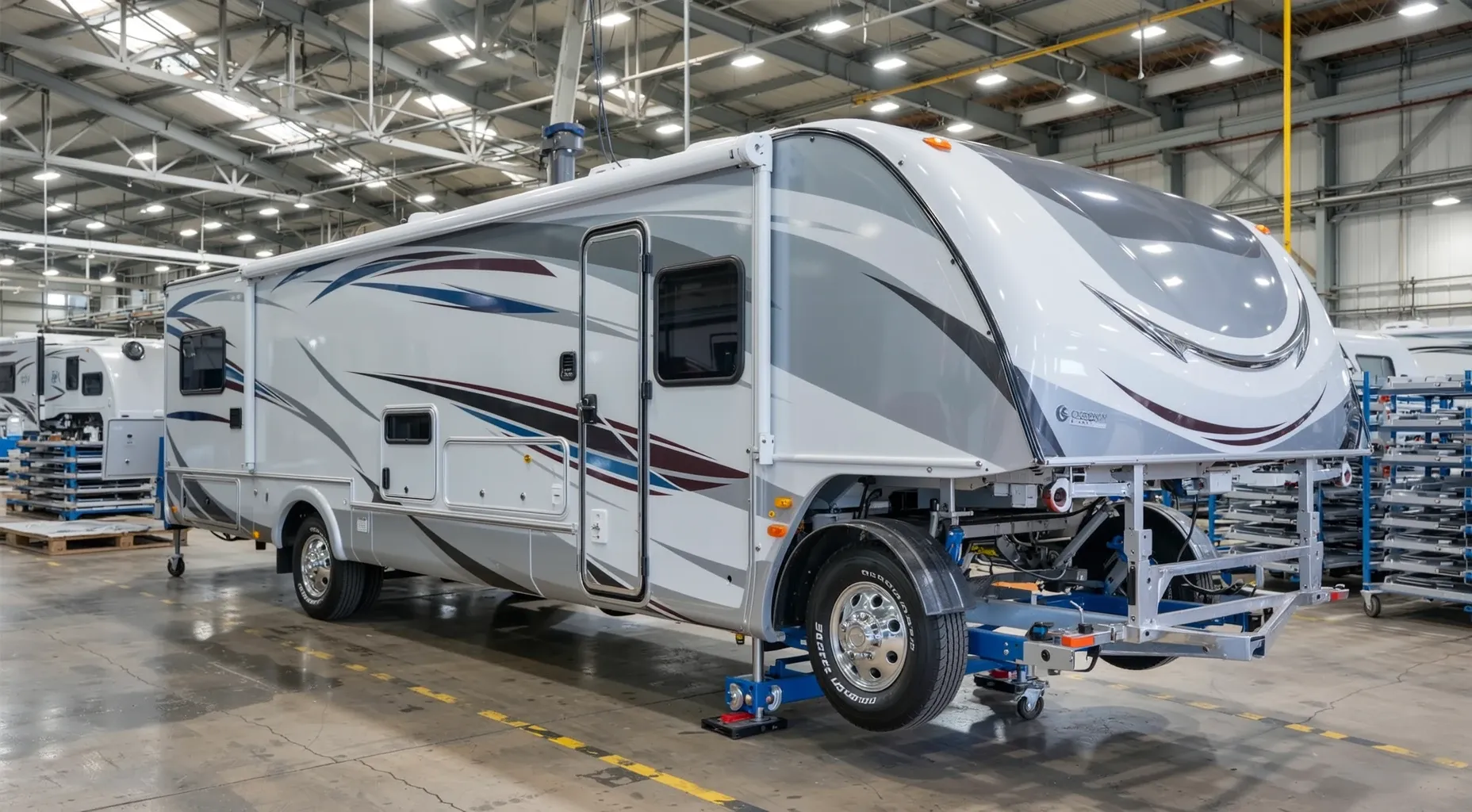
Travel Trailer and Camper Manufacturing
Description
This U.S. industry comprises establishments primarily engaged in one or more of the following: (1) manufacturing travel trailers and campers designed to attach to motor vehicles; (2) manufacturing pick-up coaches (i.e., campers) and caps (i.e., covers) for mounting on pick-up trucks; and (3) manufacturing automobile, utility, and light-truck trailers. Travel trailers do not have their own motor but are designed to be towed by a motor unit, such as an automobile or a light truck. Illustrative Examples: Automobile transporter trailers, single car, manufacturing Camper units, slide-in, for pick-up trucks, manufacturing Camping trailers and chassis manufacturing Horse trailers (except fifth-wheel-type) manufacturing Pick-up canopies, caps, or covers manufacturing Travel trailers, recreational, manufacturing Utility trailers manufacturing
Hierarchy
| Code | Title | Description |
|---|---|---|
| 33 | Manufacturing 2-digit sector | The Sector as a Whole The Manufacturing sector comprises establishments engaged in the mechanical, physical, or chemical transformation of materials, substances, or components into new products. The assembling of component parts of manufactured products is considered manufacturing, except in cases where the activity is appropriately classified in Sector 23, Construction. Establishments in the Manufacturing sector are often described as plants, factories, or mills and characteristically use power-driven machines and material handling equipment. However, establishments that transform materials or substances into new products by hand or in the worker's home and those engaged in selling to the general public products made on the same premises from which they are sold, such as bakeries, candy stores, and custom tailors, may also be included in this sector. Manufacturing establishments may process materials or may contract with other establishments to process their materials for them. Both types of establishments are included in manufacturing. Selected industries in the Manufacturing sector are comprised solely of establishments that process materials for other establishments on a contract or fee basis. Beyond these dedicated contract manufacturing industries, establishments that process materials for other establishments are generally classified in the Manufacturing industry of the processed materials. The materials, substances, or components transformed by manufacturing establishments are raw materials that are products of agriculture, forestry, fishing, mining, or quarrying as well as products of other manufacturing establishments. The materials used may be purchased directly from producers, obtained through customary trade channels, or secured without recourse to the market by transferring the product from one establishment to another, under the same ownership. The new product of a manufacturing establishment may be finished in the sense that it is ready for utilization or consumption, or it may be semi-finished to become an input for an establishment engaged in further manufacturing. For example, the product of the alumina refinery is the input used in the primary production of aluminum; primary aluminum is the input to an aluminum wire drawing plant; and aluminum wire is the input for a fabricated wire product manufacturing establishment. The subsectors in the Manufacturing sector generally reflect distinct production processes related to material inputs, production equipment, and employee skills. In the machinery area, where assembling is a key activity, parts and accessories for manufactured products are classified in the industry of the finished manufactured item when they are made for separate sale. For example, an attachment for a piece of metalworking machinery would be classified with metalworking machinery. However, component inputs from other manufacturing establishments are classified based on the production function of the component manufacturer. For example, electronic components are classified in Subsector 334, Computer and Electronic Product Manufacturing, and stampings are classified in Subsector 332, Fabricated Metal Product Manufacturing. Manufacturing establishments often perform one or more activities that are classified outside the Manufacturing sector of NAICS. For instance, almost all manufacturing has some captive research and development or administrative operations, such as accounting, payroll, or management. These captive services are treated the same as captive manufacturing activities. When the services are provided by separate establishments, they are classified in the NAICS sector where such services are primary, not in manufacturing. The boundaries of manufacturing and the other sectors of the classification system can be somewhat blurry. The establishments in the Manufacturing sector are engaged in the transformation of materials into new products. Their output is a new product. However, the definition of what constitutes a new product can be somewhat subjective. As clarification, the following activities are considered manufacturing in NAICS: <table width=100%><tr><td width=10%> </td><td><dl><dt style='padding-left: 10px; text-indent: -10px;'>Milk bottling and pasteurizing;</dt><dt style='padding-left: 10px; text-indent: -10px;'>Water bottling and processing;</dt><dt style='padding-left: 10px; text-indent: -10px;'>Fresh fish packaging (oyster<br/> shucking, fish filleting);</dt><dt style='padding-left: 10px; text-indent: -10px;'>Apparel jobbing (assigning<br/> materials to contract<br/> factories or shops for<br/> fabrication or other contract<br/> operations) as well as<br/> contracting on materials<br/> owned by others;</dt><dt style='padding-left: 10px; text-indent: -10px;'>Printing and related activities;</dt><dt style='padding-left: 10px; text-indent: -10px;'>Ready-mix concrete production;</dt><dt style='padding-left: 10px; text-indent: -10px;'>Leather converting;</dt><dt style='padding-left: 10px; text-indent: -10px;'>Grinding lenses to<br/> prescription;</dt><dt style='padding-left: 10px; text-indent: -10px;'>Wood preserving;</dt><dt style='padding-left: 10px; text-indent: -10px;'>Lapidary work for the trade;</dt></dl></td><td width=10%> </td><td><dl><dt style='padding-left: 10px; text-indent: -10px;'>Electroplating, plating, metal<br/> heat treating, and<br/> polishing for the trade;</dt><dt style='padding-left: 10px; text-indent: -10px;'>Fabricating signs and<br/> advertising displays;</dt><dt style='padding-left: 10px; text-indent: -10px;'>Rebuilding or remanufacturing<br/> machinery (i.e., automotive<br/> parts);</dt><dt style='padding-left: 10px; text-indent: -10px;'>Making manufactured homes<br/> (i.e., mobile homes) or<br/> prefabricated buildings,<br/> whether or not assembling/<br/> erecting at the customers'<br/> site;</dt><dt style='padding-left: 10px; text-indent: -10px;'>Ship repair and renovation;</dt><dt style='padding-left: 10px; text-indent: -10px;'>Machine shops; and</dt><dt style='padding-left: 10px; text-indent: -10px;'>Tire retreading.</dt></dl></td><td width=10%> </td></tr></table> Conversely, there are activities that are sometimes considered manufacturing, but which for NAICS are classified in another sector (i.e., not classified as manufacturing). They include: 1. Logging, classified in Sector 11, Agriculture, Forestry, Fishing and Hunting, is considered a harvesting operation; 2. Beneficiating ores and other minerals, classified in Sector 21, Mining, Quarrying, and Oil and Gas Extraction, is considered part of the activity of mining; 3. Constructing structures, assembling prefabricated buildings, and fabricating at the construction site by contractors are classified in Sector 23, Construction; 4. Breaking bulk and reselling in smaller lots, including packaging, repackaging, or bottling products, such as liquors or chemicals; assembling and selling computers on a custom basis; sorting and reselling scrap; mixing and selling paints to customer order; and cutting metals to customer order for resale are classified in Sector 42, Wholesale Trade, or Sector 44-45, Retail Trade; and 5. Publishing and the combined activity of publishing and printing, classified in Sector 51, Information, transform information into a product for which the value to the consumer lies in the information content, not in the format in which it is distributed (i.e., the book or software compact disc). |
| 336 | Transportation Equipment Manufacturing 3-digit subsector | Industries in the Transportation Equipment Manufacturing subsector produce equipment for transporting people and goods. Transportation equipment is a type of machinery. An entire subsector is devoted to this activity because of the significance of its economic size in all three North American countries. Establishments in this subsector utilize production processes similar to those of other machinery manufacturing establishments—bending, forming, welding, machining, and assembling metal or plastic parts into components and finished products. However, the assembly of components and subassemblies and their further assembly into finished vehicles tends to be a more common production process in this subsector than in the Machinery Manufacturing subsector. NAICS has industry groups for the manufacture of equipment for each mode of transport—road, rail, air, and water. Parts for motor vehicles warrant a separate industry group because of their importance and because they require less assembly than complete vehicles. Land use motor vehicle equipment not designed for highway operation (e.g., agricultural equipment, construction equipment, and material handling equipment) is classified in the appropriate NAICS subsector based on the type and use of the equipment. |
| 3362 | Motor Vehicle Body and Trailer Manufacturing 4-digit industry group | Industries in the Transportation Equipment Manufacturing subsector produce equipment for transporting people and goods. Transportation equipment is a type of machinery. An entire subsector is devoted to this activity because of the significance of its economic size in all three North American countries. Establishments in this subsector utilize production processes similar to those of other machinery manufacturing establishments—bending, forming, welding, machining, and assembling metal or plastic parts into components and finished products. However, the assembly of components and subassemblies and their further assembly into finished vehicles tends to be a more common production process in this subsector than in the Machinery Manufacturing subsector. NAICS has industry groups for the manufacture of equipment for each mode of transport—road, rail, air, and water. Parts for motor vehicles warrant a separate industry group because of their importance and because they require less assembly than complete vehicles. Land use motor vehicle equipment not designed for highway operation (e.g., agricultural equipment, construction equipment, and material handling equipment) is classified in the appropriate NAICS subsector based on the type and use of the equipment. |
| 33621 | Motor Vehicle Body and Trailer Manufacturing 5-digit NAICS industry | This industry comprises establishments primarily engaged in (1) manufacturing motor vehicle bodies and cabs or (2) manufacturing truck, automobile and utility trailers, truck trailer chassis, detachable trailer bodies, and detachable trailer chassis. The products made may be sold separately or may be assembled on purchased chassis and sold as complete vehicles. Motor homes are units where the motor and the living quarters are contained in the same integrated unit, while travel trailers are designed to be towed by a motor unit, such as an automobile or a light truck. Illustrative Examples: Bodies and cabs, truck, manufacturing Camper units, slide-in, for pick-up trucks, manufacturing Pick-up canopies, caps, or covers manufacturing Motor homes, self-contained, assembling on purchased chassis Semi-trailers manufacturing Travel trailers, recreational, manufacturing |
| 336214 | Travel Trailer and Camper Manufacturing 6-digit U.S. detail | This U.S. industry comprises establishments primarily engaged in one or more of the following: (1) manufacturing travel trailers and campers designed to attach to motor vehicles; (2) manufacturing pick-up coaches (i.e., campers) and caps (i.e., covers) for mounting on pick-up trucks; and (3) manufacturing automobile, utility, and light-truck trailers. Travel trailers do not have their own motor but are designed to be towed by a motor unit, such as an automobile or a light truck. Illustrative Examples: Automobile transporter trailers, single car, manufacturing Camper units, slide-in, for pick-up trucks, manufacturing Camping trailers and chassis manufacturing Horse trailers (except fifth-wheel-type) manufacturing Pick-up canopies, caps, or covers manufacturing Travel trailers, recreational, manufacturing Utility trailers manufacturing |
Need a supply chain stack that maps to this industry?
Use this NAICS classification as the starting point, then connect it to Item workflows across inventory, warehousing, order management, fulfillment, and transportation.
Classification References
- 01Manufacturing truck trailers, truck trailer chassis, cargo container chassis, detachable trailer bodies, and detachable trailer chassis for sale separately--are classified in U.S. Industry 336212, Truck Trailer Manufacturing; and
- 02Making manufactured homes (i.e., mobile homes) designed to accept permanent water, sewer, and utility connections and equipped with wheels, but not intended for regular highway use--are classified in U.S. Industry 321991, Manufactured Home (Mobile Home) Manufacturing.
Index Items
Automobile transporter trailers, single car, manufacturing
Boat transporter trailers, single-unit, manufacturing
Camper units, slide-in, for pick-up trucks, manufacturing
Camping trailers and chassis manufacturing
Caps for pick-up trucks manufacturing
Horse trailers (except fifth-wheel-type) manufacturing
Pick-up canopies, caps, or covers manufacturing
Tent trailers (hard top and soft top) manufacturing
Trailers for transporting horses (except fifth-wheel-type) manufacturing
Trailers, camping, manufacturing
Travel trailers, recreational, manufacturing
Truck campers (i.e., slide-in campers) manufacturing
Utility trailers manufacturing
How Item Can Help
Item.com's Warehouse Management System optimizes the handling of heavy travel trailers by automating load planning and optimizing storage slots for large dimensions, which reduces manual handling errors and improves space utilization in large facilities.
The Order Management System streamlines complex customer orders by integrating real-time inventory data across multiple warehouses, ensuring fast order fulfillment for customized camper configurations and reducing shipping delays.
Data Intelligence analyzes supply chain trends to predict raw material price fluctuations for steel and aluminum, allowing manufacturers to adjust procurement strategies and mitigate cost volatility before it impacts production budgets.
Item.com Tools
External Resources
Census.gov NAICS Detail
Official US Census Bureau definition and scope for NAICS 336214.
US Traveler Association
A leading trade association representing recreational vehicle manufacturers and industry professionals.
NAICS 336214 Overview - U.S. Bureau of Labor Statistics
A government page providing definitions, scope, and labor market statistics for the Travel Trailer and Camper Manufacturing sector.
Manufacturing USA - Outdoor Mobility and RV Technology
An industry directory offering resources, partnerships, and technology information for RV manufacturing companies.
