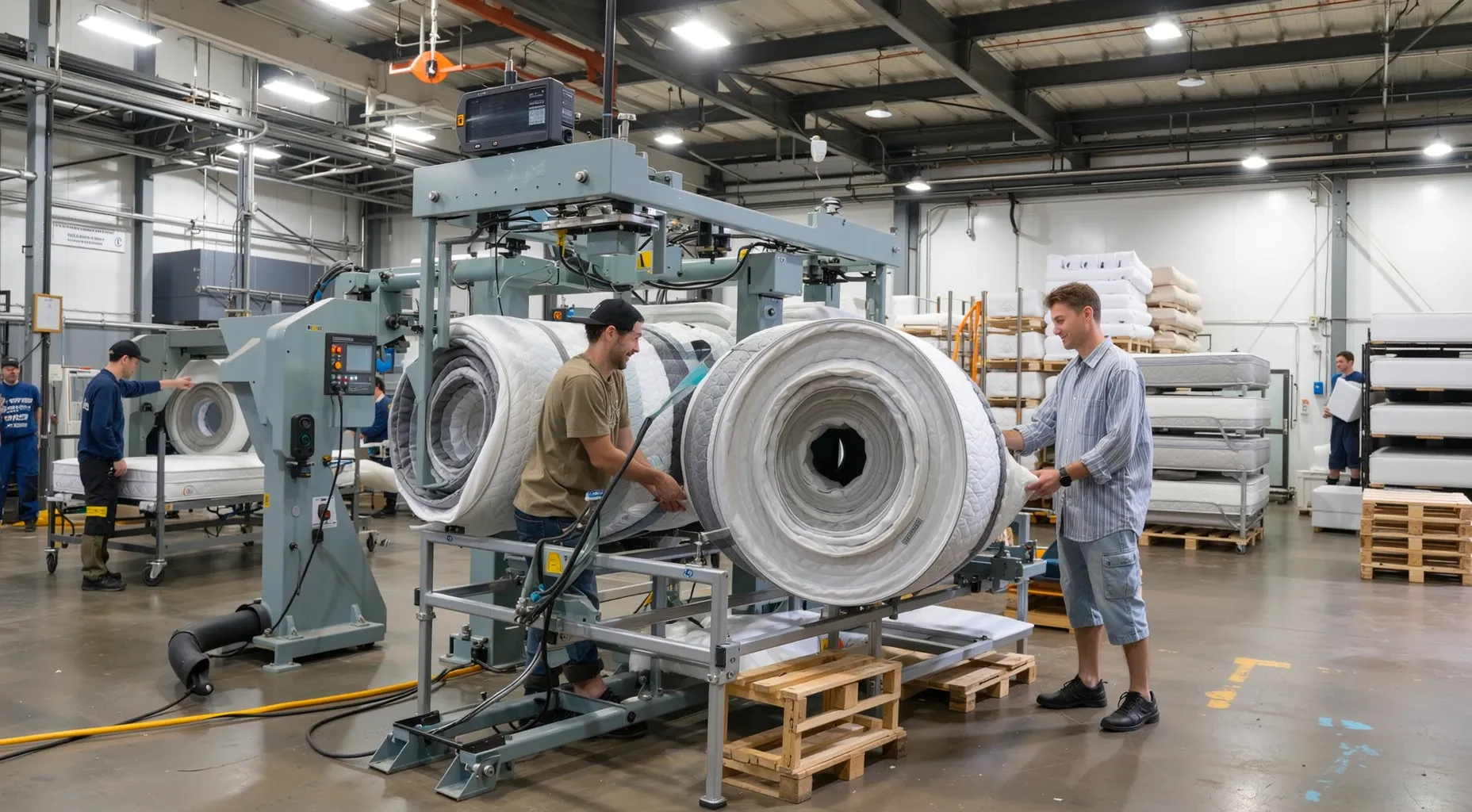
マットレス製造
Description
マットレス製造は、伝統的なインナーコイルベッドから最新のフォームおよびハイブリッドモデルまで、幅広い睡眠システムを製造することに焦点を当てた、家具生産セクターの重要なセグメントを構成します。主な事業活動には、鋼のコイル、ポリフォーム、ラテックス、ガラス繊維、およびさまざまな生地のカバーなどの原材料の調達が含まれ、これらを最終製品に変換します。このプロセスには、フォーム層のカット、コイルの組み立て、快適なトッパーの適用、および耐久性と品質基準を満たすための丈夫な外装の縫製が含まれます。一般的なオペレーターは、サプライチェーンを制御し、デザインスタジオを持つ大規模で垂直統合された企業から、複数のサプライヤーからコンポーネントを調達する、より小さな専門企業までさまざまです。これらの企業は、安全規制を満たすために、製品のテストおよび認証プロセスにも取り組んでおり、市場の需要に対応しています。一部の企業は、ボックススプリングの生産と調整可能なベースの統合を含む、睡眠家具の包括的なソリューションを提供しています。この業界は、数千人の労働者が大規模な工場複合施設で働く場合から、わずか10人程度の従業員を擁するより小さな施設まで、さまざまな規模で運営されています。これらの施設は地理的に分散しており、多くの場合、小売ハブまたはロジスティクスセンターの近くに位置し、重い在庫を地域のディストリビューターおよび直接消費者チャネルに流通させることを容易にしています。
Hierarchy
| Code | Title | Description |
|---|---|---|
| 33 | Manufacturing 2-digit sector | The Sector as a Whole The Manufacturing sector comprises establishments engaged in the mechanical, physical, or chemical transformation of materials, substances, or components into new products. The assembling of component parts of manufactured products is considered manufacturing, except in cases where the activity is appropriately classified in Sector 23, Construction. Establishments in the Manufacturing sector are often described as plants, factories, or mills and characteristically use power-driven machines and material handling equipment. However, establishments that transform materials or substances into new products by hand or in the worker's home and those engaged in selling to the general public products made on the same premises from which they are sold, such as bakeries, candy stores, and custom tailors, may also be included in this sector. Manufacturing establishments may process materials or may contract with other establishments to process their materials for them. Both types of establishments are included in manufacturing. Selected industries in the Manufacturing sector are comprised solely of establishments that process materials for other establishments on a contract or fee basis. Beyond these dedicated contract manufacturing industries, establishments that process materials for other establishments are generally classified in the Manufacturing industry of the processed materials. The materials, substances, or components transformed by manufacturing establishments are raw materials that are products of agriculture, forestry, fishing, mining, or quarrying as well as products of other manufacturing establishments. The materials used may be purchased directly from producers, obtained through customary trade channels, or secured without recourse to the market by transferring the product from one establishment to another, under the same ownership. The new product of a manufacturing establishment may be finished in the sense that it is ready for utilization or consumption, or it may be semi-finished to become an input for an establishment engaged in further manufacturing. For example, the product of the alumina refinery is the input used in the primary production of aluminum; primary aluminum is the input to an aluminum wire drawing plant; and aluminum wire is the input for a fabricated wire product manufacturing establishment. The subsectors in the Manufacturing sector generally reflect distinct production processes related to material inputs, production equipment, and employee skills. In the machinery area, where assembling is a key activity, parts and accessories for manufactured products are classified in the industry of the finished manufactured item when they are made for separate sale. For example, an attachment for a piece of metalworking machinery would be classified with metalworking machinery. However, component inputs from other manufacturing establishments are classified based on the production function of the component manufacturer. For example, electronic components are classified in Subsector 334, Computer and Electronic Product Manufacturing, and stampings are classified in Subsector 332, Fabricated Metal Product Manufacturing. Manufacturing establishments often perform one or more activities that are classified outside the Manufacturing sector of NAICS. For instance, almost all manufacturing has some captive research and development or administrative operations, such as accounting, payroll, or management. These captive services are treated the same as captive manufacturing activities. When the services are provided by separate establishments, they are classified in the NAICS sector where such services are primary, not in manufacturing. The boundaries of manufacturing and the other sectors of the classification system can be somewhat blurry. The establishments in the Manufacturing sector are engaged in the transformation of materials into new products. Their output is a new product. However, the definition of what constitutes a new product can be somewhat subjective. As clarification, the following activities are considered manufacturing in NAICS: <table width=100%><tr><td width=10%> </td><td><dl><dt style='padding-left: 10px; text-indent: -10px;'>Milk bottling and pasteurizing;</dt><dt style='padding-left: 10px; text-indent: -10px;'>Water bottling and processing;</dt><dt style='padding-left: 10px; text-indent: -10px;'>Fresh fish packaging (oyster<br/> shucking, fish filleting);</dt><dt style='padding-left: 10px; text-indent: -10px;'>Apparel jobbing (assigning<br/> materials to contract<br/> factories or shops for<br/> fabrication or other contract<br/> operations) as well as<br/> contracting on materials<br/> owned by others;</dt><dt style='padding-left: 10px; text-indent: -10px;'>Printing and related activities;</dt><dt style='padding-left: 10px; text-indent: -10px;'>Ready-mix concrete production;</dt><dt style='padding-left: 10px; text-indent: -10px;'>Leather converting;</dt><dt style='padding-left: 10px; text-indent: -10px;'>Grinding lenses to<br/> prescription;</dt><dt style='padding-left: 10px; text-indent: -10px;'>Wood preserving;</dt><dt style='padding-left: 10px; text-indent: -10px;'>Lapidary work for the trade;</dt></dl></td><td width=10%> </td><td><dl><dt style='padding-left: 10px; text-indent: -10px;'>Electroplating, plating, metal<br/> heat treating, and<br/> polishing for the trade;</dt><dt style='padding-left: 10px; text-indent: -10px;'>Fabricating signs and<br/> advertising displays;</dt><dt style='padding-left: 10px; text-indent: -10px;'>Rebuilding or remanufacturing<br/> machinery (i.e., automotive<br/> parts);</dt><dt style='padding-left: 10px; text-indent: -10px;'>Making manufactured homes<br/> (i.e., mobile homes) or<br/> prefabricated buildings,<br/> whether or not assembling/<br/> erecting at the customers'<br/> site;</dt><dt style='padding-left: 10px; text-indent: -10px;'>Ship repair and renovation;</dt><dt style='padding-left: 10px; text-indent: -10px;'>Machine shops; and</dt><dt style='padding-left: 10px; text-indent: -10px;'>Tire retreading.</dt></dl></td><td width=10%> </td></tr></table> Conversely, there are activities that are sometimes considered manufacturing, but which for NAICS are classified in another sector (i.e., not classified as manufacturing). They include: 1. Logging, classified in Subsector 321, Wood Product Manufacturing; 2. Transportation equipment manufacturing, classified in Subsector 336; and 3. Miscellaneous manufacturing, classified in Subsector 339. |
| 337 | Furniture and Related Product Manufacturing 3-digit subsector | Industries in the Furniture and Related Product Manufacturing subsector make furniture and related articles, such as mattresses, window blinds, cabinets, and fixtures. The processes used in the manufacture of furniture include the cutting, bending, molding, laminating, and assembly of such materials as wood, metal, glass, plastics, and rattan. However, the production process for furniture is not solely bending metal, cutting and shaping wood, or extruding and molding plastics. Design and fashion trends play an important part in the production of furniture. The integrated design of the article for both esthetic and functional qualities is also a major part of the process of manufacturing furniture. Design services may be performed by the furniture establishment's work force or may be purchased from industrial designers. Furniture may be made of any material, but the most common ones used in North America are metal and wood. Furniture manufacturing establishments may specialize in making articles primarily from one material. Some of the equipment required to make a wooden table, for example, is different from that used to make a metal one. However, furniture is usually made from several materials. A wooden table might have metal brackets, and a wooden chair a fabric or plastics seat. Therefore, in NAICS, furniture initially is classified based on the type of furniture (application for which it is designed) rather than the material used. For example, an upholstered sofa is treated as household furniture, although it may also be used in hotels or offices. When classifying furniture according to the component material from which it is made, furniture made from more than one material is classified based on the material used in the frame, or if there is no frame, the predominant component material. Upholstered household furniture (excluding kitchen and dining room chairs with upholstered seats) is classified without regard to the frame material. Kitchen or dining room chairs with upholstered seats are classified according to the frame material. Furniture may be made on a stock or custom basis and may be shipped assembled or unassembled (i.e., knockdown). The manufacture of furniture parts and frames is included in this subsector. Some of the processes used in furniture manufacturing are similar to processes that are used in other segments of manufacturing. For example, cutting and assembly occurs in the production of wood trusses that are classified in Subsector 321, Wood Product Manufacturing. However, the multiple processes that distinguish wood furniture manufacturing from wood product manufacturing warrant inclusion of wooden furniture manufacturing in the Furniture and Related Product Manufacturing subsector. Metal furniture manufacturing uses techniques that are also employed in the manufacturing of roll formed products classified in Subsector 332, Fabricated Metal Product Manufacturing. The molding process for plastics furniture is similar to the molding of other plastics products. However, plastics furniture producing establishments tend to specialize in furniture. NAICS attempts to keep furniture manufacturing together, but there are notable exceptions: concrete, ceramic, or stone furniture; seating for transportation equipment; and specialized hospital furniture (e.g., hospital beds and operating tables). These are classified in Subsector 327, Nonmetallic Mineral Product Manufacturing; Subsector 336, Transportation Equipment Manufacturing; and Subsector 339, Miscellaneous Manufacturing, respectively. |
| 3379 | Other Furniture Related Product Manufacturing 4-digit industry group | This industry group comprises establishments manufacturing furniture related products, such as mattresses, blinds, and shades. |
| 33791 | Mattress Manufacturing 5-digit NAICS industry | Manufacturing of mattresses. |
| 337910 | マットレス製造 6-digit U.S. detail | マットレス製造は、伝統的なインナーコイルベッドから最新のフォームおよびハイブリッドモデルまで、幅広い睡眠システムを製造することに焦点を当てた、家具生産セクターの重要なセグメントを構成します。主な事業活動には、鋼のコイル、ポリフォーム、ラテックス、ガラス繊維、およびさまざまな生地のカバーなどの原材料の調達が含まれ、これらを最終製品に変換します。このプロセスには、フォーム層のカット、コイルの組み立て、快適なトッパーの適用、および耐久性と品質基準を満たすための丈夫な外装の縫製が含まれます。一般的なオペレーターは、サプライチェーンを制御し、デザインスタジオを持つ大規模で垂直統合された企業から、複数のサプライヤーからコンポーネントを調達する、より小さな専門企業までさまざまです。これらの企業は、安全規制を満たすために、製品のテストおよび認証プロセスにも取り組んでおり、市場の需要に対応しています。一部の企業は、ボックススプリングの生産と調整可能なベースの統合を含む、睡眠家具の包括的なソリューションを提供しています。この業界は、数千人の労働者が大規模な工場複合施設で働く場合から、わずか10人程度の従業員を擁するより小さな施設まで、さまざまな規模で運営されています。これらの施設は地理的に分散しており、多くの場合、小売ハブまたはロジスティクスセンターの近くに位置し、重い在庫を地域のディストリビューターおよび直接消費者チャネルに流通させることを容易にしています。 |
Need a supply chain stack that maps to this industry?
Use this NAICS classification as the starting point, then connect it to Item workflows across inventory, warehousing, order management, fulfillment, and transportation.
Classification References
- 01ワイヤースプリングの製造--は33261、スプリングおよびワイヤー製品の製造産業に分類され、
- 02インフレータブルマットレスの製造--は326、プラスチックおよびゴム製品の製造セクターのサブセクターに分類されます。
Index Items
ベッド、スリープシステム(つまり、浮力、調整可能なもの)の製造
組み立てられたボックススプリング、購入されたスプリングから製造
インネースpringクッションの製造
マットレス(つまり、ボックススプリング、インネースpring、ノンインネースpring)の製造
フェルト、フォームゴム、ウレタンなどの材料から作られたマットレスの製造
購入されたスプリングから作られたベッドおよびボックススプリングの組み立て
ウォーターベッドマットレスの製造
How Item Can Help
Item WMS helps mattress manufacturing operators manage warehouse inventory, track stock movements, and streamline order fulfillment.
Item OMS enables mattress manufacturing businesses to manage multi-channel orders, automate routing, and reduce fulfillment errors.
Item Data Intelligence gives mattress manufacturing companies real-time visibility into logistics KPIs and supply chain performance.
