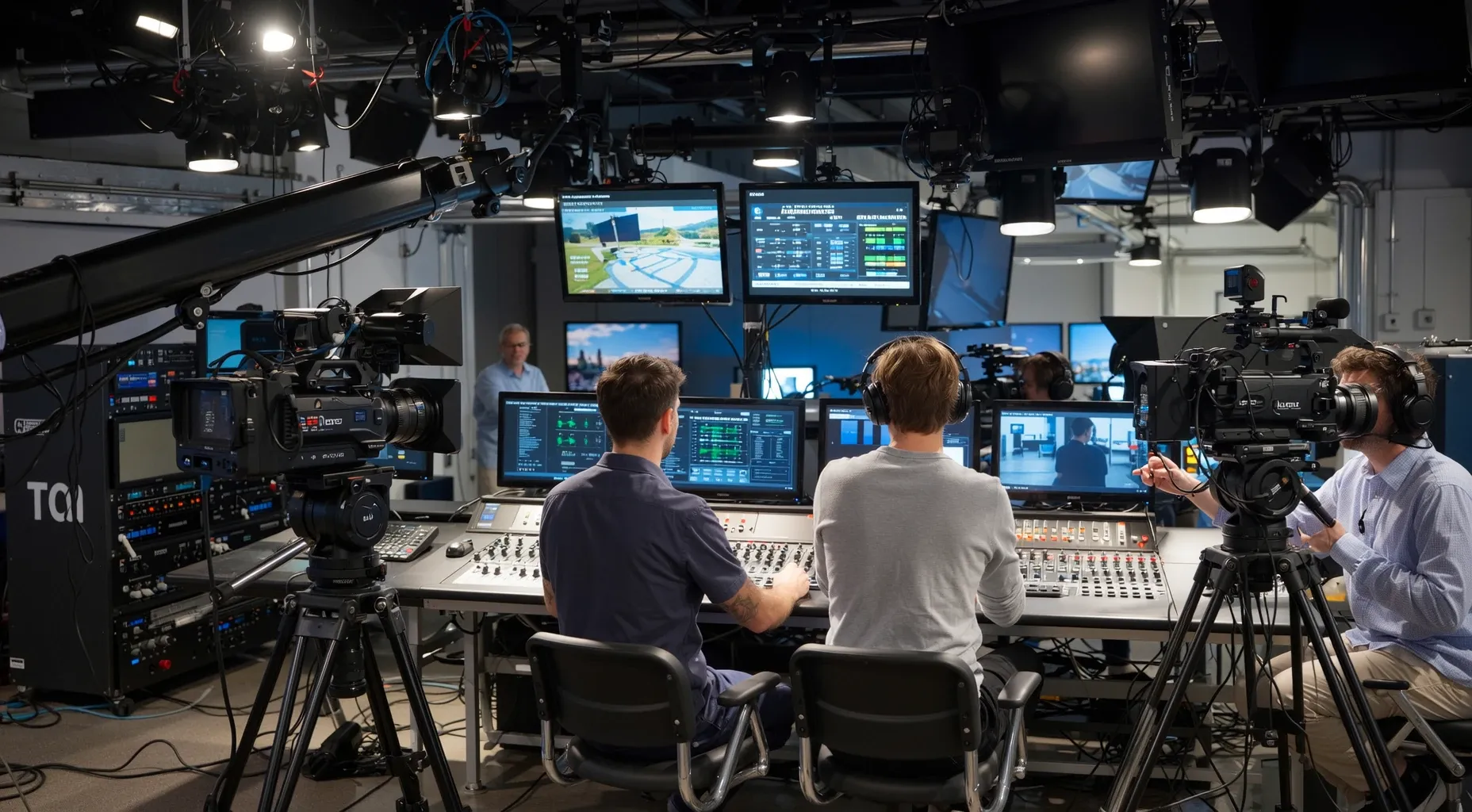
テレビ放送局
Description
この産業は、画像と音を同時に放送することに主に従事する事業所で構成されています。これらの事業所は、テレビ放送スタジオと施設を運営し、プログラムを公共に放送および送信します。プログラムは、自社のスタジオ、関連ネットワーク、または外部ソースから発信される場合があります。
Hierarchy
| Code | Title | Description |
|---|---|---|
| 51 | Information 2-digit sector | The Sector as a Whole The Information sector comprises establishments engaged in the following processes: (a) producing and distributing information and cultural products, (b) providing the means to transmit or distribute these products as well as data or communications, and (c) processing data. The main components of this sector are motion picture and sound recording industries; publishing industries, including software publishing; broadcasting and content providers; telecommunications industries; computing infrastructure providers, data processing, Web hosting, and related services; and Web search portals, libraries, archives, and other information services. The unique characteristics of information and cultural products, and of the processes involved in their production and distribution, distinguish the Information sector from the goods-producing and service-producing sectors. Some of these characteristics are: 1. Unlike traditional goods, an ''information or cultural product,'' such as an online newspaper or a television program, does not necessarily have tangible qualities, nor is it necessarily associated with a particular form. A movie can be viewed at a movie theater or through television broadcast, video-on-demand, or streaming services. A sound recording can be aired on radio, embedded in multimedia products, streamed, or sold at a record store. 2. Unlike traditional services, the delivery of these products does not require direct contact between the supplier and the consumer. 3. The value of these products to the consumer lies in their informational, educational, cultural, or entertainment content, not in the format in which they are distributed. Most of these products are protected from unlawful reproduction by copyright laws. 4. The intangible property aspect of information and cultural products makes the processes involved in their production and distribution very different from goods and services. Only those possessing the rights to these works are authorized to reproduce, alter, improve, and distribute them. Acquiring and using these rights often involves significant costs. In addition, technology has revolutionized the distribution of these products. It is possible to distribute them in a physical form, via broadcast, or online. 5. Distributors of information and cultural products can easily add value to the products they distribute. For instance, broadcasters add advertising not contained in the original product. This capacity means that unlike traditional goods distributors, they derive revenue not from sale of the distributed product to the final consumer, but from those who pay for the privilege of adding information to the original product. Similarly, a directory and mailing list publisher can acquire the rights to thousands of previously published newspaper and periodical articles and add new value by providing search and software and organizing the information in a way that facilitates research and retrieval. These products often command a much higher price than the original information. Excluded from this sector are establishments primarily engaged in custom design of software; mass reproducing software or other prerecorded audio and video material on magnetic or optical media; producing live artistic and cultural works or productions; and performing in or creating artistic and cultural works or productions as independent (i.e., freelance) individuals. |
| 516 | Broadcasting and Content Providers 3-digit subsector | Industries in the Broadcasting and Content Providers subsector include establishments that create content or acquire the right to distribute content and subsequently broadcast or distribute that content. The industry groups (Radio and Television Broadcasting Stations and Media Streaming Distribution Services, Social Networks, and Other Media Networks and Content Providers) are based on differences in the methods of communication and the nature of services provided. The Radio and Television Broadcasting Stations industry group includes establishments that operate radio or television broadcasting stations for the programming and transmission of programs to the public. Programming may originate in their own studio, from an affiliated network, or from external sources. The Media Streaming Distribution Services, Social Networks, and Other Media Networks and Content Providers industry group includes establishments providing media streaming distribution services, operating social network sites, operating media broadcasting and cable television networks, and supplying information, such as news reports, articles, pictures, and features, to the news media. The establishments classified in this subsector are often engaged in the production and purchase of programs and other textual, audio, and/or video content, and they typically generate revenues from the sale of advertising space and air time, subscriptions, donations, subsidies, and/or the sale of programs. Establishments operating telecommunications facilities and infrastructure and distributing audio and video programming, including cable and satellite television subscription programming, are included in Subsector 517, Telecommunications. Establishments primarily engaged as independent contractors in the installation and maintenance of broadcasting systems are classified in Sector 23, Construction. Establishments primarily engaged in the production, or production and distribution, of motion pictures and sound recordings are included in Subsector 512, Motion Picture and Sound Recording Industries. |
| 5161 | Radio and Television Broadcasting Stations 4-digit industry group | This industry group comprises establishments operating radio or television broadcasting stations for the programming and transmission of programs to the public. Programming may originate in their own studio, from an affiliated network, or from external sources. |
| 51612 | Television Broadcasting Stations 5-digit NAICS industry | See industry description for 516120. |
| 516120 | テレビ放送局 6-digit U.S. detail | この産業は、画像と音を同時に放送することに主に従事する事業所で構成されています。これらの事業所は、テレビ放送スタジオと施設を運営し、プログラムを公共に放送および送信します。プログラムは、自社のスタジオ、関連ネットワーク、または外部ソースから発信される場合があります。 |
Need a supply chain stack that maps to this industry?
Use this NAICS classification as the starting point, then connect it to Item workflows across inventory, warehousing, order management, fulfillment, and transportation.
Classification References
- 01ケーブルおよび衛星テレビの配信サービスを提供するために、彼らが運営する施設とインフラを使用している事業は、U.S. Industry 517111、有線通信事業者に分類されます。
- 02テレビ番組の制作は、Industry 512110、映画およびビデオ制作に分類されます。
- 03ケーブルおよび衛星テレビシステム向けにテレビ番組を制作および放送することは、Industry 516210、メディアストリーミング配信サービス、ソーシャルネットワーク、およびその他のメディアネットワークおよびコンテンツプロバイダーに分類されます。
Index Items
放送局、テレビ
テレビ放送局
How Item Can Help
The Warehouse Management System optimizes storage for bulk media equipment and consumer electronics by optimizing shelf placement and minimizing inventory errors. It tracks high-volume, time-sensitive items like servers and display units to ensure rapid fulfillment during product launches.
The Order Management System streamlines the processing of large orders containing thousands of media assets or consumer electronics. It automatically routes these complex orders to fulfillment centers, reducing processing time from days to hours.
Data Intelligence analyzes historical sales trends and real-time market demand to forecast inventory needs for specific television sets or media hardware. This predictive analytics prevents stockouts during peak seasons like the holiday shopping rush.
External Resources
Census.gov NAICS Detail
Official US Census Bureau definition and scope for NAICS 516120.
National Association of Broadcasters
The leading trade association for the US broadcasting industry representing all aspects of the medium.
Federal Communications Commission
The US government agency that regulates and enforces broadcasting rules for television stations.
TV Guide
An industry directory and portal providing TV listings, show information, and station schedules.
