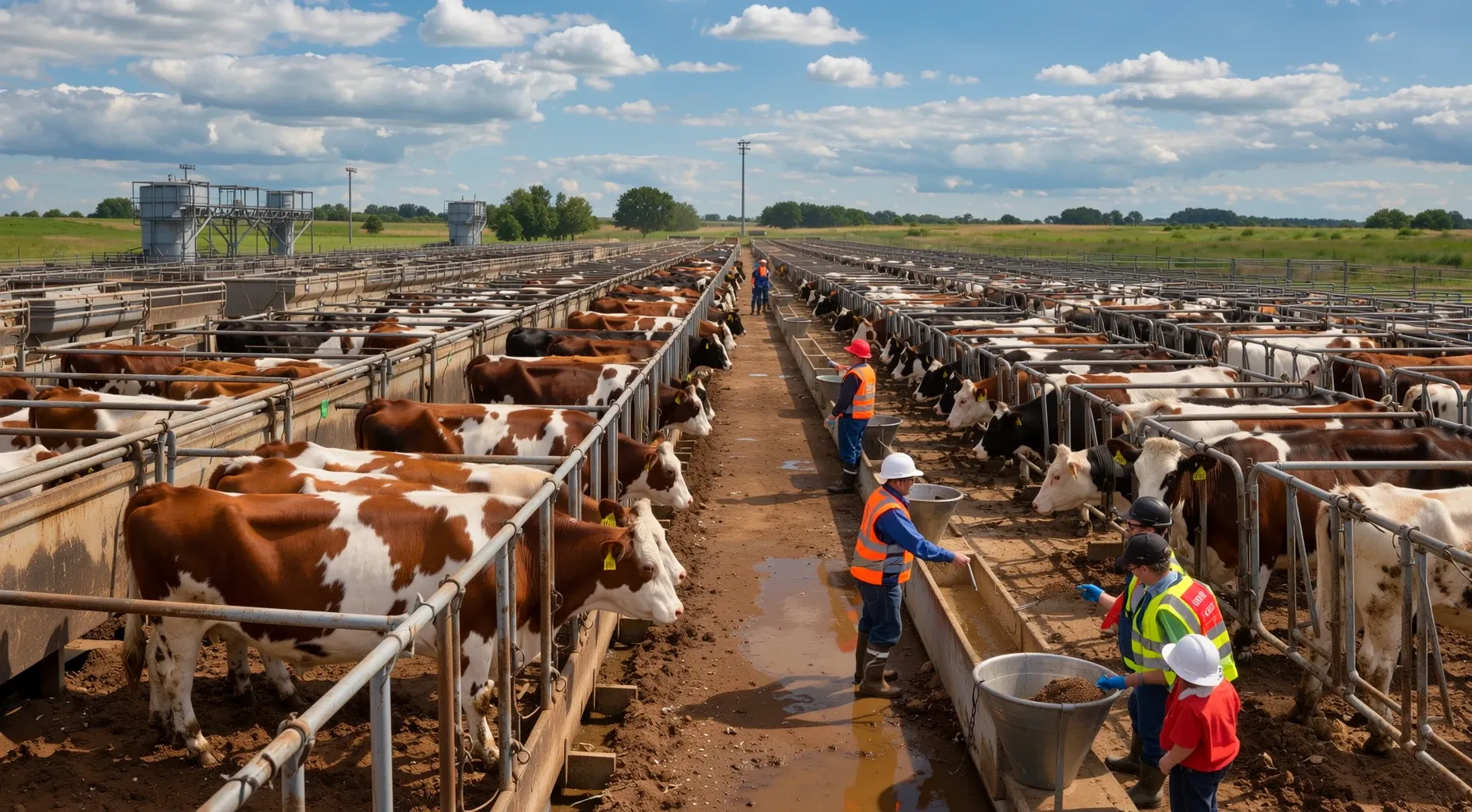
Cattle Feedlots
Description
The cattle feedlot sector specializes in the final stage of beef production, where young cattle are fed and grown to market weight. These facilities are essential for maximizing livestock value before the animals reach slaughterhouses. Operators focus on converting low-cost roughage or grain into high-quality beef through intensive nutritional management. The business involves precise control over feed rations, water quality, housing conditions, and waste management to ensure animal health and efficiency. Business activities typically include sourcing and transporting feeder cattle, often from surrounding ranches, before moving them to concentrated lots. Feedlots may process calves purchased from breeders or acquire older stock from grazing operations. Management teams monitor growth rates, implement vaccination protocols, and coordinate logistics for shipping finished cows. While small family operations exist, many enterprises function as large commercial units serving regional or national markets. The scale and scope of these operations vary significantly. Some are small family farms with limited capacity, while major companies manage facilities containing thousands of head simultaneously. Geographic distribution covers areas with abundant agricultural resources and proximity to meat processing plants. This industry supports the broader agricultural economy by creating specialized employment, driving feed and veterinary supply chains, and contributing substantially to the domestic beef supply.
Hierarchy
| Code | Title | Description |
|---|---|---|
| 11 | Agriculture, Forestry, Fishing and Hunting 2-digit sector | The Sector as a Whole The Agriculture, Forestry, Fishing and Hunting sector comprises establishments primarily engaged in growing crops, raising animals, harvesting timber, and harvesting fish and other animals from a farm, ranch, or their natural habitats. The establishments in this sector are often described as farms, ranches, dairies, greenhouses, nurseries, orchards, or hatcheries. A farm may consist of a single tract of land or a number of separate tracts which may be held under different tenures. For example, one tract may be owned by the farm operator and another rented. It may be operated by the operator alone or with the assistance of members of the household or hired employees, or it may be operated by a partnership, corporation, or other type of organization. When a landowner has one or more tenants, renters, croppers, or managers, the land operated by each is considered a farm. The sector distinguishes two basic activities: agricultural production and agricultural support activities. Agricultural production includes establishments performing the complete farm or ranch operation, such as farm owner-operators and tenant farm operators. Agricultural support activities include establishments that perform one or more activities associated with farm operation, such as soil preparation, planting, harvesting, and management, on a contract or fee basis. Excluded from the Agriculture, Forestry, Fishing and Hunting sector are establishments primarily engaged in agricultural research (e.g., experimental farms) and government establishments primarily engaged in administering programs for regulating and conserving land, mineral, wildlife, and forest use. These establishments are classified in Industry 54171, Research and Development in the Physical, Engineering, and Life Sciences; and Industry 92412, Administration of Conservation Programs, respectively. |
| 112 | Animal Production and Aquaculture 3-digit subsector | Industries in the Animal Production and Aquaculture subsector raise or fatten animals for the sale of animals or animal products and/or raise aquatic plants and animals in controlled or selected aquatic environments for the sale of aquatic plants, animals, or their products. The subsector includes establishments, such as ranches, farms, and feedlots, primarily engaged in keeping, grazing, breeding, or feeding animals. These animals are kept for the products they produce or for eventual sale. The animals are generally raised in various environments, from total confinement or captivity to feeding on an open range pasture. The industries in this subsector are grouped by important factors, such as suitable grazing or pasture land, specialized buildings, type of equipment, and the amount and types of labor required. Establishments are classified in the Animal Production and Aquaculture subsector when animal production (i.e., value of animals for market) accounts for one-half or more of the establishment's total agricultural production. Establishments with one-half or more animal production with no one animal product or family of animal products of an industry accounting for one-half of the establishment's agricultural production are treated as combination animal farming classified in Industry 11299, All Other Animal Production. |
| 1121 | Cattle Ranching and Farming 4-digit industry group | This industry group comprises establishments primarily engaged in raising cattle, milking dairy cattle, or feeding cattle for fattening. |
| 11211 | Beef Cattle Ranching and Farming, including Feedlots 5-digit NAICS industry | This industry comprises establishments primarily engaged in raising cattle (including cattle for dairy herd replacements), or feeding cattle for fattening. |
| 112112 | Cattle Feedlots 6-digit U.S. detail | The cattle feedlot sector specializes in the final stage of beef production, where young cattle are fed and grown to market weight. These facilities are essential for maximizing livestock value before the animals reach slaughterhouses. Operators focus on converting low-cost roughage or grain into high-quality beef through intensive nutritional management. The business involves precise control over feed rations, water quality, housing conditions, and waste management to ensure animal health and efficiency. Business activities typically include sourcing and transporting feeder cattle, often from surrounding ranches, before moving them to concentrated lots. Feedlots may process calves purchased from breeders or acquire older stock from grazing operations. Management teams monitor growth rates, implement vaccination protocols, and coordinate logistics for shipping finished cows. While small family operations exist, many enterprises function as large commercial units serving regional or national markets. The scale and scope of these operations vary significantly. Some are small family farms with limited capacity, while major companies manage facilities containing thousands of head simultaneously. Geographic distribution covers areas with abundant agricultural resources and proximity to meat processing plants. This industry supports the broader agricultural economy by creating specialized employment, driving feed and veterinary supply chains, and contributing substantially to the domestic beef supply. |
Need a supply chain stack that maps to this industry?
Use this NAICS classification as the starting point, then connect it to Item workflows across inventory, warehousing, order management, fulfillment, and transportation.
Classification References
- 01Establishments primarily engaged in operating stockyards for transportation and not buying, selling, or auctioning livestock are classified in U.S. Industry 488999, All Other Support Activities for Transportation.
Index Items
Beef cattle feedlots (except stockyards for transportation)
Cattle feedlots (except stockyards for transportation)
Fattening cattle
Feed yards (except stockyards for transportation), cattle
Feedlots (except stockyards for transportation), cattle
How Item Can Help
The WMS optimizes inventory management for high volumes of feed and animal feed supplements, ensuring accurate stock levels and reducing waste. It streamlines receiving and storage processes, allowing feedlots to maintain precise inventory control while supporting efficient distribution across multiple locations.
OMS enables real-time order processing and coordination between suppliers and customers, reducing lead times for perishable feed materials. By automating order workflows, businesses can handle seasonal demand spikes without compromising delivery accuracy or customer satisfaction.
Data Intelligence provides analytics on feed consumption rates and inventory turnover, helping managers optimize procurement schedules and minimize costs. These insights allow for predictive modeling of feed requirements, ensuring resources are allocated efficiently and preventing shortages during critical growth periods.
Item.com Tools
External Resources
Census.gov NAICS Detail
Official US Census Bureau definition and scope for NAICS 112112.
National Cattlemen's Beef Association
The NCA advocates for the cattle industry at the federal level and provides resources on feedlot management and market trends.
United States Department of Agriculture - Feedlots
The USDA website offers official data, guidelines, and compliance information regarding cattle feedlot operations.
Beef.com
An industry directory and news portal providing real estate listings and market analysis specifically for cattle feedlots.
