Site Preparation Contractors
Description
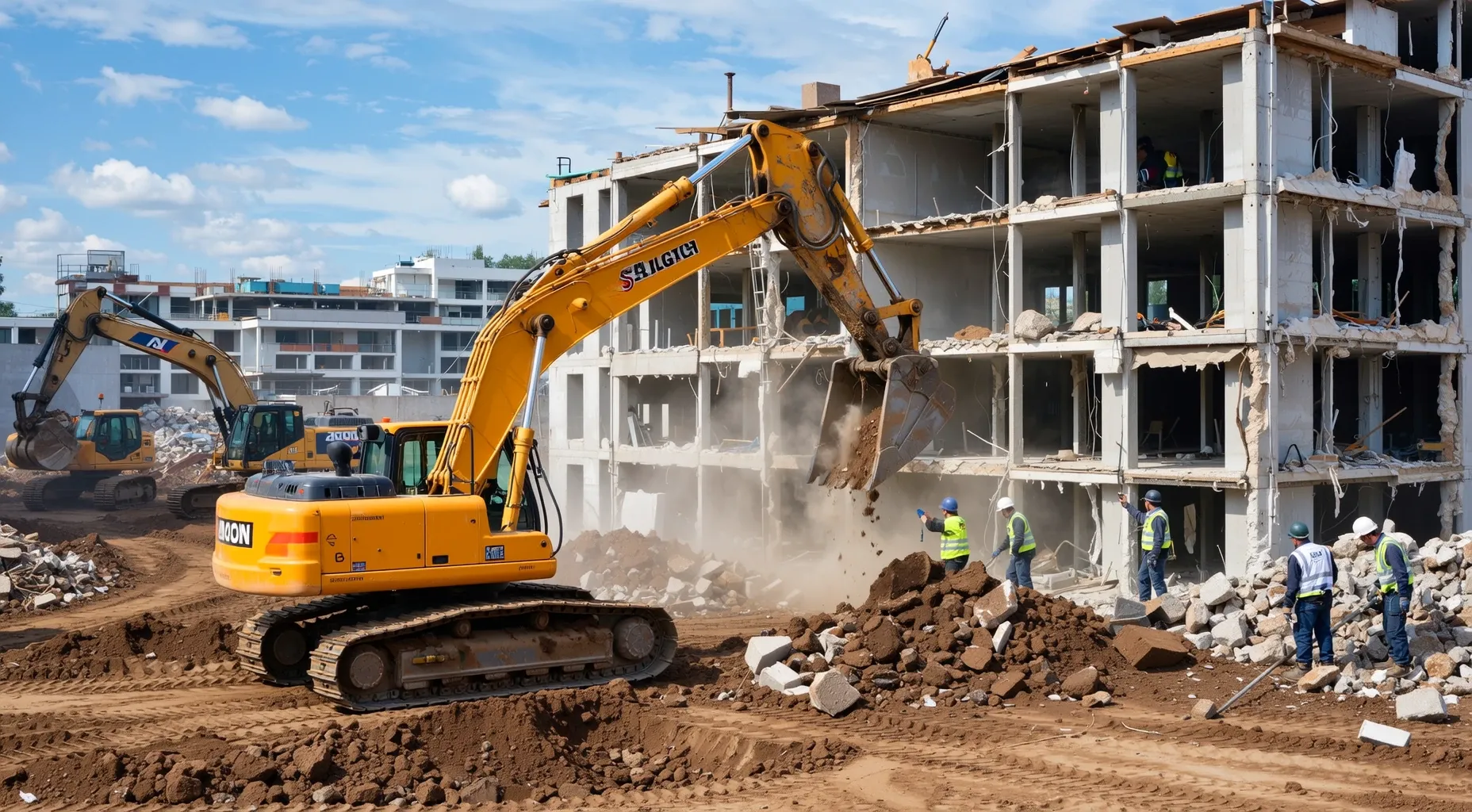
This industry comprises establishments primarily engaged in site preparation activities, such as excavating and grading, demolition of buildings and other structures, and septic system installation. Earthmoving and land clearing for all types of sites (e.g., building, nonbuilding, mining) is included in this industry. Establishments primarily engaged in construction equipment rental with operator (except cranes) are also included. Illustrative Examples: Blasting, building demolition Building interior gutting and stripping Concrete breaking and cutting for demolition Cutting new rights of way Demolition, building and structure Exterior demolition contractors Foundation digging (i.e., excavation) Foundation drilling contractors Grading construction sites Interior demolition contractors Dewatering contractors Dirt moving for construction Equipment rental (except crane), construction, with operator Excavating, earthmoving, or land clearing contractors Line slashing or cutting (except maintenance) Septic system contractors Trenching (except underwater) Underground tank (except hazardous) removal Wrecking, building or other structure Whole building deconstruction
Hierarchy
| Code | Title | Description |
|---|---|---|
| 23 | Construction 2-digit sector | The Sector as a Whole The Construction sector comprises establishments primarily engaged in the construction of buildings or engineering projects (e.g., highways and utility systems). Establishments primarily engaged in the preparation of sites for new construction and establishments primarily engaged in subdividing land for sale as building sites also are included in this sector. Construction work done may include new work, additions, alterations, or maintenance and repairs. Activities of these establishments generally are managed at a fixed place of business, but they usually perform construction activities at multiple project sites. Production responsibilities for establishments in this sector are usually specified in (1) contracts with the owners of construction projects (prime contracts) or (2) contracts with other construction establishments (subcontracts). Establishments primarily engaged in contracts that include responsibility for all aspects of individual construction projects are commonly known as general contractors, but also may be known as design-builders, construction managers, turnkey contractors, or (in cases where two or more establishments jointly secure a general contract) joint-venture contractors. Construction managers that provide oversight and scheduling only (i.e., agency) as well as construction managers that are responsible for the entire project (i.e., at risk) are included as general contractor type establishments. Establishments of the "general contractor type" frequently arrange construction of separate parts of their projects through subcontracts with other construction establishments. Establishments primarily engaged in activities to produce a specific component (e.g., masonry, painting, and electrical work) of a construction project are commonly known as specialty trade contractors. Activities of specialty trade contractors are usually subcontracted from other construction establishments, but especially in remodeling and repair construction, the work may be done directly for the owner of the property. Establishments primarily engaged in activities to construct buildings to be sold on sites that they own are known as for-sale builders, but also may be known as speculative builders or merchant builders. For-sale builders produce buildings in a manner similar to general contractors, but their production processes also include site acquisition and securing of financial backing. For-sale builders are most often associated with the construction of residential buildings. Like general contractors, they may subcontract all or part of the actual construction work on their buildings. There are substantial differences in the types of equipment, work force skills, and other inputs required by establishments in this sector. To highlight these differences and variations in the underlying production functions, this sector is divided into three subsectors. Subsector 236, Construction of Buildings, comprises establishments of the general contractor type and for-sale builders involved in the construction of buildings. Subsector 237, Heavy and Civil Engineering Construction, comprises establishments involved in the construction of engineering projects. Subsector 238, Specialty Trade Contractors, comprises establishments engaged in specialty trade activities generally needed in the construction of all types of buildings. Force account construction is construction work performed by an enterprise primarily engaged in some business other than construction for its own account, using employees of the enterprise. This activity is not included in the construction sector unless the construction work performed is the primary activity of a separate establishment of the enterprise. The installation and the ongoing repair and maintenance of telecommunications and utility networks is excluded from construction when the establishments performing the work are not independent contractors. Although a growing proportion of this work is subcontracted to independent contractors in the Construction sector, the operating units of telecommunications and utility companies performing this work are included with the telecommunications or utility activities. |
| 238 | Specialty Trade Contractors 3-digit subsector | The Specialty Trade Contractors subsector comprises establishments whose primary activity is performing specific activities (e.g., pouring concrete, site preparation, plumbing, painting, and electrical work) involved in building construction or other activities that are similar for all types of construction, but that are not responsible for the entire project. The work performed may include new work, additions, alterations, maintenance, and repairs. The production work performed by establishments in this subsector is usually subcontracted from establishments of the general contractor type or for-sale builders, but especially in remodeling and repair construction, work also may be done directly for the owner of the property. Specialty trade contractors usually perform most of their work at the construction site, although they may have shops where they perform prefabrication and other work. Establishments primarily engaged in preparing sites for new construction are also included in this subsector. There are substantial differences in types of equipment, work force skills, and other inputs required by specialty trade contractors. Establishments in this subsector are classified based on the underlying production function for the specialty trade in which they specialize. Throughout the Specialty Trade Contractors subsector, establishments commonly provide both the parts and labor required to complete work. For example, electrical contractors supply the current-carrying and noncurrent-carrying wiring devices that are required to install a circuit. Plumbing, heating, and air-conditioning contractors also supply the parts required to complete a contract. Establishments that specialize in activities primarily related to heavy and civil engineering construction that are not normally performed on buildings, such as the painting of lines on highways, are classified in Subsector 237, Heavy and Civil Engineering Construction. Establishments that are primarily engaged in selling construction materials are classified in Sector 42, Wholesale Trade, or Sector 44-45, Retail Trade, based on the characteristics of the selling unit. |
| 2389 | Other Specialty Trade Contractors 4-digit industry group | This industry group comprises establishments primarily engaged in site preparation activities and in specialized trades (except foundation, structure, and building exterior contractors; building equipment contractors; and building finishing contractors). The specialty trade work performed includes new work, additions, alterations, maintenance, and repairs. |
| 23891 | Site Preparation Contractors 5-digit NAICS industry | See industry description for 238910. |
| 238910 | Site Preparation Contractors 6-digit U.S. detail | This industry comprises establishments primarily engaged in site preparation activities, such as excavating and grading, demolition of buildings and other structures, and septic system installation. Earthmoving and land clearing for all types of sites (e.g., building, nonbuilding, mining) is included in this industry. Establishments primarily engaged in construction equipment rental with operator (except cranes) are also included. Illustrative Examples: Blasting, building demolition Building interior gutting and stripping Concrete breaking and cutting for demolition Cutting new rights of way Demolition, building and structure Exterior demolition contractors Foundation digging (i.e., excavation) Foundation drilling contractors Grading construction sites Interior demolition contractors Dewatering contractors Dirt moving for construction Equipment rental (except crane), construction, with operator Excavating, earthmoving, or land clearing contractors Line slashing or cutting (except maintenance) Septic system contractors Trenching (except underwater) Underground tank (except hazardous) removal Wrecking, building or other structure Whole building deconstruction |
Need a supply chain stack that maps to this industry?
Use this NAICS classification as the starting point, then connect it to Item workflows across inventory, warehousing, order management, fulfillment, and transportation.
Classification References
- 01Servicing land and subdividing real property into lots for sale to builders--are classified in Industry 237210, Land Subdivision;
- 02Constructing distribution lines and related buildings and structures for utilities (i.e., water, sewer, petroleum, gas, power, and communication)--are classified in Industry Group 2371, Utility System Construction;
- 03Earth retention or underwater trenching--are classified in Industry 237990, Other Heavy and Civil Engineering Construction;
- 04Crane rental with operator--are classified in Industry 238990, All Other Specialty Trade Contractors;
- 05Overburden removal as an activity prior to mineral removal from quarries or open pit mines--are classified in Sector 21, Mining, Quarrying, and Oil and Gas Extraction;
- 06Drilling oil and gas field water intake wells--are classified in U.S. Industry 213111, Drilling Oil and Gas Wells;
- 07Dismantling tanks in oil fields--are classified in U.S. Industry 213112, Support Activities for Oil and Gas Operations;
- 08Construction equipment rental without an operator--are classified in U.S. Industry 532412, Construction, Mining, and Forestry Machinery and Equipment Rental and Leasing;
- 09Tree and brush trimming for overhead utility lines--are classified in Industry 561730, Landscaping Services; and
- 10Nuclear power plant decommissioning and environmental remediation work, such as the removal of underground steel tanks for hazardous materials--are classified in Industry 562910, Remediation Services.
Index Items
Aerial or picker truck, construction, rental with operator
Backfilling, construction
Backhoe rental with operator
Blast hole drilling (except mining)
Blasting, building demolition
Blasting, construction site
Boring, for building construction
Building demolition
Building interior gutting and stripping
Bulldozer rental with operator
Caisson (i.e., drilled building foundations) construction
Cesspool construction
Concrete breaking and cutting for demolition
Construction equipment (except crane) rental with operator
Core drilling and test boring for construction
Crawler tractor rental with operator
Culvert or bridge removal
Cutting new rights of way
Demolition contractor
Demolition, building and structure
Dewatering contractors
Digging foundations
Dirt moving for construction
Dismantling engineering structures (e.g., oil storage tank)
Drainage system (e.g., cesspool, septic tank) installation
Drilled pier (i.e., for building foundations) contractors
Drilled shaft (i.e., drilled building foundations) construction
Dry well construction
Equipment rental (except crane), construction, with operator
Excavating, earthmoving or land clearing, mining (except overburden removal at open pit mine sites or quarries)
Excavating, earthmoving, or land clearing contractors
Excavation contractors
Exterior demolition contractors
Foundation digging (i.e., excavation)
Foundation drilling contractors
Grading construction sites
Grave excavation contractors
Ground thawing for construction site digging
Helical pier (i.e., drilled building foundations) construction
House demolishing
House razing
Hydrodemolition (i.e., demolition with pressurized water) contractors
Interior demolition contractors
Land clearing
Land leveling contractors
Line slashing or cutting (except maintenance)
Machinery, construction (except cranes), rental with operator
Mine site preparation and related construction activities, construction contractors
Pile driving, building foundation
Piling (i.e., bored, cast-in-place, drilled), building foundation, contractors
Power shovel, construction, rental with operator
Power, communication and pipe line right of way clearance (except maintenance)
Removal of dams, dikes, and other heavy and civil engineering constructions
Right of way cutting (except maintenance)
Road decommissioning
Septic system contractors
Septic tank and weeping tile installation
Soil compacting
Soil test drilling
Test boring for construction
Trenching (except underwater)
Underground tank (except hazardous material) removal
Weeping tile installation
Whole building deconstruction
Wrecking, building or other structure
How Item Can Help
Site Preparation Contractors use the Warehouse Management System to track and manage inventory of heavy machinery and materials, ensuring optimal stock levels for rapid project mobilization while reducing storage costs.
The Order Management System streamlines the processing of custom quotes and project requests, enabling real-time delivery scheduling that aligns procurement with tight construction deadlines.
Data Intelligence tools analyze historical project costs and resource utilization patterns to provide predictive insights, allowing contractors to negotiate better material prices and allocate resources more efficiently.
Item.com Tools
External Resources
Census.gov NAICS Detail
Official US Census Bureau definition and scope for NAICS 238910.
National Association of Home Builders
Major industry trade association offering standards, education, and advocacy for construction professionals including site preparation contractors.
US General Services Administration
Federal government agency providing resources, procurement opportunities, and regulations for public construction and site work.
Procore
Leading construction management software platform with specific tools and community resources for site preparation project management.
