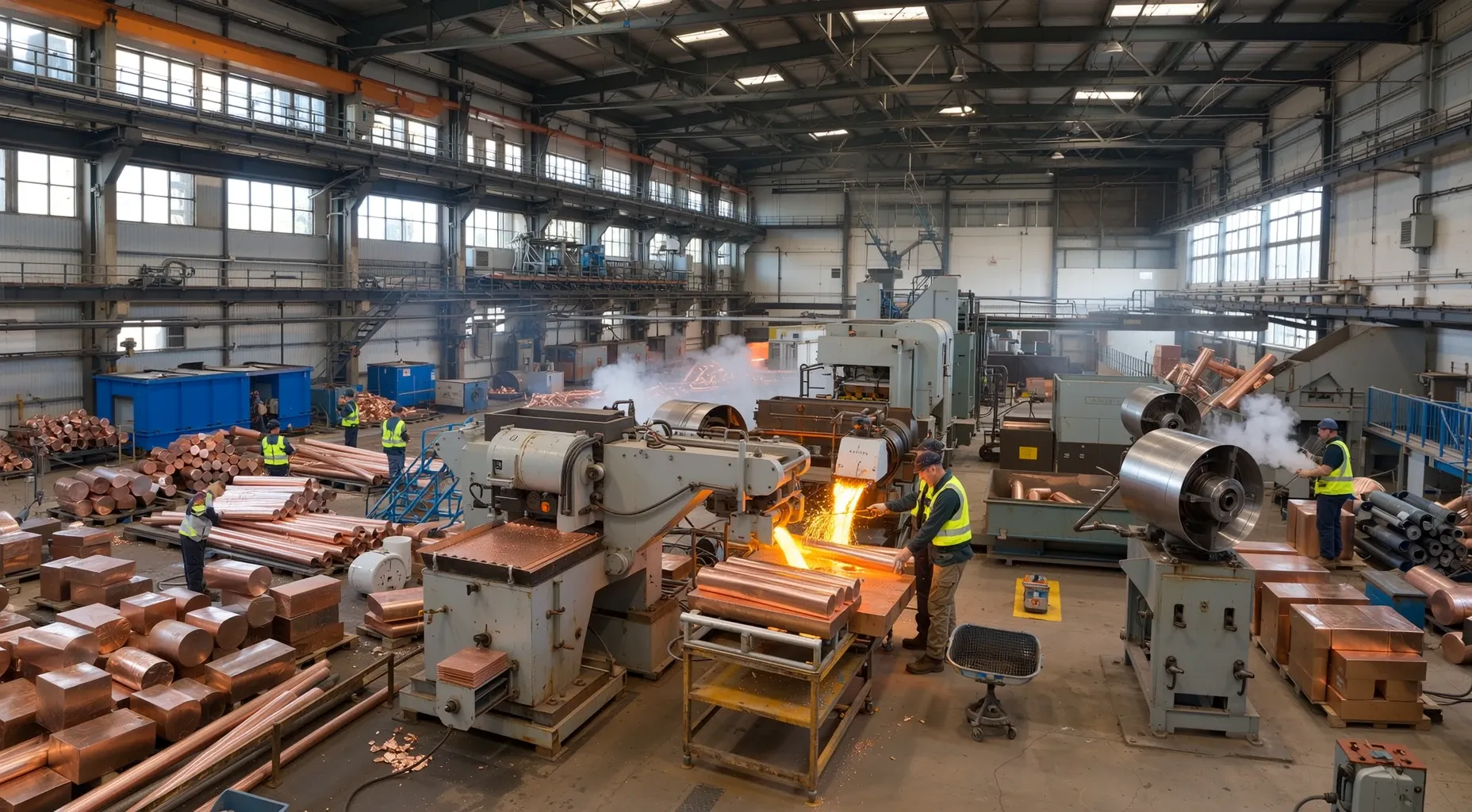
Laminado, Extrusión y Fundición de Cobre
Description
Este sector comprende establecimientos principalmente dedicados a una o más de las siguientes actividades: (1) recuperar cobre o aleaciones de cobre de chatarra; (2) fundir cobre comprado; (3) laminar, extrudir o dar forma (por ejemplo, barra, placa, lámina, tira, tubo, alambre) al cobre comprado; y (4) recuperar cobre o aleaciones de cobre de chatarra y laminar, extrudir o dar forma (por ejemplo, barra, placa, lámina, tira, tubo, alambre).
Hierarchy
| Code | Title | Description |
|---|---|---|
| 33 | Producción y procesamiento de cobre (enrollado, dibujo, extrusión y aleación) 2-digit sector | El sector en su conjunto El sector de Fabricación comprende las empresas que participan en la transformación mecánica, física o química de materiales, sustancias o componentes en nuevos productos. El ensamblaje de componentes de productos manufacturados se considera fabricación, excepto en los casos en que la actividad se clasifique adecuadamente en el Sector 23, Construcción. Las empresas del sector de Fabricación a menudo se describen como plantas, fábricas o fundiciones y utilizan típicamente máquinas y equipos de manipulación de materiales. Sin embargo, las empresas que transforman materiales o sustancias en nuevos productos mediante procesos manuales o en el hogar, y las que venden productos fabricados en el mismo lugar desde donde se venden, como panaderías, tiendas de dulces y sastres a medida, también pueden incluirse en este sector. Las empresas de fabricación pueden procesar materiales o pueden contratar con otras empresas para que procesen sus materiales para ellas. Ambas categorías de empresas están incluidas en la fabricación. Las empresas de fabricación seleccionadas en el sector de Fabricación están formadas únicamente por empresas que procesan materiales para otras empresas en base a un contrato o tarifa. Además de estas industrias de fabricación de contrato dedicadas, las empresas que procesan materiales para otras empresas generalmente se clasifican en la industria de fabricación de materiales procesados. Los materiales, sustancias o componentes transformados por las empresas de fabricación son materias primas que son productos de la agricultura, la silvicultura, la pesca, la minería o la extracción, así como productos de otras empresas de fabricación. Los materiales utilizados pueden adquirirse directamente de los productores, obtenerse a través de los canales comerciales habituales o obtenerse sin necesidad de recurrir al mercado transfiriendo el producto de una empresa a otra, bajo la misma propiedad. El nuevo producto de una empresa de fabricación puede estar terminado en el sentido de que esté listo para su utilización o consumo, o puede estar semiterminado para convertirse en una entrada para una empresa que participa en una fabricación adicional. Por ejemplo, el producto de la refinería de alúmina es la entrada utilizada en la producción primaria de aluminio; el aluminio primario es la entrada para una planta de dibujo de alambre de aluminio; y el alambre de aluminio es la entrada para una empresa de fabricación de productos de alambre fabricados. Los subsectores del sector de Fabricación generalmente reflejan procesos de producción distintos relacionados con las entradas de materiales, el equipo de producción y las habilidades de los empleados. En el área de maquinaria, donde el ensamblaje es una actividad clave, las piezas y los accesorios de los productos fabricados se clasifican en la industria del producto fabricado terminado cuando se fabrican para la venta por separado. Por ejemplo, un accesorio para una máquina de metal de trabajo se clasificaría con la maquinaria de metal de trabajo. Sin embargo, las entradas de componentes de otras empresas de fabricación se clasifican en función de la función de producción del fabricante del componente. Por ejemplo, los componentes electrónicos se clasifican en el subsector 334, Fabricación de productos informáticos y electrónicos, y las estampaciones se clasifican en el subsector 332, Fabricación de productos metálicos fabricados. Las empresas de fabricación a menudo realizan una o más actividades que se clasifican fuera del sector de Fabricación de NAICS. Por ejemplo, casi todas las actividades de fabricación tienen alguna operación de investigación y desarrollo o administrativa de captación, como contabilidad, nómina o gestión. Estas actividades de captación se tratan de la misma manera que las actividades de fabricación de captación. Cuando los servicios se proporcionan por empresas separadas, se clasifican en el sector NAICS donde dichos servicios son primarios, no en fabricación. Los límites de la fabricación y los otros sectores del sistema de clasificación pueden ser algo difusos. Las empresas del sector de Fabricación participan en la transformación de materiales en nuevos productos. Su salida es un nuevo producto. Sin embargo, la definición de lo que constituye un nuevo producto puede ser algo subjetiva. Para aclarar, las siguientes actividades se consideran fabricación en NAICS: <table width=100%><tr><td width=10%> </td><td><dl><dt style='padding-left: 10px; text-indent: -10px;'>Embotellado y pasteurización de leche;</dt><dt style='padding-left: 10px; text-indent: -10px;'>Embotellado y procesamiento de agua;</dt><dt style='padding-left: 10px; text-indent: -10px;'>Envase de pescado fresco (descascarado de ostras, fileteado de pescado);</dt><dt style='padding-left: 10px; text-indent: -10px;'>Trabajo de confección (asignar materiales a fábricas o tiendas de contrato para fabricación o otras operaciones de contrato<br/> o contratar materiales<br/> propiedad de otros);</dt><dt style='padding-left: 10px; text-indent: -10px;'>Impresión y actividades relacionadas;</dt><dt style='padding-left: 10px; text-indent: -10px;'>Producción de hormigón premezclado;</dt><dt style='padding-left: 10px; text-indent: -10px;'>Conversión de cuero;</dt><dt style='padding-left: 10px; text-indent: -10px;'>Corte de lentes<br/> a prescripción;</dt><dt style='padding-left: 10px; text-indent: -10px;'>Conservación de madera;</dt><dt style='padding-left: 10px; text-indent: -10px;'>Trabajo de labrado para el comercio;</dt></dl></td><td width=10%> </td><td><dl><dt style='padding-left: 10px; text-indent: -10px;'>Electrogalvanizado, chapado, tratamiento térmico y pulido para el comercio;</dt><dt style='padding-left: 10px; text-indent: -10px;'>Fabricación de letreros y<br/> exhibiciones publicitarias;</dt><dt style='padding-left: 10px; text-indent: -10px;'>Reconstrucción o remanufactura<br/> de maquinaria (es decir, piezas<br/> de automóvil);</dt><dt style='padding-left: 10px; text-indent: -10px;'>Fabricación de viviendas<br/> (es decir, casas móviles<br/> o edificios prefabricados,<br/> ya sea ensamblando/montando<br/> en el sitio del cliente);</dt><dt style='padding-left: 10px; text-indent: -10px;'>Reparación y renovación de barcos;</dt><dt style='padding-left: 10px; text-indent: -10px;'>Talleres de máquinas; y</dt><dt style='padding-left: 10px; text-indent: -10px;'>Retreadado de neumáticos.</dt></dl></td><td width=10%> </td></tr></table> Por el contrario, hay actividades que a veces se consideran fabricación, pero que para NAICS se clasifican en otro sector (es decir, no se clasifican como fabricación). Estos incluyen: 1. La tala, que se clasifica en el Sector 11, Agricultura, silvicultura, pesca y caza, se considera una operación de cosecha; 2. La beneficiación de minerales y otros, que se clasifica en el Sector 21, Minería, extracción de minerales y petróleo, se considera parte de la actividad de minería; 3. La construcción de estructuras, el ensamblaje de edificios prefabricados y la fabricación en el sitio por contratistas se clasifican en el Sector 23, Construcción; 4. La ruptura por volumen y la reventa en lotes más pequeños, incluida la envasado, el envasado o el embotellado de productos, como licores o productos químicos; el ensamblaje y la venta de computadoras a medida; la clasificación y la reventa de chatarra; la mezcla y la venta de pinturas a pedido; y el corte de metales a pedido para la reventa, se clasifican en el Sector 42, Comercio al por mayor, o en los Sectores 44-45, Comercio al por menor; y 5. La publicación y la actividad combinada de publicación y impresión, que se clasifican en el Sector 51, Información, se clasifican en la información, ya que transforman la información en un producto, cuyo valor para el consumidor reside en el contenido de la información, no en el formato en que se distribuye (es decir, el libro o el disco compacto de software). |
| 331 | Primary Metal Manufacturing 3-digit subsector | Industries in the Primary Metal Manufacturing subsector smelt and/or refine ferrous and nonferrous metals from ore, pig, or scrap, using electrometallurgical and other process metallurgical techniques. Establishments in this subsector also manufacture metal alloys and superalloys by introducing other chemical elements to pure metals. The output of smelting and refining, usually in ingot form, is used in rolling, drawing, and extruding operations to make sheet, strip, bar, rod, or wire, and in molten form to make castings and other basic metal products. Primary manufacturing of ferrous and nonferrous metals begins with ore or concentrate as the primary input. Establishments manufacturing primary metals from ore and/or concentrate remain classified in the primary smelting, primary refining, or iron and steel mill industries regardless of the form of their output. Establishments primarily engaged in secondary smelting and/or secondary refining recover ferrous and nonferrous metals from scrap and/or dross. The output of the secondary smelting and/or secondary refining industries is limited to shapes such as ingot or billet that will be further processed. Recovery of metals from scrap often occurs in establishments that are primarily engaged in activities, such as rolling, drawing, extruding, or similar processes. Excluded from the Primary Metal Manufacturing subsector are establishments primarily engaged in manufacturing ferrous and nonferrous forgings (except ferrous forgings made in steel mills) and stampings. Although forging, stamping, and casting are all methods used to make metal shapes, forging and stamping do not use molten metals and are included in Subsector 332, Fabricated Metal Product Manufacturing. Establishments primarily engaged in operating coke ovens are classified in Industry 32419, Other Petroleum and Coal Products Manufacturing. |
| 3314 | Producción y procesamiento de cobre 4-digit industry group | Ver descripción de la industria para 331420. |
| 33142 | Producción y procesamiento de cobre 5-digit NAICS industry | Ver descripción de la industria para 331420. |
| 331420 | Laminado, Extrusión y Fundición de Cobre 6-digit U.S. detail | Este sector comprende establecimientos principalmente dedicados a una o más de las siguientes actividades: (1) recuperar cobre o aleaciones de cobre de chatarra; (2) fundir cobre comprado; (3) laminar, extrudir o dar forma (por ejemplo, barra, placa, lámina, tira, tubo, alambre) al cobre comprado; y (4) recuperar cobre o aleaciones de cobre de chatarra y laminar, extrudir o dar forma (por ejemplo, barra, placa, lámina, tira, tubo, alambre). |
Need a supply chain stack that maps to this industry?
Use this NAICS classification as the starting point, then connect it to Item workflows across inventory, warehousing, order management, fulfillment, and transportation.
Classification References
- 01La fundición, refinación y/o el laminado, extrusión de cobre primario fabricado en la misma instalación--se clasifican en la Industria 331410, Fundición y Refinación de Metales No Ferrosos (excepto Aluminio);
- 02La fabricación de productos de alambre a partir de alambre de cobre comprado--se clasifican en la Industria 33261, Fabricación de Productos de Alambre y Cable;
- 03El fundido de cobre comprado--se clasifican en la Industria U.S. 331523, Fundiciones de Metales No Ferrosos;
- 04El laminado, extrusión o dibujo de formas a partir de metales no ferrosos comprados (excepto cobre y aluminio) o la recuperación de metales no ferrosos (excepto cobre y aluminio) de chatarra y el laminado, extrusión o dibujo--se clasifican en la Industria U.S. 331491, Laminado, Extrusión y Dibujo de Metales No Ferrosos (excepto Cobre y Aluminio);
- 05La recuperación de metales no ferrosos (excepto cobre, aluminio) de chatarra y la fabricación de formas primarias y/o aleaciones de metales no ferrosos comprados (excepto cobre y aluminio)--se clasifican en la Industria U.S. 331492, Refinación Secundaria, Fundición y Aleación de Metales No Ferrosos (excepto Cobre y Aluminio);
- 06El aislamiento de alambre de cobre comprado--se clasifican en la Industria U.S. 335929, Fabricación de Otros Cables y Cables de Comunicación y Energía;
- 07La operación de instalaciones donde los materiales reciclables mezclados, como papel, plásticos, latas de bebidas usadas y metales, se clasifican en categorías distintas sin fundir ni refinar--se clasifican en la Industria 562920, Instalaciones de Recuperación de Materiales; y
- 08El clasificación, corte y venta al por mayor de chatarra de metales sin fundir ni refinar--se clasifican en la Industria 423930, Mayoristas de Materiales Reciclables.
Index Items
Cable o cable de avión y automóvil fabricado con cobre comprado en plantas de dibujo de alambre
Aleación de cobre comprado
Aleación de metales de cobre comprados
Cable de instrumento o cordón fabricado con cobre comprado en plantas de dibujo de alambre
Cable blindado fabricado con cobre comprado en plantas de dibujo de alambre
Cable blindado, cobre, fabricado en plantas integradas de fundición y dibujo
Barra, cobre y aleación de cobre, fabricada con cobre comprado o en plantas integradas de fundición y laminado, dibujo o extrusión
Productos de latón, laminado, extrusión o dibujo, fabricados con cobre comprado o en plantas integradas de fundición y laminado, dibujo o extrusión
Productos de bronce, laminado, extrusión o dibujo, fabricados con cobre comprado o en plantas integradas de fundición y laminado, dibujo o extrusión
Cable, cobre (por ejemplo, blindado, sin aislamiento, aislado), fabricado con cobre comprado en plantas de dibujo de alambre
Cable, cobre (por ejemplo, blindado, sin aislamiento, aislado), fabricado en plantas integradas de fundición y dibujo de alambre
Tapas, discos y láminas, cobre y aleación de cobre, fabricadas con cobre comprado o en plantas integradas de fundición y laminado, dibujo o extrusión
Cable coaxial, cobre, fabricado con cobre comprado en plantas de dibujo de alambre
Cable de comunicación o cable, cobre, fabricado con cobre comprado en plantas de dibujo de alambre
Aleaciones de cobre (por ejemplo, latón, bronce) fabricadas con metal o chatarra comprados
Formas de cobre y aleación de cobre (por ejemplo, pastel, lingote, escoria, barra de alambre) fabricadas con metal o chatarra comprados
Folio de cobre fabricado con metal o chatarra comprados
Polvo de cobre, escamas y pasta fabricados con cobre comprado
Productos de cobre fabricados por dibujo de cobre comprado
Productos de cobre fabricados por laminado, dibujo o extrusión de cobre comprado
Productos de cobre fabricados en plantas integradas de fundición y extrusión
Productos de cobre fabricados en plantas integradas de fundición y dibujo
Fundición secundaria, refinación y aleación de cobre
Fundición secundaria, refinación y recuperación de cobre de metal o chatarra comprados
Conjuntos de cable, flexibles, fabricados con cobre comprado en plantas de dibujo de alambre
Cable de energía o cable, cobre, fabricado con cobre comprado en plantas de dibujo de alambre
Folio, cobre, fabricado con metal o chatarra comprados
Cable o cable aislado fabricado con cobre comprado en plantas de dibujo de alambre
Cable o cable aislado, cobre, fabricado en plantas integradas de fundición y dibujo de alambre
Alambre de magnetismo, aislado, fabricado con cobre comprado en plantas de dibujo de alambre
Tela de malla, alambre, fabricada con cobre comprado en plantas de dibujo de alambre
Polvo de metal y escamas fabricados con cobre comprado
Pasta fabricada con cobre comprado
Tubo, extrudido y dibujado, latón, bronce y cobre, fabricado con cobre comprado o en plantas integradas de fundición y laminado, dibujo o extrusión
Placa, cobre y aleación de cobre, fabricada con cobre comprado o en plantas integradas de fundición y laminado, dibujo o extrusión
Polvo fabricado con cobre comprado
Refinación secundaria de cobre
Varilla, cobre y aleación de cobre, fabricada con cobre comprado o en plantas integradas de fundición y laminado, dibujo o extrusión
Hoja, cobre y aleación de cobre, fabricada con cobre comprado o en plantas integradas de fundición y laminado, dibujo o extrusión
Cable de cubierta fabricado con cobre comprado en plantas de dibujo de alambre
Cable de señal y control fabricado con cobre comprado en plantas de dibujo de alambre
Hoja, cobre y aleación de cobre, fabricada con metal o chatarra comprados
Tubo, cobre y aleación de cobre, fabricado con metal o chatarra comprados
Cable resistente a la intemperie fabricado con cobre comprado en plantas de dibujo de alambre
Tela de malla de alambre fabricada con cobre comprado en plantas de dibujo de alambre
Tela de malla, cobre, fabricada en plantas integradas de fundición y dibujo de alambre
Alambre, cobre (por ejemplo, blindado, sin aislamiento, aislado), fabricado con cobre comprado en plantas de dibujo de alambre
Alambre, cobre (por ejemplo, blindado, sin aislamiento, aislado), fabricado en plantas integradas de fundición y dibujo de alambre
Alambre mecánico, cobre y aleación de cobre, fabricado con cobre comprado o en plantas integradas de fundición y laminado, dibujo o extrusión
How Item Can Help
The Order Management System streamlines complex supply chains by consolidating diverse inputs from mines and smelters into a single unified view, reducing order processing time and minimizing errors in copper alloy orders.
Warehouse Management Systems optimize space utilization for varying copper forms like coils and ingots while providing real-time inventory tracking essential for maintaining high-grade stock levels.
Data Intelligence platforms analyze production metrics such as roll thickness consistency and extrusion rates to predict equipment failures and suggest process optimizations for improved alloy quality.
Item.com Tools
External Resources
Census.gov NAICS Detail
Official US Census Bureau definition and scope for NAICS 331420.
Copper Development Association
A global non-profit that promotes copper's value and safety across the manufacturing sector including rolling and alloying.
U.S. Census Bureau NAICS Profile
Official government data page providing detailed industry statistics for copper rolling, drawing, extruding, and alloying.
Copper Association of South Africa
An international trade organization representing the South African copper industry and its manufacturing capabilities.
