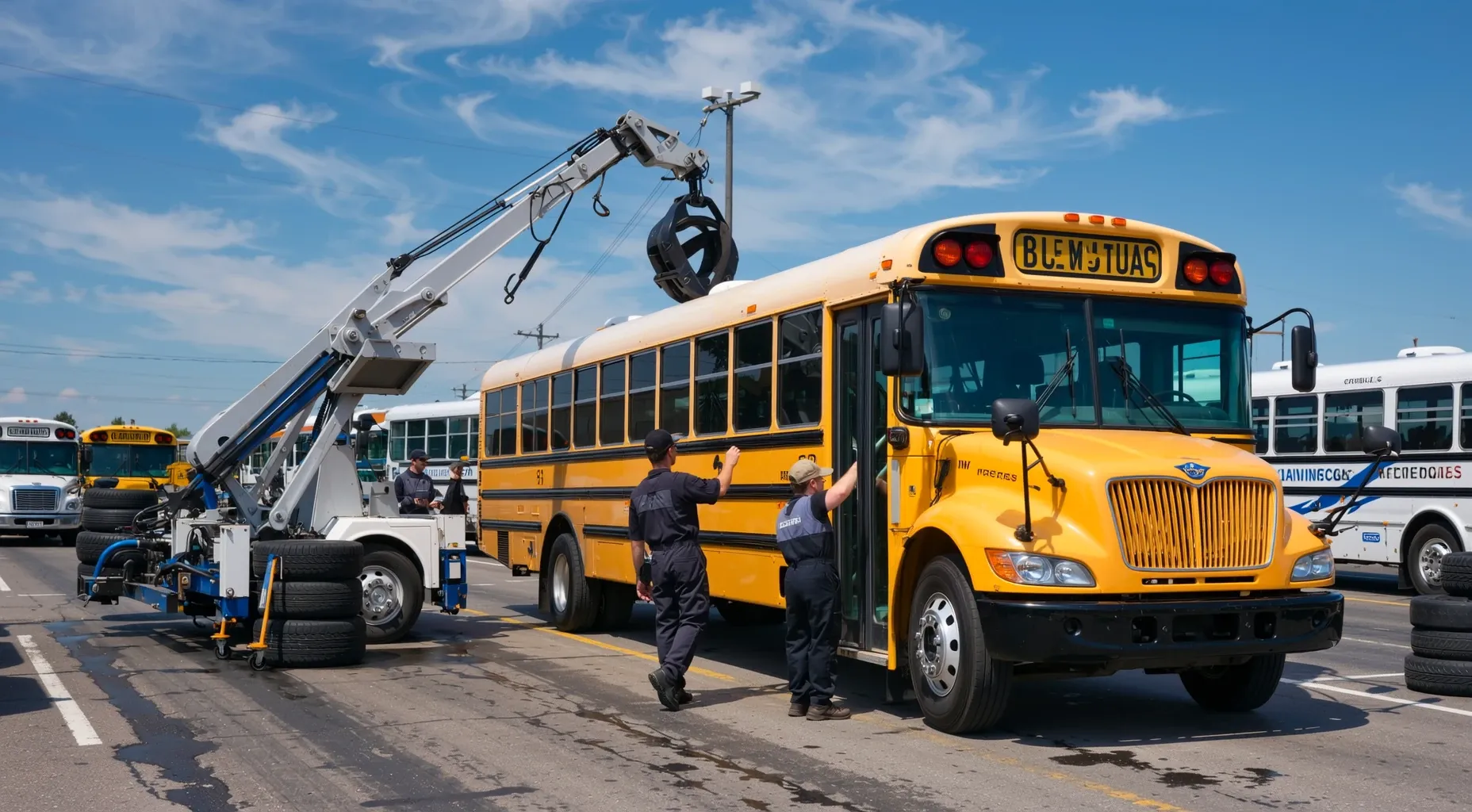
School and Employee Bus Transportation
Description
School and employee bus transportation represents a critical segment of the transit sector dedicated to moving large groups of people safely and reliably across various distances. These establishments primarily operate fleets of buses and other motor vehicles designed to carry pupils from their homes to educational facilities or employees to and from their workplaces. The core business activity involves scheduling routes, maintaining vehicle safety standards, conducting driver training, and managing daily logistics to ensure punctual arrivals and timely departures. Operations often extend beyond direct transportation, including route planning, fuel management, regulatory compliance, and insurance requirements. Operators in this field can range from large, privately owned for-hire carriers that serve multiple districts or cities to smaller, independent school districts that manage their own local bus systems. While most facilities focus on dedicated passenger vehicles, some may also provide specialized equipment such as school buses with reinforced safety features or smaller shuttle vans for shorter distances. The scale of these businesses varies significantly, with some companies transporting thousands of students or workers daily, while others serve only a specific neighborhood or campus. Despite the differences in size, all operators share a commitment to punctuality, safety regulations set by federal and state authorities, and the efficient movement of their client groups during their designated hours.
Hierarchy
| Code | Title | Description |
|---|---|---|
| 48 | Transportation and Warehousing 2-digit sector | The Sector as a Whole The Transportation and Warehousing sector includes industries providing transportation of passengers and cargo, warehousing and storage for goods, scenic and sightseeing transportation, and support activities related to modes of transportation. Establishments in these industries use transportation equipment or transportation-related facilities as a productive asset. The type of equipment depends on the mode of transportation. The modes of transportation are air, rail, water, road, and pipeline. The Transportation and Warehousing sector distinguishes three basic types of activities: subsectors for each mode of transportation, a subsector for warehousing and storage, and a subsector for establishments providing support activities for transportation. In addition, there are subsectors for establishments that provide passenger transportation for scenic and sightseeing purposes, postal services, and courier services. A separate subsector for support activities is established in the sector because, first, support activities for transportation are inherently multimodal, such as freight transportation arrangement, or have multimodal aspects. Secondly, there are production process similarities among the support activity industries. One of the support activities identified in the Support Activities for Transportation subsector is the routine repair and maintenance of transportation equipment (e.g., aircraft at an airport, railroad rolling stock at a railroad terminal, or ships at a harbor or port facility). Such establishments do not perform complete overhauling or rebuilding of transportation equipment (i.e., periodic restoration of transportation equipment to original design specifications) or transportation equipment conversion (i.e., major modification to systems). An establishment that primarily performs factory (or shipyard) overhauls, rebuilding, or conversions of aircraft, railroad rolling stock, or ships is classified in Subsector 336, Transportation Equipment Manufacturing, according to the type of equipment. Many of the establishments in this sector often operate on networks, with physical facilities, labor forces, and equipment spread over an extensive geographic area. Warehousing establishments in this sector are distinguished from merchant wholesaling in that the warehouse establishments do not sell the goods. Excluded from this sector are establishments primarily engaged in providing travel agent, travel arrangement, and reservation services that support transportation establishments, hotels, other businesses, and government agencies. These establishments are classified in Sector 56, Administrative and Support and Waste Management and Remediation Services. Establishments primarily engaged in providing rental and leasing of transportation equipment without operator are classified in Subsector 532, Rental and Leasing Services. Establishments primarily engaged in providing medical care with transportation are classified in Sector 62, Health Care and Social Assistance. |
| 485 | Transit and Ground Passenger Transportation 3-digit subsector | Industries in the Transit and Ground Passenger Transportation subsector include a variety of passenger transportation activities, such as urban transit systems; chartered bus, school bus, and interurban bus transportation; and taxis. These activities are distinguished based primarily on such production process factors as vehicle types, routes, and schedules. In this subsector, the principal splits identify scheduled transportation as separate from nonscheduled transportation. The scheduled transportation industry groups are Urban Transit Systems, Interurban and Rural Bus Transportation, and School and Employee Bus Transportation. The nonscheduled industry groups are the Charter Bus Industry and Taxi and Limousine Service. The Other Transit and Ground Passenger Transportation industry group includes both scheduled and nonscheduled transportation. Scenic and sightseeing ground transportation services are not included in this subsector but are included in Subsector 487, Scenic and Sightseeing Transportation. Sightseeing does not usually involve place-to-place transportation; the passenger's trip starts and ends at the same location. |
| 4854 | School and Employee Bus Transportation 4-digit industry group | Industries in the Transit and Ground Passenger Transportation subsector include a variety of passenger transportation activities, such as urban transit systems; chartered bus, school bus, and interurban bus transportation; and taxis. These activities are distinguished based primarily on such production process factors as vehicle types, routes, and schedules. In this subsector, the principal splits identify scheduled transportation as separate from nonscheduled transportation. The scheduled transportation industry groups are Urban Transit Systems, Interurban and Rural Bus Transportation, and School and Employee Bus Transportation. The nonscheduled industry groups are the Charter Bus Industry and Taxi and Limousine Service. The Other Transit and Ground Passenger Transportation industry group includes both scheduled and nonscheduled transportation. Scenic and sightseeing ground transportation services are not included in this subsector but are included in Subsector 487, Scenic and Sightseeing Transportation. Sightseeing does not usually involve place-to-place transportation; the passenger's trip starts and ends at the same location. |
| 48541 | School and Employee Bus Transportation 5-digit NAICS industry | See industry description for 485410. |
| 485410 | School and Employee Bus Transportation 6-digit U.S. detail | School and employee bus transportation represents a critical segment of the transit sector dedicated to moving large groups of people safely and reliably across various distances. These establishments primarily operate fleets of buses and other motor vehicles designed to carry pupils from their homes to educational facilities or employees to and from their workplaces. The core business activity involves scheduling routes, maintaining vehicle safety standards, conducting driver training, and managing daily logistics to ensure punctual arrivals and timely departures. Operations often extend beyond direct transportation, including route planning, fuel management, regulatory compliance, and insurance requirements. Operators in this field can range from large, privately owned for-hire carriers that serve multiple districts or cities to smaller, independent school districts that manage their own local bus systems. While most facilities focus on dedicated passenger vehicles, some may also provide specialized equipment such as school buses with reinforced safety features or smaller shuttle vans for shorter distances. The scale of these businesses varies significantly, with some companies transporting thousands of students or workers daily, while others serve only a specific neighborhood or campus. Despite the differences in size, all operators share a commitment to punctuality, safety regulations set by federal and state authorities, and the efficient movement of their client groups during their designated hours. |
Need a supply chain stack that maps to this industry?
Use this NAICS classification as the starting point, then connect it to Item workflows across inventory, warehousing, order management, fulfillment, and transportation.
Classification References
- 01Operating local and suburban bus transit systems (except mixed mode)--are classified in U.S. Industry 485113, Bus and Other Motor Vehicle Transit Systems;
- 02Providing interurban and rural bus transportation--are classified in Industry 485210, Interurban and Rural Bus Transportation; and
- 03Providing buses for charter--are classified in Industry 485510, Charter Bus Industry.
Index Items
Bus operation, school and employee
Employee bus services
School bus services
School or employee bus transportation for the disabled or elderly
How Item Can Help
Item.com's Warehouse Management System optimizes the storage and picking processes for large fleets of buses and parts, reducing inventory errors and shipping costs. It provides real-time visibility into stock levels, ensuring critical equipment like tires and fuel is available to keep operations running smoothly.
The Order Management System streamlines the entire customer experience by integrating online orders with backend logistics, allowing businesses to handle high volumes of complex requests efficiently. It enables automated order routing to the right dispatch center or maintenance shop, speeding up service delivery and improving customer satisfaction.
By analyzing historical maintenance data and fuel consumption patterns, Item.com's Data Intelligence tools predict potential equipment failures before they occur. This predictive capability allows businesses to schedule repairs during off-peak hours, minimizing route disruptions and lowering overall operational costs.
External Resources
Census.gov NAICS Detail
Official US Census Bureau definition and scope for NAICS 485410.
National Association of Private Bus Operators
Leading trade association for private bus carriers operating in the school and employee transport sector.
Department of Transportation Federal Transit Administration
US government agency providing regulatory oversight and data standards for transit services including school bus transportation.
National Council of State Directors of School Transportation
Industry organization representing state-level agencies that regulate and oversee public school bus services.
